
What do you mean, life is complex? I don’t want complexity! This is the 21st century. We have machines to do things for us. AI to think for us. And if we’re rich enough, people to indulge us in every need or desire we can imagine. Give me SIMPLE.
If you can afford it, that’s a tempting thought.
If you can’t afford it, maybe your dream is to be able to. It’s a tempting thought.
If you can’t afford to live, being one of those who gets paid to fulfill others’ desires may sound tempting as well.
And yet, that’s exactly the problem, isn’t it?
I have to pause here, and ask you:
what do you think the “problem” is from that question?
Seriously. Lots of people live just like that. So, what’s the problem?
It’s tempting to take the easy way through life.
We think we can make life simple. And we can. Even the person who can’t afford to live can have an easier life by getting paid to do what someone else wants. But at what cost? Here’s a hint: the problem with the three choices is right in there. But maybe it’s overlooked as well. It’s just one word. Tempting.
You do remember something about temptation, right? Where we gave up the easy way to have eternal life with God?
God made life this way for a reason
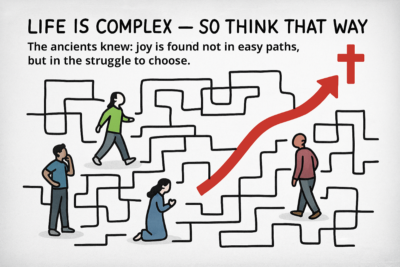
Life isn’t complex by accident. God shaped it that way — not to frustrate us, but to invite us into a deeper way of seeing. The ancients understood that joy and wisdom don’t come from easy answers, but from wrestling with paradox, tension, and choice. If we only think in simple binaries, we miss the richness of what God is doing. But when we learn to think like the ancients — embracing complexity, holding paradox, and walking faithfully through hard times — we begin to glimpse the reason behind life’s design. It’s in that struggle that the joy Jesus promised becomes real.
For anyone who thinks God made this life complex and difficult to punish us – let me set that straight right up front. That’s not the reason.
This life is complicated because it had to be. Adam and Eve, and through them all of us, rejected God in the Garden of Eden. God could’ve left us in that state forever. Or He could have just blown the whole thing up and started over. If it was me, I probably would’ve. Past tense. I’m realizing why it didn’t. Not just as a thought exercise – but as a necessity.
If God had left us “as is” and walked away, that would be cruel.
If God had just wiped everything out and started over, the results would be the same. Over and over and over.
But here’s the catch. God’s desire was for us to love Him. Desire means choice. It’s a necessary choice because love cannot be given without a choice to not love. And giving us that choice opened up a whole can of worms. But it had to be done.
In our western world today, we have a hard time coming to grips with that.
But in those days – thousands of years ago, they knew that. It was life and death for them. It was often a better of worse life based on following God – because it was the Old Covenant. Yes – we call it the Old Testament, but dropping the word Covenant loses something really important. It wasn’t just history – it was a promise.
But then another promise came to life. Jesus. A New Covenant, not just a New Testament of History.
And we dropped much of the old history, declared the old covenant of little to no value, and simplified our lives into one thing – a personal relationship with Jesus.
In the process, we lost more history, more of the old promise, and tons of understanding.
Then, we made the world black and white. Positive or negative. Good or evil. Right or wrong. There was one best answer to everything.
And we lost even more.
Ultimately, we seem to have left ourselves in a place where we can get to Heaven, , but only as one escaping through the flames. We can experience joy of a certain kind, but your joy may be complete is likely something we think we have but really don’t.
We lost those things and so much more.
Take another look at the image at the top of the page. Do we even know that life is truly complex, why it’s complex, and do we have the ability to navigate it successfully, not coming out with nothing left but ourselves, by the skin of our teeth as we say today?
Please, think about those things, and other events from your own life, as we go through one example from the Bible showing what we lost from one verse in Genesis, to one verse in Romans, and through to today.
Joy and strength in complexity
God gave us something complex, because only in complexity do we discover the depth of joy and courage. When we flatten faith into simplicity, we lose the very thing that made the ancients willing to die for it — the lived trust that goes beyond belief.
To see what was laid out above, I’m using a passage familiar to Jews, Christians, and Muslims. All three of the Abrahamic religions, while they don’t completely agree on the interpretation, know and revers this passage.
God’s Covenant With Abram – Genesis
Ge 15:1 After this, the word of the LORD came to Abram in a vision:
“Do not be afraid, Abram.
I am your shield,
your very great reward.”
Ge 15:2 But Abram said, “O Sovereign LORD, what can you give me since I remain childless and the one who will inherit my estate is Eliezer of Damascus?” 3 And Abram said, “You have given me no children; so a servant in my household will be my heir.”
Ge 15:4 Then the word of the LORD came to him: “This man will not be your heir, but a son coming from your own body will be your heir.” 5 He took him outside and said, “Look up at the heavens and count the stars—if indeed you can count them.” Then he said to him, “So shall your offspring be.”
Ge 15:6 Abram believed the LORD, and he credited it to him as righteousness.
This was an impossible promise.
Well, OK – it was an interesting promise. Ever since the flood, people died earlier. Their lifespan was reduced from hundreds of years down to no more than 120. Having kids at Abrams age hadn’t been possible ever since then. So, what was this about him having offspring too numerous to count?
In his mind, and Sarai’s (Abram’s wife), it was impossible.
And yet, with no proof – nothing but a promise – we read:
Ge 15:6 Abram believed the LORD, and he credited it to him as righteousness.
The question is then – what did belief mean?
❓ What does “belief” mean to you?
When you think of “belief,” do you imagine belief as agreement, blind faith, something else?
Belief then isn’t belief now
I often write about how belief means more than what we think of today. For instance, in John 3:16:
Jn 3:16 “For God so loved the world that he gave his one and only Son, that whoever believes in him shall not perish but have eternal life.
Jesus’ words meant that our belief is so strong that it will be life changing. That makes sense if we think about it, because it speaks to the transformation that takes place in us as a result of our belief and the subsequent changes in our lives.
Belief then isn’t what it was before then
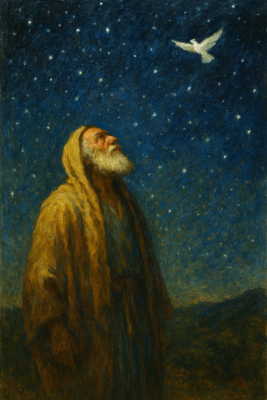
Wait — belief then isn’t what it was before then? What does that even mean?
Think of it this way: now refers to our time. Then points to Jesus’ time. And before then takes us back to Abram’s time. In this example, those three eras frame how “belief” has shifted. By the end of the example, the distinctions will be clearer.
To explore this, we’ll look at three perspectives: the Jewish point of view, the early Christian point of view, and the modern point of view.
I won’t go into deep detail here — that will come in later segments of the series. For now, I want to sketch out how our understanding has changed: what began as Jewish Scripture, was partially carried into Christian Scripture, and has since been translated into modern languages.
We’ve already seen how meaning was lost between the early Christian Church and today. Now we’ll step back even further, to examine what happened to the original meaning of Moses’ words — words given by God — as the early church was just beginning.
Remember, we’re looking at the implications of the word we read as “belief” from:
Ge 15:6 Abram believed the LORD, and he credited it to him as righteousness.
Word meanings change over time
This is, at heart, a word study. It has to be — but I’ll keep it short and to the point.
To make things easier, I’m adding visual clues: icons. Each icon will mark what has been carried forward, and what has been lost.
🔑 Icon Legend: Layers of FaithSupport — being upheld, bound together, leaning into God’s firmness.
Confidence — orientation, direction, trust in God’s guidance through paradox.
Belief — entrustment, agreement, or mental assent depending on the era.
We’ll look at the word believed through three different Points of View (POV). Since the passage is about Abram in Genesis, we begin with the Jewish POV — God’s chosen people in the Old Covenant. Then we’ll move to the early Christian Church. Finally, we’ll consider the modern POV.
If we were living in those times, each POV would be obvious to us. But today, depending on our study path, we might hold any of the three. That’s why it matters to pause, compare, and go deeper.
✡️ Jewish POV (Genesis 15:6)
Context – setting the scene
“Abram believed the Lord, and He counted it to him as righteousness.” In Hebrew, the verb is הֶאֱמִן (he’emin), from the root אָמַן (’aman) — to be firm, upheld, supported. Abram’s faith wasn’t a simple mental agreement; it was entrusting himself to God’s reliability when circumstances looked impossible. Jewish tradition often reads this as covenantal trust: Abram leaned into God’s firmness, embodying faith as lived reliance rather than abstract belief.
✡️ Key Jewish concepts of “believed”
- Abram he’emin the Lord — rooted in אָמַן (’aman)**, meaning to be firm, upheld, supported.
- Emphasis: Abram entrusts himself to God’s reliability, not just “believes” a statement.
- Jewish tradition often sees this as covenantal trust, lived in tension with circumstances.
✡️ Jewish POV summary
✡️ Jewish POV (Genesis 15:6)Faith as support, confidence, and belief lived in tension.
✡️ This shows we started with three concepts implicitly understood during the Old Testament/Old Covenant times by God’s chosen people for the covenant. Below we see what will be kept and lost over time.
Preserved: Abram’s trust rooted in ’aman — firmness, being upheld, covenantal reliance.
Lost (later): The tactile sense of being upheld; faith as lived entrustment.
Why it matters: Shows faith as relational and embodied, not just intellectual agreement.
✝️ Christian POV (Romans 4)
Context – setting the scene
Abraham Justified by Faith – Romans
Ro 4:1 What then shall we say that Abraham, our forefather, discovered in this matter? 2 If, in fact, Abraham was justified by works, he had something to boast about—but not before God. 3 What does the Scripture say? “Abraham believed God, and it was credited to him as righteousness.”
Paul quotes Genesis 15:6 in Romans, translating ’aman into the Greek πίστις (pistis)**. Here, faith is relational trust in God’s promise, but already the nuance shifts. Pistis emphasizes confidence and fidelity, yet it doesn’t carry the tactile imagery of being upheld. Paul uses Abram as the model of justification by faith — showing that righteousness comes not through works, but through trusting God’s word. The richness is preserved, but streamlined into a theological argument.
✝️ Key Christian concepts of “believed”
- Paul quotes Genesis 15:6, translating ’aman into πίστις (pistis)**.
- Emphasis: Faith as relational trust in God’s promise, but already streamlined into “belief/faith.”
- Paul uses Abram as the model of justification by faith, highlighting trust over works.
✝️ Christian POV summary
✝️ Christian POV (Romans 4)Faith streamlined into relational trust, but already narrowing.
✝️ We are now down from three key concepts to two. Below we see that one more will soon be lost as well.
Support — being upheld, bound together, leaning into God’s firmness.
Confidence — orientation, direction, trust in God’s guidance through paradox.
Belief — entrustment, agreement, or mental assent depending on the era.
Why it matters: Confidence in God and Belief in God are still there. But the idea of being upheld/supported by God is missing with the Greek word used in Romans. Partly though language focus, more emphasis is placed more on relational ideas than of the upholding and support from the Hebrew. So, just in the translation from Hebrew to Greek, something is lost. with one isolated event, it’s hard to know if there was more to it than language differences. But we should realize that things are already changing. And we haven’t even reached the Modern POV.
But here it is…
🌍 Modern POV (Today)
When we speak of “faith” today, we often mean little more than mental assent: “I believe God exists” or “I agree with these doctrines.” That’s a far thinner version than either ’aman or pistis. The experiential, paradox-embracing dimension is lost. Faith becomes something easy to say, but not something worth dying for. The ancients were willing to stake their lives on entrustment; we often reduce it to agreement.
So, it doesn’t really matter whether we look at the Genesis or Romans verses on Abram. Our understanding of what happened in them is more than a little removed from the originals.
When we speak of “faith” today, we often mean little more than mental assent: “I believe God exists” or “I agree with these doctrines.” That’s a far thinner version than either ’aman or pistis. The experiential, paradox-embracing dimension is lost. Faith becomes something easy to say, but not something worth dying for. The ancients were willing to stake their lives on entrustment; we often reduce it to agreement.
🌍 Key Modern concepts of “believed”
- “Faith” often reduced to mental assent: “I believe God exists” or “I agree with doctrine.”
- Loss of depth: no sense of entrustment, no paradox, no lived tension.
- Result: Faith becomes something easy to say, but not something worth dying for — unlike the ancients.
🌍 Modern POV summary
🌍 Modern POV (Today)Agreement without entrustment, simplicity without paradox.
🌍 We are now down from three key concepts to one. Sadly, too many modern Christians don’t truly understand the depth of even that one.
Support — being upheld, bound together, leaning into God’s firmness.
Confidence — orientation, direction, trust in God’s guidance through paradox.
Belief — entrustment, agreement, or mental assent depending on the era.
Conclusion – Life Is Complex — So Think That Way
When we place the Jewish, Christian, and modern points of view side by side, the changes become clear. Each era preserved something vital, but each also lost something essential. What began as covenantal entrustment was streamlined into theological argument, and eventually thinned into mental assent.
That’s why it matters to pause and go deeper. Faith isn’t meant to be reduced to agreement or casual friendship; it’s meant to be lived entrustment — the kind of reliance that brings joy even in hard times. Recovering that depth doesn’t mean discarding what we have today, but reclaiming what the ancients knew: that belief is more than words, it’s a life anchored in God’s firmness.
As we continue, we’ll explore how language itself has shaped these shifts — and how reclaiming lost nuance can open us again to the fullness of joy and courage that faith was always meant to hold.
🪞 Reflection Ideas
When you think of “faith” – do you imagine belief as agreement, or entrustment as lived reliance? How might reclaiming the ancient sense of ’aman change the way you experience joy in hard times?
Is your faith more like assent or entrustment? Where have you experienced the difference — when belief moved beyond mental agreement into lived reliance on God’s firmness?
❓ What does “belief” mean to you now – after reading this?
When you think of “belief,” do you imagine belief as agreement, blind faith, something else?
This is only the beginning…
This is the first of what I pray will be a meaningful and helpful series. Over the years I’ve been writing, I’ve come to learn more and more about how much we’ve lost from the original intent of the God inspired we claim to believe and hopefully try to live by. But more and more, I wonder things like:
- Would I have been saved when I was younger?
- How much more of God’s offer of joy and peace could I have had if I dug deeper when I was younger?
But then, now I also wonder,
- Where would I be if I didn’t live the life I’ve had so far? I may not love the journey, but I do love where I am and what I’m doing.
- Which leads to – could I even do the things I do now – the writing, leading classes, without going through life as it was?
We claim to believe God will work all things out for good. Some of us believe that for everyone who loves God. Others believe it’s only for the ones God chose to experience it. That view alone tells us something about what translations and interpretations can do.
And so – this is the beginning – of a series where I do something I’ve often done before. Point these things out. But instead of burying these different beliefs from different time and different modern viewpoints, I want to make them more obvious.
They matter. How can we begin to follow God if we don’t take the time to understand Him as much as humanly possible. He gave us minds. We really should use them to know Him and love Him with them.
And so:
We’ve seen how belief shifted from entrustment to assent, losing depth along the way. For me, that loss isn’t just academic — it’s a reminder to explore God’s word and my faith until it becomes lived reliance, not just words. That’s the encouragement I want to leave with you: joy and courage are found in entrustment, even when life feels complex. The challenge is simple but hard — will we reclaim the depth the ancients knew, or settle for something less?
Discover more from God versus religion
Subscribe to get the latest posts sent to your email.