
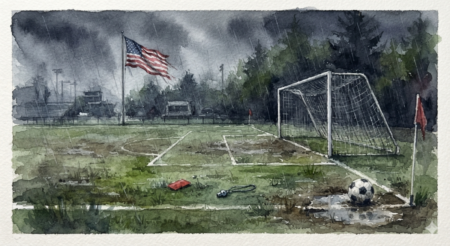
You probably heard about the suspended red card, where, for the first time ever, a red card automatic suspension for a game was itself suspended. If not, the trail was that the U.S. President called up the FIFA President, and the deal was done. We pretty much know there was a deal, because said U.S. President is transactional. And the author of The Art of the Deal.
So – what was the deal?
But hey – that’s life in these divided states today. It’s normal. It’s what almost half the people in the country voted for. Yes – almost half of the voters – 49.8%.
So, as usual, that’s not what I’m writing about. After all, if God wants this person to be our leader, so be it. Although, there is the question of what it means when God raises up someone to be a leader.
To that end, my concern is for the souls of those who think this scenario of a player being allowed to play the next game after a red card in football (world football, that is) is “right”, “justified”, or whatever you want to call it – if you think that’s OK, I have some serious questions for you.
Is there such a thing as Christian sportsmanship?
I’m old enough to know when sportsmanship was a good thing. For the players, it’s been dead and gone for a really long time. Cheating is the word of the day – and failing to even try to cheat is viewed as not trying hard enough to get every advantage.
One would hope, at least I do, that cheating is still wrong for Christians.
But then, a president, who claims to have done more for Christianity than anyone ever – except maybe Jesus – steps in to do something that’s never been done before in world football. And he likely did a deal, as I mentioned. A deal to overturn a decision on the field, after the game was over.
Further, he made a statement to demean and question the referee. However, the ref didn’t make the call. It was done by VAR – video review.
He also claimed it was unfair to punish a player for a game that wasn’t even played yet. That’s the way red cards work. In fact, it’s the way every suspension, in every sport, works. It’s not like you know ahead of time someone’s going to get suspended for an action – and then suspend for that game because you somehow knew it was going to happen.
All this – and the most Christian American, maybe the most Christian person anywhere/ever, thinks it’s right?
He is what he is. But tell me – do you think that’s right, in God’s eyes? Is might makes right now something you believe is Christian?
Will God suspend punishment for His judgment because someone – even this President – asks for it and offers a deal?
Is ignoring rules Christian?
I wonder, will God overturn a judgment if we offer Him a good enough deal?
Let’s consider a parable Jesus told. One that doesn’t seem to get as much attention as some others. Even for me, this is the first time I’ve used this parable.
The Parable of the Net – Matthew
Mt 13:47 “Once again, the kingdom of heaven is like a net that was let down into the lake and caught all kinds of fish. 48 When it was full, the fishermen pulled it up on the shore. Then they sat down and collected the good fish in baskets, but threw the bad away. 49 This is how it will be at the end of the age. The angels will come and separate the wicked from the righteous 50 and throw them into the fiery furnace, where there will be weeping and gnashing of teeth.
Mt 13:51 “Have you understood all these things?” Jesus asked.
“Yes,” they replied.
Mt 13:52 He said to them, “Therefore every teacher of the law who has been instructed about the kingdom of heaven is like the owner of a house who brings out of his storeroom new treasures as well as old.”
Is the parable of the net about what we see visually?
This parable seems so obvious. Look for the good fish and keep them while throwing away everything that wasn’t good. In other words, it’s a visual observation. That perception is borne out by the meaning of the Greek word.
📖† 65.22 καλόςb, ή, όν: pertaining to having acceptable characteristics or functioning in an agreeable manner, often with the focus on outward form or appearance—‘good, fine.’ πᾶν δένδρον ἀγαθὸν καρποὺς καλοὺς ποιεῖ ‘every good tree produces fine fruit’ Mt 7:17. 1Louw, J. P., & Nida, E. A. (1996). In Greek-English lexicon of the New Testament: based on semantic domains (electronic ed. of the 2nd edition., Vol. 1, p. 622). United Bible Societies.
Greek-English lexicon of the New Testament
And there it is. “outward form or appearance“/
There is, of course, a problem there.
No, the parable of the net is not about what we see visually
The problem doesn’t arise unless/until we read verses 51 and 52.
In those verses, Jesus asks His disciples – He was now alone with them, since He went into a house and left the crowd. And Jesus asked the disciples, “Have you understood all these things?”
Let’s turn to an outside source here, to look at an analysis of this passage.
✏️ Only the final judgment will reveal who was truly committed to the kingdom, and how wise the committed were to invest their lives in it (13:47–50).
Fruits often reveal true and false disciples in the present (7:15–23), but Matthew also emphasizes that some who seem to be genuine today may not persevere to the end, and some who will become believers may not have yet heard the gospel (13:23).
Continuing the practice of parabling in language relevant to his hearers, Jesus applies fishing imagery (cf. 4:18–19). Those who lived around the Lake of Galilee would often have seen fishermen separating the edible and kosher fish from the inedible ones (Harrington 1980: 23). Of at least twenty-four species of fish counted in the Lake of Galilee, many were unclean or inedible, and the net would not discriminate in its catch (just as wheat and darnel appeared similar in the early stages; Jeremias 1972: 226). Jesus probably refers here not to a net cast from a single boat but to the still larger seine net either dragged between two boats or drawn to land by long ropes (Jeremias 1972: 225–26).
Although Jesus here draws from the same profession as in 4:19 for his image of gathering fish, the point he is illustrating is quite different. Now he refers not to gathering people into the church, but gathering people to judgment (possibly echoing Ezek 47:10, though we were more skeptical of that allusion in 4:19). Until the final day, Jesus will continue eating with sinners to seek and save the lost (Ladd 1974b: 101). Yet the point here seems less the coexistence of the righteous and the wicked in the church (cf. Kingsbury 1969: 124) than their coexistence in this present age (18:15–20; “the world” in 13:38; cf. “separate” in 25:32). The kingdom had not consumed the wicked with fire (3:10–12) or come “with signs to be observed” (cf. Lk 17:20); it had invaded the world in a hidden way, and would remain hidden until the end. Nevertheless, those who apply the parable to the church are not wholly amiss: the same line between the righteous and the wicked would ultimately divide Jesus’ professing disciples (13:20–23). 2Keener, C. S. (2009). The Gospel of Matthew: A Socio-Rhetorical Commentary (pp. 392–393). Wm. B. Eerdmans Publishing Co.
The Gospel of Matthew: A Socio-Rhetorical Commentary
Parables apply a deeper meaning to ordinary life occurrences
So – there is a difference between separating fish and separating believers from non-believers.
We, Christians, should know this. And, we should know why this is so.
And yet, public opinion, statements made – show that it’s not at all the case.
Given that, let’s keep going, since what should be obvious – obviously isn’t at all obvious to too many Christians. Again, souls are at risk.
The end of a different analysis of the same parable includes:
✏️ When Jesus had completed this series of parables, He asked His disciples if they understood them, and they confidently replied, “Yes, Lord.” Understanding involves responsibility. To explain this, the Lord added a final parable (Matt. 13:51–52) to remind them of their responsibilities. 3Wiersbe, W. W. (1996). The Bible exposition commentary (Vol. 1, p. 47). Victor Books.
Warren Weirsbe in The Bible exposition commentary
Uh oh. Responsibility.
It’s not just hearing words, because if that’s all we do, then we can also attach our own meaning to those words.
Honestly, all Christians should know this. Parables aren’t for ordinary life lessons. Instead, parables take ordinary life events, events that people at that time were very familiar with, and then use them to make a deeper point.
Given that, there should be no expectation that the parable of the net means doing a visual inspection of the outside of a person.
So, we’d better look at the next parable is.
That next parable is actually, as far as the NIV is concerned, is verse 52:
Mt 13:52 He said to them, “Therefore every teacher of the law who has been instructed about the kingdom of heaven is like the owner of a house who brings out of his storeroom new treasures as well as old.”
The old and the new.
The teacher of the law, and now – by this statement – the disciple who also teaches others – must also be able to combine the old and the new.
And, by the way, of course the disciples didn’t understand this. Not that they knew they didn’t understand. After all, they didn’t have the Holy Spirit yet. But – as Christians today – we do have the Holy Spirit. It’s up to us to decide whether to listen to Him or not, but the Holy Spirit is within us.
Then what is the meaning of the Parable of the Net?
So – what should we take away from the Parable of the Net?
The Old
Well, the old is pretty obvious. It doesn’t really apply at all. You may remember the words Jesus had for the Pharisees and teachers of the law about that.
Seven Woes – Matthew
…
Mt 23:25 “Woe to you, teachers of the law and Pharisees, you hypocrites! You clean the outside of the cup and dish, but inside they are full of greed and self-indulgence. 26 Blind Pharisee! First clean the inside of the cup and dish, and then the outside also will be clean.
Mt 23:27 “Woe to you, teachers of the law and Pharisees, you hypocrites! You are like whitewashed tombs, which look beautiful on the outside but on the inside are full of dead men’s bones and everything unclean. 28 In the same way, on the outside you appear to people as righteous but on the inside you are full of hypocrisy and wickedness.
…
You cannot tell a book by its cover is what we say today.
The New
And what’s the new lesson for the Parable of the Net? Let’s look at a passage from Hebrews for that.
A Sabbath-Rest for the People of God – Hebrews
…
Heb 4:12 For the word of God is living and active. Sharper than any double-edged sword, it penetrates even to dividing soul and spirit, joints and marrow; it judges the thoughts and attitudes of the heart. 13 Nothing in all creation is hidden from God’s sight. Everything is uncovered and laid bare before the eyes of him to whom we must give account.
OK – so nothing’s hidden from God’s sight. That’s undeniable.
I wrote “When Someone Says “God Was Watching”: Is That Good?“, which is about misperceptions of what it means when God’s watching. I’d like to add another element to that. God also sees/knows when we choose to willfully ignore the implications/intentions of actions by ourselves – or in this case by others – convincing ourselves everything’s OK, or even everything’s good or righteous, when we know in our hearts that they aren’t.
There’s a passage that looks at exactly that scenario. The entire passage is about the Man of Lawlessness in the End Times. No – I’m not saying Trump is that man. My point is that this kind of thing, if we’re honest, takes place all the time. It’s been a constant ever since The Fall. It will get much worse, but it’s not something that will begin to happen in The End.
The Man of Lawlessness – Revelation
…
2Th 2:5 Don’t you remember that when I was with you I used to tell you these things? 6 And now you know what is holding him back, so that he may be revealed at the proper time. 7 For the secret power of lawlessness is already at work; but the one who now holds it back will continue to do so till he is taken out of the way. 8 And then the lawless one will be revealed, whom the Lord Jesus will overthrow with the breath of his mouth and destroy by the splendor of his coming. 9 The coming of the lawless one will be in accordance with the work of Satan displayed in all kinds of counterfeit miracles, signs and wonders, 10 and in every sort of evil that deceives those who are perishing. They perish because they refused to love the truth and so be saved. 11 For this reason God sends them a powerful delusion so that they will believe the lie 12 and so that all will be condemned who have not believed the truth but have delighted in wickedness.
Yes – because they refused to love the truth.
So – will your feelings on this red card thing send you to Hell?
No – this won’t send you to Hell. And if that’s what you believe I’m saying – let me make it clear.
I wrote at the outset that I have some serious questions for Christians who think it’s OK to do something like this because one person with power called another person with power and a deal came out that permitted something that’s never been permitted before? Something that throws all rules for this sport into chaos. Something that potentially throws rules for any sport into chaos. Something that maybe – if we take this to the extreme – explains the apparent American belief that no rules need to be followed – especially for the rich and powerful, if you like them.
That last paragraph raises a lot of questions. From one “simple” thing to a beyond belief scenario that is already playing out in the country in which I was born. Yes – real American. And I find this truly scary for those who follow this path far enough that they move from the narrow path to Jesus to the wide path to the place that a single decision won’t take you to.
And yet, …
There’s always this debate about whether someone can lose their salvation. I think the answer is no. But – I also believe that God cannot and will not be mocked, and that the real question is whether or not someone was actually saved in the first place.
Presumably, Christians know about the unforgivable sin. And we figure we’ll never do that, so we can’t lose our salvation. And yet, there’s this other passage – that when combined with something like the Parable of the Sower – points to a far more worrisome possibility.
If you don’t know the Parable of the Sower, here it is:
The Parable of the Sower – Matthew
13:1-15 pp — Mk 4:1-12; Lk 8:4-10
13:16, 17 pp — Lk 10:23, 24
13:18-23 pp — Mk 4:13-20; Lk 8:11-15
Mt 13:1 That same day Jesus went out of the house and sat by the lake. 2 Such large crowds gathered around him that he got into a boat and sat in it, while all the people stood on the shore. 3 Then he told them many things in parables, saying: “A farmer went out to sow his seed. 4 As he was scattering the seed, some fell along the path, and the birds came and ate it up. 5 Some fell on rocky places, where it did not have much soil. It sprang up quickly, because the soil was shallow. 6 But when the sun came up, the plants were scorched, and they withered because they had no root. 7 Other seed fell among thorns, which grew up and choked the plants. 8 Still other seed fell on good soil, where it produced a crop—a hundred, sixty or thirty times what was sown. 9 He who has ears, let him hear.”
Mt 13:10 The disciples came to him and asked, “Why do you speak to the people in parables?”
Mt 13:11 He replied, “The knowledge of the secrets of the kingdom of heaven has been given to you, but not to them. 12 Whoever has will be given more, and he will have an abundance. Whoever does not have, even what he has will be taken from him. 13 This is why I speak to them in parables:
“Though seeing, they do not see;
though hearing, they do not hear or understand.
Mt 13:14 In them is fulfilled the prophecy of Isaiah:
“ ‘You will be ever hearing but never understanding;
you will be ever seeing but never perceiving.
Mt 13:15 For this people’s heart has become calloused;
they hardly hear with their ears,
and they have closed their eyes.
Otherwise they might see with their eyes,
hear with their ears,
understand with their hearts
and turn, and I would heal them.’ 16 But blessed are your eyes because they see, and your ears because they hear. 17 For I tell you the truth, many prophets and righteous men longed to see what you see but did not see it, and to hear what you hear but did not hear it.
Mt 13:18 “Listen then to what the parable of the sower means: 19 When anyone hears the message about the kingdom and does not understand it, the evil one comes and snatches away what was sown in his heart. This is the seed sown along the path. 20 The one who received the seed that fell on rocky places is the man who hears the word and at once receives it with joy. 21 But since he has no root, he lasts only a short time. When trouble or persecution comes because of the word, he quickly falls away. 22 The one who received the seed that fell among the thorns is the man who hears the word, but the worries of this life and the deceitfulness of wealth choke it, making it unfruitful. 23 But the one who received the seed that fell on good soil is the man who hears the word and understands it. He produces a crop, yielding a hundred, sixty or thirty times what was sown.”
Please notice, if you haven’t already, two of the four possibilities did actually appear to receive the word of God, possibly act on it, but eventually to no avail. Were they saved? No. Only one of the four sets of “seeds”/people were saved.
Now, try to put that with this passage:
Warning Against Falling Away – Hebrews
6:4-6 Ref—Heb 10:26-31
Heb 5:11 We have much to say about this, but it is hard to explain because you are slow to learn. 12 In fact, though by this time you ought to be teachers, you need someone to teach you the elementary truths of God’s word all over again. You need milk, not solid food! 13 Anyone who lives on milk, being still an infant, is not acquainted with the teaching about righteousness. 14 But solid food is for the mature, who by constant use have trained themselves to distinguish good from evil.
Heb 6:1 Therefore let us leave the elementary teachings about Christ and go on to maturity, not laying again the foundation of repentance from acts that lead to death, and of faith in God, 2 instruction about baptisms, the laying on of hands, the resurrection of the dead, and eternal judgment. 3 And God permitting, we will do so.
Heb 6:4 It is impossible for those who have once been enlightened, who have tasted the heavenly gift, who have shared in the Holy Spirit, 5 who have tasted the goodness of the word of God and the powers of the coming age, 6 if they fall away, to be brought back to repentance, because to their loss they are crucifying the Son of God all over again and subjecting him to public disgrace.
Heb 6:7 Land that drinks in the rain often falling on it and that produces a crop useful to those for whom it is farmed receives the blessing of God. 8 But land that produces thorns and thistles is worthless and is in danger of being cursed. In the end it will be burned.
Heb 6:9 Even though we speak like this, dear friends, we are confident of better things in your case—things that accompany salvation. 10 God is not unjust; he will not forget your work and the love you have shown him as you have helped his people and continue to help them. 11 We want each of you to show this same diligence to the very end, in order to make your hope sure. 12 We do not want you to become lazy, but to imitate those who through faith and patience inherit what has been promised.
Do you see what it says? Do you truly understand what it says?
It is possible to fall away!
What is impossible to be brought back to repentance after falling away!
This is extreme, I know. And I’m not talking about straying from God. I’m pointing out that the Bible does speak to falling away from God.
Jesus spoke about the need to follow the narrow path.
The Bible is full of warnings to “stay in the word”, to help each other, to stand firm to the end.
Do you think those warnings were for nothing?
Falling away is a real thing.
And so – this is my reminder – please don’t let this person, this event, or anyone/anything like it – pull you so far away from the Jesus that you no longer love the truth.
That you no longer can get back to the path.
That you find out you were one of the seeds that fell in shallow soil.
That you were overgrown by the weeds – like these weeds that are taking people away from truth.
That you can no longer be brought back to salvation.
The bottom line on the red card
While watching BBC today, I heard so much about Americans talking about how unfair the red card was.
Hey – I’ve got news for you. Maybe you only watch the US games, and your opinions are based solely on what’s called American “exceptionalism”.
The only thing exceptional here is the treatment you’re cheering over one American player being granted something that shouldn’t have been given.
I’ve watched nearly every game, and I mean of every country. There are lots of unfair calls. There are refs that appear to want the stars of the game – the real stars that have played for years – like Messi and Ronaldo – to continue to win. Sometimes they did, when they probably shouldn’t have. Today, Ronaldo’s team was given two or three extra minutes of stoppage time – minutes that had no justification in reality – to try to tie the game. They didn’t. But in one Argentina game, what appeared to be bias for him did allow the game result to change from loss to win. And there were others.
In sports, there are always controversies. But this – one powerful person calling another – to get something like this overturned – it smacks of might makes right – the rich and powerful prevail, no matter what.
What we need to remember, at least as Christians – our ultimate citizenship goal is the Kingdom of Heaven. And that King is the ultimate might. And yet, when He came to earth, He was humble. He wants us to be the same.
He also has simple commands for us. Two of them. Both are about love.
Where is the love in what Americans are cheering for – ignoring not only a rule, but a practice that’s never before overturned – wasn’t overturned for anyone else this year – and probably never will be again?
Have we really reached the point where we think America can step all over everyone and make this happen – only for us – and then have the nerve to still claim to be Christian?
Or are you giving up your Kingdom of Heaven citizenship, because this is the path your life is taking and you love this more than Jesus Christ, namesake of our religion?
FInal thought
If there’s any doubt, any lack of clarity – I’ll close with this:
There’s always debate about whether someone can “lose their salvation.” I don’t believe they can. But Scripture is equally clear that God cannot and will not be mocked, and that the real question is whether someone was ever actually transformed by the Spirit in the first place.
And this is where our cultural moment becomes spiritually dangerous. When Christians celebrate a powerful man overturning a rule simply because he can — even in something as trivial as a football game — we are building a habit that shapes our hearts. We are learning to admire power more than truth, partiality more than justice, and winning more than righteousness.
Hebrews 6 warns about this exact posture: people who stand close to spiritual things, talk the language, feel the excitement, but never actually surrender to the Spirit’s character. The danger isn’t “losing salvation.” The danger is becoming the kind of person who was never saved at all — because they learned to love power that bends rules and called it God’s work.
Footnotes:
- 1Louw, J. P., & Nida, E. A. (1996). In Greek-English lexicon of the New Testament: based on semantic domains (electronic ed. of the 2nd edition., Vol. 1, p. 622). United Bible Societies. ↩︎
- 2Keener, C. S. (2009). The Gospel of Matthew: A Socio-Rhetorical Commentary (pp. 392–393). Wm. B. Eerdmans Publishing Co. ↩︎
- 3Wiersbe, W. W. (1996). The Bible exposition commentary (Vol. 1, p. 47). Victor Books. ↩︎
Discover more from God versus religion
Subscribe to get the latest posts sent to your email.