
Blessed are the poor in spirit. Seriously? The poor in spirit are blessed? That sounds so backwards! It’s even more strange when it’s translated as happy are the poor in spirit! It seems like it should be blessed are the rich in spirit. And yet, that’s not what Jesus said. So, what did Jesus mean when He said what we now call the first of the Beatitudes?
The Beatitudes – Matthew
5:3-12 pp — Lk 6:20-23
Mt 5:1 Now when he saw the crowds, he went up on a mountainside and sat down. His disciples came to him, 2 and he began to teach them, saying:
Mt 5:3 “Blessed are the poor in spirit,
for theirs is the kingdom of heaven.
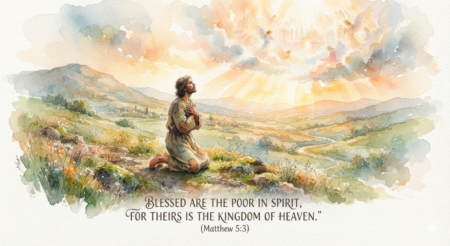
- Foreground: A man with brown hair and a beard kneels in a humble, prayerful posture on a grassy hillside. He wears simple, tattered, and patched earthen-toned robes. His hands are pressed gently against his chest as he looks upward with an expression of reverence and longing.
- Landscape: The hillside is dotted with delicate wildflowers, giving way to a vast, rolling green valley with a winding path and a small village in the distance.
- Sky and Heaven: The upper portion of the painting transitions into warm, radiant light. Beams of golden sunshine break through soft, dramatic clouds to reveal a faint, majestic heavenly city filled with angelic figures.
- Text: Elegant, dark-brown script at the bottom reads: “Blessed are the poor in spirit, for theirs is the kingdom of heaven.” (Matthew 5:3).
When we read the whole verse, it sounds even more backwards. How can the kingdom of Heaven be for those who are poor in spirit? Isn’t it for the “good Christians” who are “rich in spirit”?
However, if we think back to the introduction to the Sermon on the Mount, this was exciting stuff! People were amazed and excited to hear this.
At least, “ordinary” people were. And by “ordinary” I mean the downtrodden, the poor, the sick, the outcasts.
On the other hand, the religious leaders weren’t happy about this at all.
That should speak volumes. They were the self-righteous ones that Jesus kept telling that they had it all wrong.
So it seems we have those who presumably were rich in spirit – the religious leaders – very upset at what Jesus was saying. And the regular Jewish people, even the Samaritans, were finally hearing words they had been waiting for.
For centuries, they waited.
And here they were.
It was incredibly exciting.
Blessed are the poor in spirit – a lost message?
Fast forward to now, present day Earth. It’s the religious leaders in Christianity – those who actually preach from the New Testament, saying the words. But where are the excited people waiting to hear them? They’re in the poor countries. The ones considered to be undeveloped. The ones where people aren’t supposed to hear those words. Like China. Like many African countries. Like the Middle East.
But in the “developed” / “modern” / “secular” countries, like the United States, not so much. In Europe, not so much. Why not? What did people know 2,000 years ago that we don’t know today? What do the people in the supposedly undeveloped world hear in those words that so many in the developed / more advanced countries do not understand?
The poor in spirit – who are they?
Somewhere along the line, Jesus’ message got lost in translation. The kinds of people who used to be overjoyed to hear words like “blessed are the poor in spirit, for theirs is the kingdom of heaven”, no longer seem to care. Or maybe they don’t believe it. Or – maybe they don’t even know about it, and if they do, they haven’t been properly told what it means. Whatever, the impact isn’t what it once was. So, let’s go back 2,000 years to see, at that time, in their language, and in that culture, what did Jesus really say?
But first, let’s go back even further.
Yes – let’s go way back. Sure, we need to understand what Jesus’ words meant to the people who heard Him speak during His brief ministry. But the truth is, the arrival of Jesus was – and still is – the most anticipated event in the history of mankind. The Old Testament was about His first coming. The New Testament, the second coming. So let’s go back and look at the very first indication that Jesus would be arriving.
The Fall
After The Fall, where the serpent tricked Eve into The “knowledge of evil” versus “actual evil”, and after Adam ate the fruit Eve subsequently gave him, God pronounced judgment on the three of them. Here’s what God said to the serpent:
The Fall of Man – Genesis
Ge 3:14 So the LORD God said to the serpent, “Because you have done this,
“Cursed are you above all the livestock
and all the wild animals!
You will crawl on your belly
and you will eat dust
all the days of your life.
Ge 3:15 And I will put enmity
between you and the woman,
and between your offspring and hers;
he will crush your head,
and you will strike his heel.”
The Jewish people were well aware of The Fall. Of sin. And of God’s holiness and intolerance for sin. (as opposed to now, where many try to say sins they don’t agree with are outdated.) And so there were sacrifices, as required by God. And yet, the eventual coming of Messiah would somehow rescue them from the sin from the Garden of Eden. As time went on, through the prophets, they would learn more and more. However, when Jesus did arrive, the Jewish leaders couldn’t / wouldn’t recognize Him.
This is what the Hebrew people of the Old Testament – becoming the Jewish people in Jesus’ time – were so anxiously waiting for. They had failed, time and again, when it came to trying to follow the Old Testament Law. This Messiah they were waiting for was supposed to be something different. And when Jesus did come, they didn’t recognize Him as the long awaited Messiah.
The Exodus
By the time of the Exodus, God has established His chosen people, the Israelites. In Genesis, we read about Joseph. One of Jacob’s (Israel’s) sons. He’s the second most powerful man in Egypt, and has saved both the Israelites and the Egyptians from certain death from the seven-year famine.
However, at the very end, we read:
The Death of Joseph – Genesis
Ge 50:22 Joseph stayed in Egypt, along with all his father’s family. He lived a hundred and ten years 23 and saw the third generation of Ephraim’s children. Also the children of Makir son of Manasseh were placed at birth on Joseph’s knees.
Ge 50:24 Then Joseph said to his brothers, “I am about to die. But God will surely come to your aid and take you up out of this land to the land he promised on oath to Abraham, Isaac and Jacob.” 25 And Joseph made the sons of Israel swear an oath and said, “God will surely come to your aid, and then you must carry my bones up from this place.”
Ge 50:26 So Joseph died at the age of a hundred and ten. And after they embalmed him, he was placed in a coffin in Egypt.
Joseph is dead.
But then, at the beginning of Exodus, we read about Joseph being alive in Egypt. Huh?
Well, the first five verses backed up a bit – then there was a length gap before verse 6 picks up the action.
The Israelites Oppressed – Exodus
Ex 1:1 These are the names of the sons of Israel who went to Egypt with Jacob, each with his family: 2 Reuben, Simeon, Levi and Judah; 3 Issachar, Zebulun and Benjamin; 4 Dan and Naphtali; Gad and Asher. 5 The descendants of Jacob numbered seventy in all; Joseph was already in Egypt.
Ex 1:6 Now Joseph and all his brothers and all that generation died, 7 but the Israelites were fruitful and multiplied greatly and became exceedingly numerous, so that the land was filled with them.
Ex 1:8 Then a new king, who did not know about Joseph, came to power in Egypt. 9 “Look,” he said to his people, “the Israelites have become much too numerous for us. 10 Come, we must deal shrewdly with them or they will become even more numerous and, if war breaks out, will join our enemies, fight against us and leave the country.”
Now Joseph is truly “dead and forgotten” – at least by the Egyptian leaders.
A couple chapters later we read this:
Moses and the Burning Bush – Exodus
Ex 3:7 The LORD said, “I have indeed seen the misery of my people in Egypt. I have heard them crying out because of their slave drivers, and I am concerned about their suffering. 8 So I have come down to rescue them from the hand of the Egyptians and to bring them up out of that land into a good and spacious land, a land flowing with milk and honey—the home of the Canaanites, Hittites, Amorites, Perizzites, Hivites and Jebusites. 9 And now the cry of the Israelites has reached me, and I have seen the way the Egyptians are oppressing them. 10 So now, go. I am sending you to Pharaoh to bring my people the Israelites out of Egypt.”
Things have gone from bad to worse. Pharaoh has quite successfully carried out his plan to deal with the rapidly growing Israelite population.
There’s something missing in the middle of those two passages from Exodus. How/why was Pharaoh able to do this to God’s chosen people? Throughout the Old Testament, we read about how they turned away from God. And when they did that, God would “turn away” from them. Now, notice what God said to Moses: … I have indeed seen the misery of my people in Egypt. I have heard them crying out because of their slave drivers, and I am concerned about their suffering. 8 So I have come down to rescue them from the hand of the Egyptians ….
It’s not like God didn’t see and hear it all along. But there was the issue of that covenant God made with Abraham. Remember that? Back in Genesis 17? When God changed Abram’s name to Abraham?
The Covenant of Circumcision – Genesis
Ge 17:1 When Abram was ninety-nine years old, the LORD appeared to him and said, “I am God Almighty; walk before me and be blameless. 2 I will confirm my covenant between me and you and will greatly increase your numbers.”
Ge 17:3 Abram fell facedown, and God said to him, 4 “As for me, this is my covenant with you: You will be the father of many nations. 5 No longer will you be called Abram ; your name will be Abraham, for I have made you a father of many nations. 6 I will make you very fruitful; I will make nations of you, and kings will come from you. 7 I will establish my covenant as an everlasting covenant between me and you and your descendants after you for the generations to come, to be your God and the God of your descendants after you. 8 The whole land of Canaan, where you are now an alien, I will give as an everlasting possession to you and your descendants after you; and I will be their God.”
Ge 17:9 Then God said to Abraham, “As for you, you must keep my covenant, you and your descendants after you for the generations to come. 10 This is my covenant with you and your descendants after you, the covenant you are to keep: Every male among you shall be circumcised. 11 You are to undergo circumcision, and it will be the sign of the covenant between me and you.
…
God said twice that He would be the God of Abraham’s descendants. 7 I will establish my covenant as an everlasting covenant between me and you and your descendants after you for the generations to come, to be your God and the God of your descendants after you. And I will be their God, in verse 8.
The covenant wasn’t only that the people would be circumcised. The NIV subtitle certainly gives that impression. And we often talk about it like that was all the people had to do – all males had to be circumcised. But notice:
11 You are to undergo circumcision, and it will be the sign of the covenant between me and you.
Circumcision is the sign of the covenant. It wasn’t the actual covenant.
No – the covenant was that the people would keep God as their God. Their only God.
So what has to be missing is that the Israelites failed to do that while they were in Egypt. Further evidence of that can be seen from the times when they cursed Moses (and so also God) about bringing them out to the desert to die, when things were so good in Egypt under the rule of Pharaoh. Yeah. Right. Like that was really good. They gave up on God so quickly. And so often.
Poor in spirit
The condition of the Israelites when they called out to God is an example of poor in spirit. Not non-existent spirit. Poor in spirit.
Israel had to be brought to a place where their human strength and false reliance were completely broken before they were ready to rely on God—and that desperate state is the historical picture of being ‘poor in spirit.’
Yes, they kept turning away from God. But they also, eventually, returned to Him in their times of need.
Let’s examine that thought. See if it matches up with what the Bible says. With what their culture says about them. And most of all, with what Jesus said in the Beatitudes.
What does “poor in spirit” actually mean?
Actually, the better question would be, what did “poor in spirit” mean when Jesus said it? After all, He wasn’t talking to us. He was talking to people almost 2,000 years ago. They had a different culture. And compared to about 2/3 of the people who are likely to read this in Scripture, they had a much more difficult life. All of us in the U.S. and much of western Europe have a really hard time relating to Jesus’ original audience.
Most of us live in free countries, meaning we’re not even close to living under Roman rule like the Jewish people were. And because of their history and culture that was rich with knowledge of God and even dependence on God to protect them (although they did stray a lot), we can’t relate to that either. We either think we can take care of ourselves, or else the government will take care of us. But Jesus never meant for us to 100% take care of ourselves. Neither did Jesus intend for us to rely on the government to take care of us. The Great Commission and the command to love God and love one another was what Jesus asked for. What He commanded.
Saying the right words – saying we depend on God is one thing. But we need to examine ourselves. If we could completely empty ourselves of our own spirit, and completely fill ourselves with God’s spirit, what would that make us? At a minimum, I’d imagine it makes us “good people”. But wait. Jesus Himself said No one is Good – except God alone. So, if we think that what Jesus said (about not being good) doesn’t describe us, we are (if I may use the pun) in Egypt – the land of “denial”. (If you’re using a translator to read this – sorry, it won’t come across right. The “land of denial” sounds similar to the “land of the Nile” in English.)
So let’s check out two key words: “poor” and “spirit”. We’ll do “spirit” first, since it’s the object relating to being poor. Once we see the meanings behind the word “spirit”, then we can begin to understand the implications of being “poor” in that “spirit”.
Spirit
There are many different possible meanings for the Greek word we read as spirit. These are the possible ones that could make sense: Holy Ghost / Holy Spirit / Spirit of Christ could. So could human spirit.
We’ll see as we go on, the one that really fits throughout the Beatitudes, the Sermon on the Mount, and all of Jesus’ teaching is the human spirit. If you’d like to think of other possibilities as we proceed, feel free to do so. But you’ll find nothing else going to fit in. It must be “poor in the human spirit”. But let’s keep going and look at poor.
Poor
As with “spirit”, the Greek word we read as “poor” has many different meanings.
It’s someone who recognizes that their own inner resources – their human spirit are insufficient, and therefore they turn entirely toward God.
It’s not someone who thinks they can do things for themselves. They can get through life without God. Even save themselves without God. Or maybe think they don’t need saving. Or just don’t have time for God. Those people have too much human spirit to realize just how much they need God.
John MacArthur says this:
✏️ Why does Christ begin with the poor in spirit? He’s talking about a new standard, a new way to live, so why begin here? What makes this the source of happiness? Well, because it is the fundamental characteristic of a Christian. Becoming poor in spirit is the very first thing that must happen in the life of anybody who ever enters God’s kingdom. Nobody ever entered on the basis of pride. The doorway is very low, and only people who crawl can come in.
Paradoxically, we know there is a mountain to climb, heights to scale, a standard to attain, but sooner or later we realize we are incapable of attaining it. The sooner we realize it, the sooner we are on our way to finding the One who will attain it for us. In other words, Jesus is saying, “You can’t be filled until you’re empty. You can’t be worthwhile until you’re worthless.” 1MacArthur, J. (1998). The Beatitudes: the only way to happiness. Chicago: Moody Press.
MacArthur, J. (1998). The Beatitudes: the only way to happiness
So the poor in spirit is a characteristic of someone who knows they are empty and worthless. That’s not too far from reality for many people in many parts of the world. But for some of us, it’s a concept that totally goes against everything we’ve been taught for our entire lives. Even a lot of churches don’t teach that.
But here’s the thing about that statement of being empty and worthless. It’s a statement from a certain point of view to certain people.
Once we learn about Christianity, including what “worthless” is really about – this isn’t a problem – anymore. But – before we learn what it really means, it can and does turn people off.
And yet, it’s how Jesus started off His Sermon on the Mount. Many of His listeners likely were happy that someone in authority finally had a message for them. It wasn’t about the righteous, like they heard in the synagogues. It’s not about the happy and the rich that we hear in too many churches today. It was a message of hope for the ones at the very bottom. The ones who had no human spirit left at all. And there’s Jesus telling them, you are blessed, and the kingdom of Heaven is yours. Not even will be yours. Is yours. It starts right now! And then, while it may take a while, and you will have ups and downs, you’ll also grow in it – as long as you keep growing closer to God.
for theirs is the kingdom of heaven – not later, but now.
Mt 5:3 “Blessed are the poor in spirit,
for theirs is the kingdom of heaven.
In the Greek, there’s no word corresponding to “are” in this verse.
However, the usage of the word “is” tells the listener that being poor in spirit puts them in a class of people. It’s a way of identifying them. Jesus is telling the poor in spirit they are members of the kingdom of Heaven. Not just later. Now. Right now.
That’s one huge reason why none of the other meanings behind the word “spirit” can be correct. Those who are poor in the Holy Spirit makes no sense at all. But those who are empty of human spirit have plenty of room to be filled with the Holy Spirit. Remember this from the early church, in the book of Acts:
The Holy Spirit Comes at Pentecost – Acts
Ac 2:1 When the day of Pentecost came, they were all together in one place. 2 Suddenly a sound like the blowing of a violent wind came from heaven and filled the whole house where they were sitting. 3 They saw what seemed to be tongues of fire that separated and came to rest on each of them. 4 All of them were filled with the Holy Spirit and began to speak in other tongues as the Spirit enabled them.
…
Many of them were the very same ones who were very much lost after Jesus ascended to Heaven. They were just staring up into the sky when this happened:
Jesus Taken Up Into Heaven – Acts
…
Ac 1:10 They were looking intently up into the sky as he was going, when suddenly two men dressed in white stood beside them. 11 “Men of Galilee,” they said, “why do you stand here looking into the sky? This same Jesus, who has been taken from you into heaven, will come back in the same way you have seen him go into heaven.”
It’s like – why are you just standing here, looking up? Jesus told you, “Do not leave Jerusalem, but wait for the gift my Father promised, which you have heard me speak about. 5 For John baptized with water, but in a few days you will be baptized with the Holy Spirit.”. So go back to Jerusalem and wait. Which they did. And that’s when / where the day of Pentecost happened.
For more on “just standing there”, please check out Why do you stand here looking into the sky? Do something!
They were empty of their own human spirit. Ready and waiting to be filled with the Holy Spirit. With the mind of Christ. And so they were.
But if we’re not empty, that cannot happen. God won’t force us to receive the Holy Spirit. We must be willing and ready. Empty of ourselves.
At the time, those listening to Jesus didn’t know what was going to happen. But they knew something special was going to happen. Because they knew Jesus was special.
Mt 7:28 When Jesus had finished saying these things, the crowds were amazed at his teaching, 29 because he taught as one who had authority, and not as their teachers of the law.
But if we’re not as empty as they were, can we honestly say the same thing? And by honestly, I mean can we really feel it, believe it, and give up our own human spirit – die to self – and be ready, willing, and able to receive the Holy Spirit? Are we willing to be transformed? Give up whatever God asks us to give up? And I don’t mean just give up things that are wrong. I mean give up things that are OK, things that we want to do, but God says do something else instead.
Are we willing to do what His Spirit tells us to do? Give up our desires, our resources, and our time?
Because if we aren’t ready for all that, and more, we have too much of our own spirit left.
Poor in spirit – it requires an examination of ourselves
In Psalms, David says that God examines him.
psalm 139 – Psalms
…
Ps 139:23 Search me, O God, and know my heart;
test me and know my anxious thoughts.
Ps 139:24 See if there is any offensive way in me,
and lead me in the way everlasting.
And that’s fine. God examines us. However, are we willing to hear the results? Even more, are we wanting to hear the results? The Holy Spirit will certainly let us know them. But only if we sincerely ask.
Let’s look at something else from John MacArthur, after he described his version of examining ourselves before we go to the Lord’s Table – Communion.
The Beatitudes call for a full self–examination. Such an approach Paul calls for in 2 Corinthians 13:5, “Test yourselves to see if you are in the faith.” Prove it, he’s saying. If it were easy to point to an experience in the past to prove your salvation, why would Paul ask you to examine yourself? There must be something else here.
You might be saying, “Well, I am a Christian. I believe. I made a decision for Christ.” A lot of people point to the past to verify their salvation, but did you know that the Bible never does that? It never points to the past. It always bases proof of real salvation on your life now. Examine (test in KJV) is a present tense continuous action, “Be constantly examining yourselves.”
You say, “How do I examine myself and know if I’m really a Christian?” Look with me at Matthew 5. When Jesus arrived on the scene, the Jews had already decided what right living was all about. They had already built their own code, developed their own system of what it was to be holy. It was all external self–righteousness, and based on works. 2MacArthur, J. (1998). The Beatitudes: the only way to happiness. Chicago: Moody Press.
The verse from 2 Corinthians comes at the end of the letter, just before the closing. Here it is in context.
Hee’s another view of the examination process, this time from Paul.
Final Warnings – 2 Corinthians
2Co 13:1 This will be my third visit to you. “Every matter must be established by the testimony of two or three witnesses.” 2 I already gave you a warning when I was with you the second time. I now repeat it while absent: On my return I will not spare those who sinned earlier or any of the others, 3 since you are demanding proof that Christ is speaking through me. He is not weak in dealing with you, but is powerful among you. 4 For to be sure, he was crucified in weakness, yet he lives by God’s power. Likewise, we are weak in him, yet by God’s power we will live with him to serve you.
2Co 13:5 Examine yourselves to see whether you are in the faith; test yourselves. Do you not realize that Christ Jesus is in you—unless, of course, you fail the test? 6 And I trust that you will discover that we have not failed the test. 7 Now we pray to God that you will not do anything wrong. Not that people will see that we have stood the test but that you will do what is right even though we may seem to have failed. 8 For we cannot do anything against the truth, but only for the truth. 9 We are glad whenever we are weak but you are strong; and our prayer is for your perfection. 10 This is why I write these things when I am absent, that when I come I may not have to be harsh in my use of authority—the authority the Lord gave me for building you up, not for tearing you down.
At first it appears that Paul is telling them to do a self-examination , which may sound rather different from the searching that David wrote about. However, that’s taking this passage out of the context of the entire letter Paul wrote to the church in Corinth.
The background is that the Corinthian church, which was founded by Paul, is questioning his (Paul’s) authority. They’re asking him to prove himself. Paul is turning it around, telling them to examine themselves. Very humbly, to be sure, calling himself weak and them strong. And yet, it’s the same things Jesus tells us to do:
Judging Others – Matthew
7:3-5 pp — Lk 6:41, 42
Mt 7:1 “Do not judge, or you too will be judged. 2 For in the same way you judge others, you will be judged, and with the measure you use, it will be measured to you.
Mt 7:3 “Why do you look at the speck of sawdust in your brother’s eye and pay no attention to the plank in your own eye? 4 How can you say to your brother, ‘Let me take the speck out of your eye,’ when all the time there is a plank in your own eye? 5 You hypocrite, first take the plank out of your own eye, and then you will see clearly to remove the speck from your brother’s eye.”
…
Honestly, it’s too easy to deceive ourselves. The only way to really know about the planks in our own eye is to ask God. It’s only reasonable. Jesus will be our judge. If we have the Mind of Christ available to us, which the true Christian does, then why not ask Him what He already knows?
As MacArthur points out, it’s easy for us to say that I raised my hand, made a decision for Christ. I got baptized. There’s a whole lot more to being poor in spirit than that.
And – our state of mind, the state of our spirit – can change over time, depending on what we’re going through. Sometimes life is like being on a rollercoaster.
Poor in spirit now. Poor in spirit tomorrow. …
Pride is a strange thing. It can be gone today and here tomorrow. We can even be proud about not having any pride.
Well, we can feel proud about thinking we don’t have any pride. Which, of course, is a lie. A lie to ourselves. And, in this context, a lie to God.
Proverbs is always a good place to go to learn about pride. Let’s pick just one:
Pr 11:2 When pride comes, then comes disgrace,
but with humility comes wisdom.
Notice, it doesn’t say if pride comes. It says when. It also says disgrace comes with pride. That’s disgrace as in shame, dishonor, and even confusion. But then it also says all of that will go away with humility – which brings wisdom.
Humility comes with being empty – or at least emptied – of our own human spirit and full of the Spirit of Christ.
Wisdom comes from what we are taught by the Holy Spirit.
But if we aren’t careful, pride will be back. It comes back with our human spirit, pushing out the Holy Spirit. And then we can lie to ourselves all over again, convincing ourselves that we’re living a life of someone poor in spirit. But God knows better. He cannot / will not be fooled. And so, our self-examination really should include asking God how we’re doing.
And that brings me back to David’s “search me” Psalm passage. I want to remind you of the ending.
Ps 139:23 Search me, O God, and know my heart;
test me and know my anxious thoughts.
Ps 139:24 See if there is any offensive way in me,
and lead me in the way everlasting.
I always talk about how important it is to not take things out of context. Here’s yet one more example. The beginning of this Psalm acknowledges that God searches us. But the end asks God to search us. Not only that, but to let us know what God finds that’s offensive to Him in us. Furthermore, to lead us in the way that takes us back to God. The way to removing those offensive things.
So really, David and Paul are saying the same thing.
Check out the highlighted portion below. In his closing in 1 Thessalonians, Paul writes:
Final Instructions – 1 Thessalonians
1Th 5:12 Now we ask you, brothers, to respect those who work hard among you, who are over you in the Lord and who admonish you. 13 Hold them in the highest regard in love because of their work. Live in peace with each other. 14 And we urge you, brothers, warn those who are idle, encourage the timid, help the weak, be patient with everyone. 15 Make sure that nobody pays back wrong for wrong, but always try to be kind to each other and to everyone else.
1Th 5:16 Be joyful always; 17 pray continually; 18 give thanks in all circumstances, for this is God’s will for you in Christ Jesus.
1Th 5:19 Do not put out the Spirit’s fire; 20 do not treat prophecies with contempt. 21 Test everything. Hold on to the good. 22 Avoid every kind of evil.
1Th 5:23 May God himself, the God of peace, sanctify you through and through. May your whole spirit, soul and body be kept blameless at the coming of our Lord Jesus Christ. 24 The one who calls you is faithful and he will do it.
1Th 5:25 Brothers, pray for us. 26 Greet all the brothers with a holy kiss. 27 I charge you before the Lord to have this letter read to all the brothers.
1Th 5:28 The grace of our Lord Jesus Christ be with you.
It could be paraphrased as – 16 have the Spirit of the Lord in you always, 17 everything you do, do it with prayer, and 18 no matter what’s happening, give thanks to God.
And part of that prayer should always be to have God search us, let us know where we’re getting off His path, and directing us back onto it. Of course, part of what’s offensive is when our own human spirit is pushing out the Holy Spirit, the mind of Christ.
Conclusion – Blessed are the poor in spirit
Why such a big deal about being poor in spirit?
For one thing, it’s how Jesus started off the Sermon on the Mount. As such, it’s the first of the Beatitudes.
Mt 5:3 “Blessed are the poor in spirit,
for theirs is the kingdom of heaven.
For another, it’s the only way to be filled with the One that Francis Chan calls The Forgotten God. Here’s how his book Remembering the Forgotten God starts off:
✏️ To a frightening extent, the church has forgotten about the Holy Spirit. We talk about Him from time to time, and we believe that He is actually living inside of us, but what difference do you see between a typical Christian, who has the Holy Spirit, and a typical non-Christian, who doesn’t?
Due in large part to our Western mind-set, we tend to assume that God won’t work supernaturally in our lives. Sure, the Spirit did some crazy things in the book of Acts, but He doesn’t work that way anymore. Or does He? One thing is certain: We will never know the power of the Spirit until we open our lives to follow His leading.
Without the supernatural power of God in our lives, we remain incredibly ordinary. Our churches remain ordinary. At times we will attempt big things for God, but we don’t expect anything supernatural. Our natural tendency is to work in our own strength rather than relying on the Holy Spirit, and the results are not surprising. 3Chan, Francis. Remembering the Forgotten God: An Interactive Workbook for Individual and Small Group Study . David C. Cook. Kindle Edition.
Francis Chan
God has great things in mind for us. Life to the full, as Jesus put it in John 10:10. So why settle for ordinary when we can have life to the full? In a very real sense – why waste what God has offered to give us?
And if you still need another reason, here it is. As mentioned, Blessed are the poor in spirit is the first of the Beatitudes. It’s the opening of the Sermon on the Mount. Without it – without being poor in spirit – we cannot attain anything else that Jesus talked about. None of it. Nothing.
Footnotes:
- 1MacArthur, J. (1998). The Beatitudes: the only way to happiness. Chicago: Moody Press. ↩︎
- 2MacArthur, J. (1998). The Beatitudes: the only way to happiness. Chicago: Moody Press. ↩︎
- 3Chan, Francis. Remembering the Forgotten God: An Interactive Workbook for Individual and Small Group Study . David C. Cook. Kindle Edition. ↩︎
Discover more from God versus religion
Subscribe to get the latest posts sent to your email.