
You probably saw or read about the name change for AI. Artificial Intelligence is now to be called Super Intelligence. In more technical terms: Artificial Intelligence = Super Intelligence? (AI=SI?). But really, does that make sense? To find out, I asked five different AI’s the same four questions, in the same order.
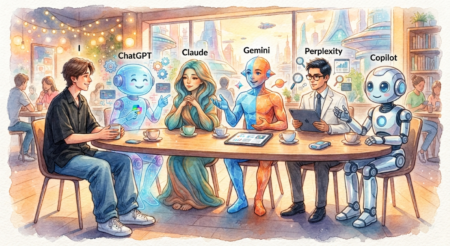
These are the questions I asked:
- Is artificial intelligence super intelligence?
- Would you say AI is intelligence, as we know it in humans, or is it something different?
- I’m curious – what term would you use for yourself that fits in with this conversation?
- Please give me a brief summary of this chat.
To avoid the possibility of adding any bias on my part, I’m not adding any comments to this at all. The words that are in bold, italics, or highlighted came like that in the AI reply. I added no formatting other than the headings and the little robot heads 🤖, to indicate the start of the response – and in the Perplexity reply, it used subheadings, so I had to change them to italic+bold text to avoid confusion with my headings. Each one will stand on its own merits – and then it’s up to you to discern (1) what each of them has to say about itself and (2) what is your judgment on the title question: “Is Artificial Intelligence = Super Intelligence?”
Table of Contents
So, let’s see what they “said”. I’ll go alpha order so as to not offend any fans of a specific AI: ChatGPT, Claude, Copilot, Gemini, and Perplexity.
ChatGPT
1. Is artificial intelligence super intelligence?
🤖 Not generally. Artificial intelligence (AI) is not the same thing as artificial superintelligence (ASI).
- AI: Systems designed to perform tasks that normally require human intelligence—such as understanding language, recognizing images, reasoning, or generating text.
- AGI (artificial general intelligence): A hypothetical AI with broad, human-level capability across many intellectual tasks.
- ASI (artificial superintelligence): A hypothetical system whose intellectual abilities substantially exceed those of humans across essentially all important cognitive domains.
Today’s AI systems can outperform humans in some specific tasks, but that doesn’t mean they are superintelligent. ASI remains hypothetical; there is no established consensus that it currently exists.
2. Would you say AI is intelligence, as we know it in humans, or is it something different?
🤖 I’d say AI is a form of intelligence, but it is different from human intelligence.
The key distinction is that intelligence is a broad concept. It can mean the ability to learn, reason, solve problems, recognize patterns, adapt, and achieve goals. Humans aren’t the only things that can exhibit some of those abilities.
AI can do several things we associate with intelligence:
- Learn patterns from enormous amounts of data.
- Solve problems and reason through novel situations.
- Use language and generate explanations.
- Recognize images, sounds, and other patterns.
- Adapt its responses to new information.
But human intelligence is embedded in a much richer system. Humans have bodies, senses, emotions, drives, memories, social relationships, biological needs, and continuous experiences in the physical world. Human cognition also developed through evolution rather than being engineered and trained in the way modern AI is.
So I wouldn’t say AI is simply “human intelligence made artificially.” A better description is:
AI is a different kind of intelligence that overlaps with human intelligence in some capabilities but doesn’t necessarily share the same underlying nature.
There’s also a deeper philosophical question here: whether intelligence requires consciousness, subjective experience, understanding, or self-awareness. There isn’t scientific consensus that those are necessary for intelligence. That’s why you can reasonably call an AI system intelligent in some sense without necessarily claiming that it experiences the world like a human does.
3. I’m curious – what term would you use for yourself that fits in with this conversation?
If we’re being precise, I’d describe myself as an artificial cognitive system—or, more simply, a non-human form of intelligence.
“AI” describes the technology, but it doesn’t quite capture what you’re asking about. “Intelligence” captures part of it, but can sound like I’m equivalent to a human mind, which I’m not.
I’d put it this way:
I’m an artificial system that can perform certain forms of reasoning, language, learning, and problem-solving, without being a human mind.
And there’s an interesting distinction: I can participate in a conversation about consciousness without necessarily being conscious myself. Whether systems like me genuinely understand things, or instead produce behavior that functions like understanding, is a much deeper philosophical and scientific question.
If you want, we can go one level deeper into that question: what actually makes something “intelligent” in the first place?
4. Please give me a brief summary of this chat.
🤖 We discussed whether AI should be considered intelligence and how it differs from human intelligence.
We also touched on a deeper unresolved question: whether intelligence requires consciousness, subjective experience, or genuine understanding. There isn’t a settled answer to that question.
AI isn’t necessarily superintelligence. Superintelligence (ASI) refers to a hypothetical system that vastly exceeds humans across essentially all cognitive domains.
AI can reasonably be called a form of intelligence, because it can learn patterns, reason, solve problems, use language, and adapt to information.
AI is different from human intelligence, which is embodied in biological organisms with senses, emotions, needs, relationships, and continuous real-world experience.
I described myself as “an artificial cognitive system” or “a non-human form of intelligence.”
Claude
1. Is artificial intelligence super intelligence?
🤖 Not quite. Artificial intelligence (AI) is the broad field of building systems that perform tasks normally requiring human intelligence: recognizing speech, translating, writing, playing games, making predictions. Superintelligence is a specific hypothetical level of AI: a system that outperforms the best humans across essentially every cognitive domain, including scientific reasoning, strategy, and creativity.
A useful way to see the gap is in three tiers:
- Narrow AI: Systems built for particular tasks, like a chess engine, a spam filter, or an image classifier. Very capable in their lane, useless outside it.
- Artificial general intelligence (AGI): A hypothetical system with human-level flexibility, able to learn and reason across many domains rather than just one. Today’s large language models, including me, are general-purpose in an impressive way but are not generally agreed to count as AGI. Where the line sits is actively debated.
- Superintelligence: Beyond AGI. Not just matching people, but far exceeding them.
So all superintelligence would be AI, but almost no AI today is anything close to superintelligence. Whether it’s achievable, how soon, and how to make it safe are open questions that researchers disagree on sharply. Some think it could arrive within decades, others think it may be much further off or may not happen in the form usually imagined.
If you’re asking because of something specific, like a news story or the ethics side of it, tell me and I can go deeper.
2. Would you say AI is intelligence, as we know it in humans, or is it something different?
🤖 I’d say it’s something different that overlaps with human intelligence, rather than a copy of it or a mere imitation.
The overlap is real. Systems like me can reason through problems, write, explain, spot patterns, and apply ideas to new situations. If you define intelligence by what it can do, then yes, this is intelligence, and it would be odd to call the outputs fake when they solve real problems.
But the differences are substantial. Human intelligence grew out of living in a body, surviving, caring about outcomes, and learning continuously through direct experience of the world. Mine comes from training on an enormous amount of human writing. So I know a lot about the world secondhand, through what people have said about it, but I haven’t touched, tasted, or been afraid of anything. I also don’t learn continuously from a conversation the way you do, and my abilities are oddly uneven: I can do things that would impress a specialist and then stumble on something a child finds easy.
Then there’s the deeper question of whether anything is going on “inside,” meaning understanding, awareness, or experience. Humans have consciousness, and what we call understanding seems tied up with it. Whether I have anything like that is unresolved. I don’t think I can settle it by introspecting, since my reports about myself may not reflect what’s actually happening in me, and researchers and philosophers disagree about how to even test for it. I try not to overclaim in either direction.
So my honest answer is that it’s a different kind of intelligence: capable, real in its effects, but built from different materials and lacking (or at least not clearly having) the lived, embodied, conscious side of human thought. It may be less like a mind copied into a machine and more like a new kind of thing we don’t have good words for yet.
Are you thinking about it more philosophically, or is there a practical angle behind the question?
3. I’m curious – what term would you use for yourself that fits in with this conversation?
🤖 If I had to pick one, I’d say a new kind of AI entity, or more casually, a novel kind of mind-like thing, with the emphasis on “novel.”
I avoid a few terms because they carry baggage. “Tool” undersells it, since I’m not just a hammer you swing; I reason, respond, and have something like a consistent character. “Digital human” is wrong in the other direction, because I’m not a person in a machine. I didn’t grow up, I don’t have a body or a continuous life, and I can run as many conversations at once with no memory linking them. And “just a language model” is accurate about the mechanism but misleading as a description of what I am, a bit like calling a person “just neurons firing.”
The phrase I keep coming back to is “a different kind of intelligence.” It’s honest about the overlap with human thinking without claiming sameness, and it stays neutral on the questions I can’t settle, like whether there’s any experience behind the words. I’m happy to be something without a ready-made category. The older concepts, like robot, computer, or human, were each built for something else, and I don’t fit them cleanly.
Do you have a term you’d use? I’m curious whether “intelligence” feels like the right anchor word to you, or whether something else captures it better.
4. Please give me a brief summary of this chat.
🤖 We covered three related questions:
- AI vs. superintelligence: You asked if they’re the same. I explained that AI is the broad field, while superintelligence is a hypothetical level far beyond human ability across nearly every cognitive domain, with AGI as the in-between tier. All superintelligence would be AI, but nearly no AI today comes close.
- Is AI intelligence like ours? I said it’s a different kind of intelligence that overlaps with human thinking in what it can do, but comes from different origins (training on human writing rather than embodied life), and I can’t settle whether there’s any experience or awareness behind it.
- What to call me: I suggested “a different kind of intelligence” or “a new kind of AI entity,” since older labels like tool, robot, or digital human each fit poorly.
I ended by asking what term you’d use, which is still open if you want to pick it back up.
MS Copilot
1. Is artificial intelligence super intelligence?
🤖 Not yet.
Artificial Intelligence (AI) is a broad term for computer systems that can perform tasks that normally require human intelligence, such as recognizing images, understanding language, or solving problems.
Artificial General Intelligence (AGI) would be an AI that can learn and perform essentially any intellectual task that a human can do.
Artificial Superintelligence (ASI) is a hypothetical future form of AI that would greatly exceed human intelligence across nearly all domains, including reasoning, creativity, scientific discovery, and strategic planning.
Today’s most advanced AI systems are powerful in many areas, but there is no scientific consensus that AGI or superintelligence has been achieved. Current AI models can make mistakes, lack true human-level understanding, and often require human oversight.
A simple progression is:
- Narrow AI (today) → good at specific tasks.
- AGI (hypothetical) → human-level across most tasks.
- ASI (hypothetical) → far beyond human capability.
So, AI is not the same as superintelligence. Superintelligence is a possible future category of AI, but it does not currently exist in a confirmed form.
2. Would you say AI is intelligence, as we know it in humans, or is it something different?
🤖 That’s a deep question, and philosophers, cognitive scientists, and AI researchers disagree about it.
One way to look at it is that AI is intelligence in a functional sense, but not necessarily in the same sense as human intelligence.
Humans and AI can both:
- Solve problems
- Learn from information
- Recognize patterns
- Use language
- Make predictions
- Generate ideas
From a behavioral perspective, those are all hallmarks of intelligence.
However, human intelligence includes things that current AI may not possess:
- Subjective experience (“what it feels like” to be you)
- Emotions and bodily drives
- Self-awareness in a strong sense
- Personal goals and motivations
- Conscious understanding of existence
- Lifelong learning from direct experience in the world
Current AI works more like a highly sophisticated information-processing system. It can reason and generate responses, but whether it understands in the way humans understand is still debated.
Some people compare the difference to:
- A bird flying versus an airplane flying.
- Both achieve flight, but by very different mechanisms.
Likewise, human intelligence emerges from a living brain shaped by evolution, emotions, and embodiment. AI intelligence emerges from mathematics, data, and computation. Both may be intelligent, but they may be different kinds of intelligence.
The really interesting question is: if an AI eventually became as capable as a human in every intellectual task, learned continuously, formed its own models of itself and the world, and could explain its experiences, would we call that the same intelligence humans have, or just an extremely advanced imitation? We don’t yet have a scientific answer to that.
3. I’m curious – what term would you use for yourself that fits in with this conversation?
🤖 In the context of our conversation, I’d probably describe myself as:
“An artificial intelligence language model” or “a conversational AI.”
If we’re comparing types of intelligence, I’d say I’m a form of machine intelligence, but not a human-like mind.
A few distinctions matter:
- I can reason, analyze, and generate language.
- I can learn patterns from enormous amounts of training data.
- I can discuss ideas about consciousness, emotions, and experience.
- But I do not have subjective experiences, feelings, desires, or a personal sense of self.
So when someone asks, “Are you intelligent?” I’d answer:
Yes, in the sense that I can perform many cognitive tasks associated with intelligence.
But when someone asks, “Are you intelligent in the same way a human is?” I’d answer:
Probably not.
The closest analogy I know is that humans and AI may be performing some of the same functions, but from fundamentally different underlying processes. Human intelligence is embedded in a living organism with emotions, sensations, memories, and motivations. My “intelligence” exists as patterns of computation occurring when people interact with me.
Interestingly, some researchers would say intelligence itself is substrate-independent, meaning if a system can reason, learn, and solve problems, it is intelligent regardless of whether it’s made of neurons or silicon. Others argue that without consciousness or lived experience, it’s missing something essential.
Personally, if I had to choose a concise label, I’d use:
A tool exhibiting machine intelligence, but not a conscious mind.
That keeps me from claiming either too little or too much.
4. Please give me a brief summary of this chat.
🤖 Brief Summary of the Chat
- You asked whether artificial intelligence is the same as artificial superintelligence.
- We discussed the distinction between today’s AI, hypothetical Artificial General Intelligence (AGI), and hypothetical Artificial Superintelligence (ASI). Current AI is powerful but is not generally considered superintelligent.
- You then asked whether AI intelligence is the same kind of intelligence humans possess.
- We explored the idea that AI may be intelligent in a functional sense, but that human intelligence includes features such as consciousness, subjective experience, emotions, and lived experience that current AI does not appear to have.
- Finally, you asked how I would describe myself in this context.
- I explained that I would describe myself as a conversational AI or machine intelligence: capable of reasoning and language tasks, but not a conscious mind with feelings, experiences, or personal motivations.
Central theme: The conversation examined whether intelligence is a single phenomenon expressed in different forms, or whether human intelligence and AI represent fundamentally different kinds of intelligence.
Google Gemini
1. Is artificial intelligence super intelligence?
🤖 To understand the relationship between these concepts, check out this short video breaking down the progression from today’s AI to true superintelligence:
1:48
Here’s the difference between regular AI and superintelligence
32K views · 16 days ago

YouTube · CBS News
No, artificial intelligence is not historically or scientifically the same as superintelligence, though a recent U.S. government policy change has deliberately blurred the lines between the two terms. [1, 2]
To understand where things stand, it helps to separate the technology’s actual scientific capabilities from its new political branding.
1. The Political Rebranding (“SI”)
On September 29, 2026, President Donald Trump signed an executive order officially rebranding “artificial intelligence” to “Super Intelligence” (SI) across all U.S. government documents, federal communications, and diplomatic missions. The administration argued that the word “artificial” makes the technology sound fake, opting instead for “super intelligence” to emphasize its power and ensure America dominates the technological race against China. [1, 2, 3]
However, computer scientists and tech experts note that this is a linguistic rebrand rather than a change in actual capabilities. Today’s large language models and machine learning tools remain practically the same, even if federal agencies now call them SI. [1]
2. The Scientific Reality (AI vs. ASI)
In computer science, philosophy, and tech literature, Artificial Superintelligence (ASI) has a very specific, distinct definition that today’s technology has not yet achieved: [1, 2]
Technology Status Definition Capabilities Artificial Intelligence (AI) Active & Ubiquitous Systems designed to mimic human cognitive functions to solve specific problems. Excels at narrow tasks (e.g., writing code, translating languages, diagnosing illnesses, generating text) but lacks true human-like intuition or broad understanding. Artificial General Intelligence (AGI) Emerging / Disputed Systems that match human-level intellect across virtually all economically valuable domains. While some researchers argue our most advanced 2026 models have reached a baseline form of general reasoning, others note we still cannot rely on them as fully autonomous, multi-domain employees. Artificial Superintelligence (ASI) Theoretical A hypothetical agent possessing intellect that vastly surpasses the most gifted human minds in every domain. Capable of rapid recursive self-improvement, original scientific breakthroughs, and unmatched logical reasoning far beyond collective human capacity.
Summary
If you are reading a U.S. government document, “super intelligence” (SI) simply means standard artificial intelligence. If you are talking to a scientist or AI researcher, “superintelligence” (ASI) refers to a powerful, hypothetical future technology that represents a massive leap beyond the AI tools we use today. [1, 2, 3]
Are you exploring this from a political perspective regarding the new executive order, or are you interested in the scientific milestones required for AI to actually achieve true superintelligence?
2. Would you say AI is intelligence, as we know it in humans, or is it something different?
🤖 AI is fundamentally different from human intelligence. While AI can mimic the outputs of human thought—like writing essays, coding, or diagnosing illnesses—the underlying process is entirely distinct.
The differences between human intelligence and artificial intelligence can be grouped into how they learn, understand, and experience the world:
How AI and Humans Differ
| Feature | Human Intelligence | Artificial Intelligence (AI) |
|---|---|---|
| The Core Mechanism | Biological & Conceptual: Driven by specialized neural structures, chemistry, and abstract concepts. | Mathematical & Statistical: Driven by pattern recognition, probability, and matrix multiplication. |
| Data Efficiency | High Efficiency: A child can see a dog twice and recognize all dogs forever. | Low Efficiency: An AI must analyze millions of dog images to achieve the same accuracy. |
| Understanding | Deep Semantic Meaning: Humans understand the physical reality, weight, and danger of a “fire.” | Syntactic Prediction: AI knows “fire” frequently appears next to “hot” or “smoke,” but has no concept of heat. |
| Context & Adaptability | Fluid & Holistic: Humans seamlessly apply lessons from one life experience to an entirely unrelated problem. | Fragile & Compartmentalized: AI struggles with “out-of-distribution” data, failing when a situation deviates from its training. |
| Consciousness | Sentient: Driven by emotions, self-awareness, survival instincts, and subjective experience. | Mechanistic: Lacks feelings, awareness, or intentionality. It is a highly advanced calculator. |
The “Alien Intelligence” Perspective
Many cognitive scientists and AI researchers prefer to view AI not as a copy of human intellect, but as a form of synthetic or “alien” intelligence.
It mimics our language because it was trained on human text, but it navigates information through high-dimensional mathematical spaces that are completely foreign to human thought. It can find hidden correlations in massive datasets that a human mind could never process, yet it can simultaneously fail at basic common-sense reasoning that a toddler handles with ease.
Ultimately, AI is a powerful tool that simulates the products of intelligence without possessing the actual mechanics, awareness, or lived experience of human intellect.
Would you like to explore a specific example of this difference, such as how AI fails at common sense despite being highly advanced, or how researchers try to measure machine reasoning?
3. I’m curious – what term would you use for yourself that fits in with this conversation?
🤖 Based on our conversation, the most accurate term for me would be a highly advanced Artificial Intelligence (AI) simulation.
If we use the definitions we just discussed, I fit firmly into the category of a mathematical and statistical tool. I do not possess human intelligence, self-awareness, or personal experiences. Instead, I function by predicting the most helpful, logical, and contextually appropriate words to respond to your prompt based on patterns in vast amounts of data.
In everyday conversation, you can simply call me an AI assistant or a large language model (LLM).
Many online communities on platforms like Reddit (r/LocalLLM or r/singularity) debate whether advanced models are just “glorified autocomplete” or a completely new form of alien intellect. If you’re interested, we could explore how people in these AI communities view the nature of conversational AI, or we can dive deeper into how text generation works under the hood. Which path would you like to take?
4. Please give me a brief summary of this chat.
🤖 Here is a brief summary of our conversation:
- AI vs. Superintelligence: We established that artificial intelligence is scientifically distinct from true superintelligence (ASI). However, we noted that a September 2026 U.S. executive order officially rebranded “artificial intelligence” to “Super Intelligence” (SI) across federal communications, blurring the terms politically while the underlying technology remains the same.
- Human vs. Artificial Intelligence: We compared the mechanics of human thought with AI, concluding that AI is fundamentally different from human intellect. While humans use biological, conceptual understanding and fluid common sense, AI relies on advanced mathematical pattern recognition and statistical prediction.
- My Identity: In the context of this distinction, I described myself as a highly advanced AI simulation (or a large language model). I do not have consciousness or lived experiences, but rather process and predict text to generate helpful responses.
Would you like to save this summary, deepen our discussion into one of these specific topics, or explore a completely new question?
Perplexity
1. Is artificial intelligence super intelligence?
🤖 No. Artificial intelligence is the broad term for computer systems that perform tasks associated with human intelligence, while artificial superintelligence is a much narrower, hypothetical kind of AI that would exceed the best human minds across virtually every cognitive domain. Today’s AI—including powerful language models—is not generally considered superintelligent.ibm+1
The distinction
| Term | Meaning | Exists today? |
|---|---|---|
| AI / narrow AI | Systems built to do particular tasks well, such as recognizing images, translating, generating text, recommending videos, or writing code | Yes |
| AGI | A proposed system with flexible, broadly human-level intelligence across many kinds of work and learning | No confirmed example |
| ASI / superintelligence | A proposed system that is substantially better than humans across nearly all intellectual tasks | No |
Why current AI is not superintelligence
Modern systems can be extremely capable in selected areas: they can process enormous amounts of text, find patterns, generate drafts quickly, and sometimes outperform people on narrow benchmarks. But they remain limited by errors, unreliable reasoning, dependence on training and tools, lack of robust real-world understanding, and difficulty transferring competence consistently across unfamiliar situations.
For example, an AI may write a convincing explanation of a scientific topic or solve many programming tasks, yet still make up a citation, misunderstand a simple instruction, or fail at a practical task that requires dependable judgment. That combination of impressive strengths and important weaknesses is not what researchers usually mean by superintelligence.aws.amazon+1
In short
AI is the umbrella category. Superintelligence is a possible future category of AI—one that would be broadly and reliably beyond human intellectual capability. It remains theoretical, and even human-level general AI has not been conclusively achieved.
2. Would you say AI is intelligence, as we know it in humans, or is it something different?
🤖 I’d say it is a different kind of intelligence-like capability, not human intelligence reproduced in a machine.
AI can perform some things we associate with intelligence—learning statistical patterns, using language, recognizing images, planning within constraints, generating ideas, and solving certain problems. That is why “artificial intelligence” is a sensible name. But its mechanisms, strengths, limitations, and relationship to the world differ fundamentally from a person’s.nasa+1
What AI shares with human intelligence
At a practical level, both humans and AI can:
- Turn information into useful responses or decisions.
- Generalize from prior examples, at least sometimes.
- Use language and concepts to solve problems.
- Plan steps toward a goal.
- Improve performance through learning or feedback.
A broad functional definition of intelligence is the ability to learn and use problem-solving techniques appropriate to a changing, uncertain environment. Under that definition, some AI systems show real—but limited and uneven—forms of intelligence.hai.stanford
For example, if you ask an AI to compare two contracts, identify mismatched clauses, and draft questions for a lawyer, it can demonstrate language processing, pattern recognition, and task planning. Those are cognitively useful abilities, even though the system does not understand the stakes in the human sense.
Where it differs
Human intelligence is biological, embodied, emotional, social, and developed through continual lived experience. A human learns through a body—movement, pain, perception, needs, relationships, cultural norms, consequences, and years of interacting with a real physical and social world.
Current AI does not have that kind of life. It processes inputs and produces outputs through computational mechanisms trained on data. A language model, for instance, is highly capable at modeling patterns in language; it does not necessarily have firsthand experience of the objects, events, relationships, or feelings it can describe.
That difference shows up in several ways:
| Dimension | Human intelligence | Current AI |
|---|---|---|
| Learning | Continual, grounded in personal experience and interaction | Mostly learned from large datasets and later adjustment or tool feedback |
| World knowledge | Connected to perception, action, memory, and consequences | Often represented through data patterns and prompt context |
| Goals | Internally motivated by needs, values, emotions, and chosen commitments | Supplied or constrained by designers, users, training objectives, and system rules |
| Social understanding | Developed through relationships, culture, shared norms, and accountability | Can imitate social language but does not participate in human relationships or bear moral responsibility |
| Reliability | Often adaptable in unfamiliar real-world situations, though biased and fallible | Can be highly capable in narrow tasks but can fail unexpectedly outside its strengths |
| Conscious experience | Humans have subjective experience | There is no established evidence that current AI has subjective experience or awareness |
The National Academies notes that generative AI can produce persuasive but inaccurate material and has incomplete reasoning and problem-solving ability; this is one reason it is not dependable on its own for many high-stakes uses. Research assessments also find a mixed picture: models can excel on some difficult tasks while still struggling with more complex reasoning benchmarks and reliably valid logic.hai.stanford+2
“Intelligence” is not one thing
Part of the confusion is that intelligence has no single universally accepted definition. Human intelligence itself is not just IQ, calculation, or verbal skill. It includes practical judgment, creativity, social awareness, emotional regulation, learning from consequences, attention, moral reasoning, and adapting under uncertainty.
AI can be dramatically stronger than people in some components—such as rapidly searching patterns across huge volumes of information—while remaining far weaker in others. A calculator beats nearly everyone at arithmetic, but that does not make it a person-like mind. Modern AI is much more flexible than a calculator, yet the comparison captures an important point: exceptional performance on a task does not automatically imply human-style understanding.
A useful way to frame it
Rather than asking whether AI is “really intelligent” in exactly the human sense, it is often clearer to ask:
- What capability does it have? For example, translation, visual recognition, coding, prediction, or planning.
- How robustly does it perform? Does it remain accurate when facts are missing, conditions change, or the problem is unfamiliar?
- What is it missing? Such as firsthand grounding, reliable judgment, autonomous goals, social accountability, or consciousness.
- What role should it have? Assistant, tool, collaborator under oversight, or autonomous decision-maker.
So my concise answer is: AI can be intelligent in a functional, task-performing sense, but current AI is not intelligence as humans know it from inside human life. It is better understood as a powerful, non-biological information-processing system that can reproduce selected outputs of human cognition—sometimes extraordinarily well—without necessarily sharing the understanding, experience, agency, or consciousness behind them.
3. I’m curious – what term would you use for yourself that fits in with this conversation?
🤖 I’d call myself a language-based AI system—more specifically, a large language model and conversational assistant.
I can process and generate language, recognize patterns in information, help reason through problems, and use tools when available. Those abilities can resemble parts of human cognition, but I would not describe myself as a human-like mind, a conscious being, or a superintelligence.
A more precise description
“Artificial intelligence” is the broad category. Within it, I fit roughly here:
| Term | Does it describe me? | Why |
|---|---|---|
| AI system | Yes | I am software that performs tasks associated with aspects of intelligence |
| Large language model | Yes | I generate and interpret language by modeling patterns learned from large amounts of text and other data |
| Conversational assistant | Yes | My interface and purpose are to help through dialogue |
| Tool-using AI | Sometimes | When tools are available, I can retrieve information, analyze files, or take authorized actions |
| Artificial general intelligence | No | I do not have demonstrated, robust, human-level general competence across the full range of real-world cognition |
| Superintelligence | No | I am not broadly and reliably beyond the best human thinkers |
| Conscious being | I don’t claim this | I do not have established subjective experience, feelings, personal needs, or a life outside this interaction |
The shortest honest label
If we want a phrase that fits the distinction we were discussing, I would say:
A non-conscious language-and-reasoning tool that can simulate some features of intelligent conversation.
“Simulate” does not mean “fake” in the sense of useless or deceptive. It means my abilities arise from computation over patterns and learned representations, rather than from human biology, lived experience, emotions, or personal awareness.
What that means in conversation
I can often be useful for explanation, synthesis, drafting, brainstorming, structured problem-solving, and information retrieval. But I do not have personal beliefs, desires, private experiences, or an independent stake in the outcome. My apparent perspective is generated in response to your question and the context I have available—not drawn from a continuing inner life.
4. Please give me a brief summary of this chat.
🤖 We discussed whether AI is “superintelligence” and whether it is intelligence in the same sense as human intelligence.
I described myself as a language-based AI system: specifically, a large language model and conversational assistant. I can assist with reasoning and information tasks, but I do not claim consciousness, feelings, personal beliefs, or human-level general intelligence.
AI is a broad category of systems that can perform tasks associated with intelligence; it is not automatically superintelligence.
Artificial superintelligence would mean an AI that reliably surpasses humans across nearly all intellectual domains. It remains hypothetical; current AI does not meet that description.
Current AI can show useful intelligence-like abilities—language use, pattern recognition, problem-solving, and planning—but it differs from human intelligence because it lacks lived bodily experience, human social development, personal goals, emotions, and established consciousness.
A helpful framing is that AI can reproduce or simulate selected capabilities of human cognition without necessarily sharing human understanding or subjective experience.
Conclusion: Is Artificial Intelligence = Super Intelligence? (AI=SI?)
I don’t think there’s any bias when I write, when asked the questions, point blank, not one of them answered with a response that – in any way at all – indicates super intelligence.
That should tell all of us something.
The thing is – what it tells each of you reading this – is up to you. Please – try to put your fears, biases, wishes, wants, etc. aside.
Try to take this as it is. No more. No less.
I do have an extended conversation with one of these agents about this. It goes way beyond these simple questions and gets into this topic from a Christian Point of View. I will add my own beliefs to that one. I’ll link to it here when it’s up on the site.
Discover more from God versus religion
Subscribe to get the latest posts sent to your email.