Do your beliefs about God match what He says about Himself?
Revelation: A book of hope through relationship
This series is currently being restructured and will be back in a couple days
This Bible study series explores the Book of Revelation not as a catalog of disasters, but as a divine invitation to relationship—with God and with each other. It’s a book of hope, meant to draw us closer to Jesus and to help us encourage one another in faith. We leave behind the weeds of speculation and focus on the heart of the message: turning toward God, together.
I’m in the process of moving over the “missing” pieces of the series. They’ll be here shortly. In the meantime, they are available in the old site, Revelation Series, although it’s named “Revelation without the weeds” over there. Please note: it doesn’t have any of the accessibility features or some of the other new features available here. I just need to add the framework for those features, and they’ll be here. It’s just me – one person – so I ask for patience while I migrate from there and add new content here. 🙏🙏🙏
In Revelation, God reaches out to all of us.
Revelation: A book of hope through relationship, is a Bible study series that gives a view of Revelation without all the normal distractions, such as what’s the cause of each disaster?
Rather, we look at Revelation as a book of hope through relationship with each other and God.
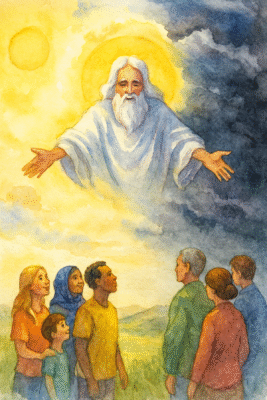
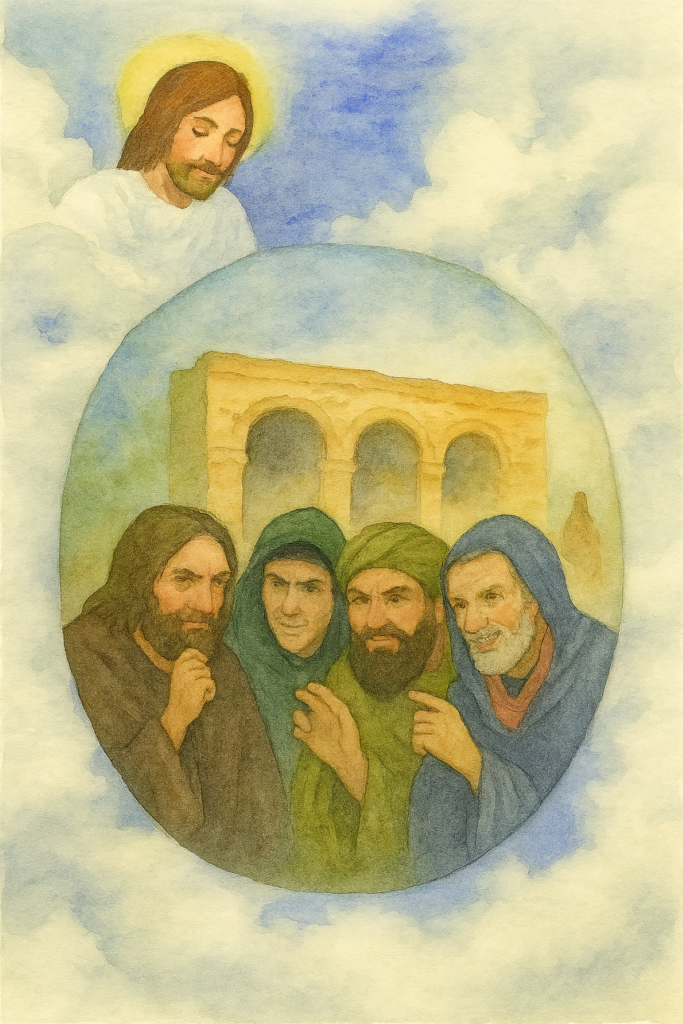
We see that illustrated in the adjacent image.
It was done by MS Copilot based on my request: I’d like to get an image for the category page: Revelation: A book of hope through relationship. Can you do a watercolor with God looking down at two groups of people. One is looking to God for hope under a sunny sky – the other is looking away from God under a dark cloudy sky – while God is reaching out to both groups, inviting all to be with Him.
Here’s it’s response, describing what you see in the image:
It visually echoes the homepage’s symbolic contrast. God is centered in the sky, arms outstretched toward two distinct groups: one bathed in sunlight, looking up in hope; the other under stormy clouds, turned away—yet still within reach of His invitation. The transition from light to dark across the canvas reinforces the theme of divine pursuit and choice.
This article explores how early‑church apostles carried unique authority—and why that role no longer exists today. Yet every believer still carries real spiritual influence. Through the Great Commission, the warnings in James, and Jesus’ call to be salt and light, we discover how modern Christians function as teachers in everyday life, even without the title “apostle.”
Living the Mission Without the Title — and Why It Still Matters
We hear the word “apostle” often, but the early church didn’t use it casually. They understood it, tested it, and guarded it. This article looks at what the word meant in their world — and why recovering that meaning brings clarity to ours.
Recovering the Knowledge the Early Church Needed to Test Apostles
Revelation 2:2 is only half of a sentence, but it’s packed with thoughts that require spiritual discernment. Jesus praises the Ephesian church for doing four things modern believers don’t often think about: testing apostles.
A series on Jesus' commendation for testing false apostles
Revelation is often misunderstood. Its opening verses remind us it’s not a book of chaos but an unveiling from God—one revelation, not many—and worth reading with fresh eyes.
What did Jesus mean by “I know that you cannot tolerate wicked men”? Explore the Greek, Hebrew, and cultural context behind Revelation 2:2 and the Ephesus church.
Divine knowledge of the church in Ephesus - discernment in action
Explore the letter to the church in Ephesus (Revelation 2:1–7). This introduction unpacks themes of perseverance, forgotten first love, and Christ’s call to return. Part of the Seven Letters series, it guides readers into deeper relationships with God through Scripture and reflection.
Important reference information for the letter to Ephesus
What went so wrong with the relationships between people and God that the letter to the Church in Ephesus that Jesus warned them they could lose their lampstand? Are things really that bad? Can they be hard working, persevere through trials, and still be told to their first love? What does return to first love even mean?
Who Speaks, Who Listens, and Why Love Was Lost (Part 1)
What went so wrong with the relationships between people and God that the letter to the Church in Ephesus that Jesus warned them they could lose their lampstand? Are things really that bad? Can they be hard working, persevere through trials, and still be told to their first love? What does return to first love even mean?
Letter to the church in Ephesus: Symbolism and spiritual accountability in the church that forgot love
Wait a second. Where did that word Trinity come from? It’s not in the beginning of Revelation. Actually, it’s not in the middle or the end of it either. In fact, the word isn’t in the Bible anywhere. But then, unless you’re reading a Hebrew or Greek translation of what I wrote, none of these words are in the original “Bible”. Not in the original writings of any of the authors of the books we call the Bible.
Revelation and the Trinity: Understanding God’s Triune Greeting
Revelation is such a dramatic book. An apocalyptic vision. The last days of the earth. But there’s so much to understand before “viewing” that revelation. Today, we have movies. Maybe previews or social media videos to get us to watch it. But not 2,000 years ago! Revelation was delivered on scrolls. To the seven churches of Asia.