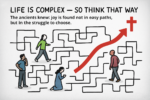
Many Ways, One Truth, Two Paths 🧩
Exploring how the ancients held paradox and choice together. In their world, many ways of thinking coexisted, but truth was singular — God’s truth. Each person faced two paths: to embrace or to resist. This category uncovers the frameworks they knew then, and invites us to rediscover the wisdom of living with tension, choice, and faith.
However, if we don’t understand things the ancients knew it the beginning, we’ll have a hard time reaching the point where we understand the “Miracle happens here” box.
We’ll also not achieve the full promise Jesus made to us when he said:
Jn 15:9 “As the Father has loved me, so have I loved you. Now remain in my love. 10 If you obey my commands, you will remain in my love, just as I have obeyed my Father’s commands and remain in his love. 11 I have told you this so that my joy may be in you and that your joy may be complete. 12 My command is this: Love each other as I have loved you.
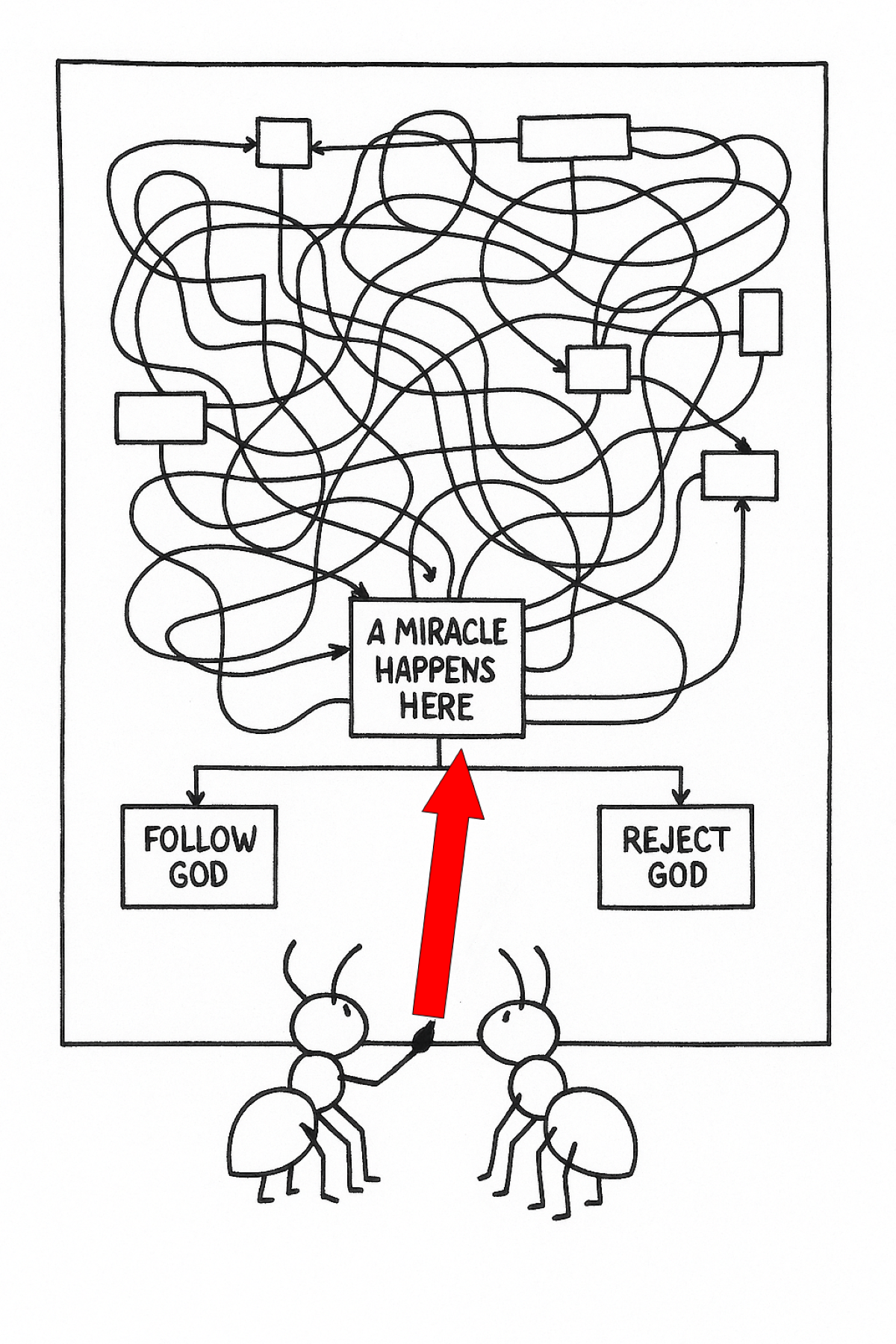
While the Red Arrow, symbolizing Jesus’ death on the cross and God’s offer of salvation may seem out of place, I don’t believe it is. Ever since Genesis 3:15, even Adam & Eve knew there was a “Messiah” promised by God when He spoke to the serpent after The Fall:
Ge 3:15 And I will put enmity
between you and the woman,
and between your offspring and hers;
he will crush your head,
and you will strike his heel.
The image now takes us from Genesis (the beginning) to Revelation (The End) of the Bible. And the time of the fulfillment of our ultimate choice:
- Genesis beginnings: Humanity confronted with many ways of thinking, from Eden onward — temptation, self-reliance, confusion.
- The miracle at the cross: Jesus’ blood as the decisive “process box” — salvation offered.
- Two paths: Acceptance or rejection, echoing the wisdom literature’s “way of life” vs. “way of death.”
- Revelation culmination: The two paths lead to the two ultimate outcomes — eternal life with God or separation.