
Revelation 2:2 is only half of a sentence, but it’s packed with thoughts that require spiritual discernment. Jesus praises the Ephesian church for doing four things modern believers don’t often think about: 1) understanding what an apostle is, 2) recognizing the weight of a claim to divine authority, 3) testing those claims, and 4) discerning the difference between true and false messengers. Each of these ideas is embedded in the verse, and each one carries its own biblical history and warnings. To understand Jesus’ commendation, we need to walk through the verse step by step.
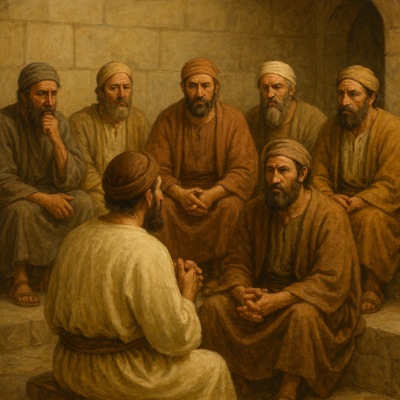
The adjacent image reflects a scene that took place, in some form, in the church in Ephesus.
A group of men from the church. probably elders, are questioning, testing someone who claims to be a messenger from God.
It’s one of the things for which Jesus commended the Ephesian church. Not only did they test such people. they found at least some of them to be false apostles.
But what exactly does that mean?
Isn’t an Apostle one of the “original” 12 – minus Judas Iscariot and plus Matthias, who replaced Judas. And Paul made 13. Sounds pretty easy to “detect” false apostles. So, what’s this about?
Well, it’s the four items in the opening. Four concepts that are clearly laid out in in the latter part of Rev 2:2″
To the Church in Ephesus 🔍
Rev 2:1 “To the angel of the church in Ephesus write:
These are the words of him who holds the seven stars in his right hand and walks among the seven golden lampstands: 2 I know your deeds, your hard work and your perseverance. I know that you cannot tolerate wicked men, that you have tested those who claim to be apostles but are not, and have found them false. 3 You have persevered and have endured hardships for my name, and have not grown weary.
We’ll go through them one at a time to see what each of them meant then, should mean now, and why they’re important even today.
That short piece of Revelation 2:2 carries four distinct layers of meaning:
- What “apostle” (ἀπόστολος) meant in the time of the early church
- A modern-day functional equivalent of the early church apostle?
- What it means to claim divine authority—whether self-declared or endorsed by others
- What “testing” actually involved
- Why discernment mattered—especially in light of Jeremiah’s warning about Hananiah
Each layer deserves its own look. So this post is just the beginning.
Next: What did ἀπόστολος mean back then—and why does that matter now?
Discover more from God versus religion
Subscribe to get the latest posts sent to your email.