
When Jesus praised the Ephesian church for testing those who claimed to be apostles, He wasn’t referring only to the Twelve. In their world, the word ἀπόστολος had a broader meaning—one that included anyone who claimed to be sent by God with authority. To understand the weight of their discernment, we need to understand what “apostle” meant in the first century.
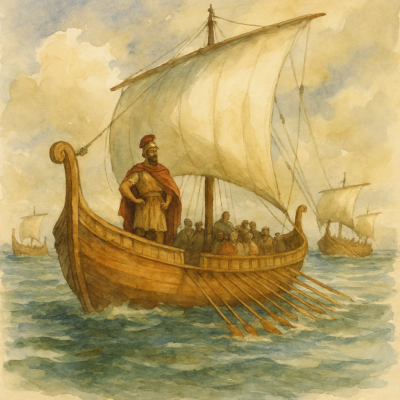
Believe it or not, the adjacent image with the ships sailing off to foreign lands was an example of an apostolos – apostle – back in the first century.
The Greek word in Revelation that we read as apostle had varying meanings back then.
It was adopted by Christianity to point to specific people.
But then, even in Christianity it has a variety of interpretations.
All of this, put together, should lead us to an important question.
What did the word “ἀπόστολος“, apostolos/apostle, mean when we come across it in The Letter to the Church in Ephesus, in Revelation?
Many Christians today hear the word “apostle” and immediately think of the Twelve, or perhaps Paul, or perhaps modern leaders who claim the title.
But the early church didn’t treat the word casually, and they didn’t apply it broadly. They tested it. They weighed it. They understood that the word carried authority, responsibility, and accountability.
Recovering that early understanding helps us navigate the confusion surrounding the term today.
To the Church in Ephesus 🔍
Rev 2:1 “To the angel of the church in Ephesus write:
These are the words of him who holds the seven stars in his right hand and walks among the seven golden lampstands: 2 I know your deeds, your hard work and your perseverance. I know that you cannot tolerate wicked men, that you have tested those who claim to be apostles but are not, and have found them false. 3 You have persevered and have endured hardships for my name, and have not grown weary.
The original meaning of apostle/ἀπόστολος/apostolos
Since the word apostle was used in the early church to identify someone, it’s worthwhile to find out what it meant originally. That’ll give us a clue as to how it’s used within the church.
Apostle
- Apostle
-
In the 1st century, the Greek word ἀπόστολος (apóstolos) was primarily a secular term meaning a “sent one,” specifically referring to an official envoy, ambassador, or delegate commissioned to act on behalf of a higher authority. Unlike a simple messenger (angelos), an apostolos possessed the authority and credentials of the sender, making their actions and words directly representative of the one who sent them.
Secular & Historical Contexts (1st Century)
- Ambassador/Envoy: An official representative sent to conduct business, often diplomatic or governmental in nature.
- Naval/Maritime Term: Derived from the verb apostellein (“to send off”), it was used to describe a fleet of ships or an admiral (the apostolos) sent out on a specific mission, such as to establish a colony or secure territory.
- Legal Documents: It could refer to a passport or, in a legal context, a document authorizing a ship to sail.
- Commercial Agent: A person sent with a specific commission to manage affairs, such as a collector of funds.
Key Aspects of the Term
- Authority: The apostolos was not just a messenger but a legal delegate with the authority to act for the sender.
- Commission: They were sent with a specific mission to accomplish.
- Representation: When the apostolos acted, their actions were interpreted as those of the one who sent them.
While the term is now overwhelmingly associated with the New Testament, in the wider Greco-Roman world of the 1st century, it was a recognized term for a high-level official emissary or a military-naval commander.
In general, we can say that an apostle, in the secular Greek sense, was a messenger with some sort of authority given by someone else. Further, the authority was such that action on their part was considered to be from the source of authority.
That’s fine, but what about in the religious sense? Before we get to Christianity though, let’s see the Hebrew equivalent.
The Hebrew view of יִשְׁלַח/shalach/apostolos/apostle
This part is critical to understanding the message in the Letter to the Church in Ephesus. John used words the Jewish people would’ve instantly understood. And even though it’s Greek in what we read today, they would’ve interpreted through their Jewish lens.
One of my sources defines shaliach/salach like this:
In its Jewish context, shaliach can be a person “who, whether a man or woman, was the agent or emissary of the sender: the concept of shaliah shel’ adam kemoto [‘a person’s agent is as the person himself’] and thus fully representative of the sender. Inherent in this definition is the idea of being chosen as a representative of a higher power, such as God or a king, and of having the authority to transmit the message of the one who sent him. 1Koelner, R. Y. (2022). Paul’s Letter to Titus: His Emissary to Crete, about Congregational Life (p. 22). Lederer Books: An Imprint of Messianic Jewish Publishers.
That’s all well and good, however, it’s not quite complete. The Old Testament has examples of angels as messengers of God.
And maybe you remember this unusual messenger from God?
Balaam’s Donkey 🔍
Nu 22:21 Balaam got up in the morning, saddled his donkey and went with the princes of Moab. 22 But God was very angry when he went, and the angel of the LORD stood in the road to oppose him. Balaam was riding on his donkey, and his two servants were with him. 23 When the donkey saw the angel of the LORD standing in the road with a drawn sword in his hand, she turned off the road into a field. Balaam beat her to get her back on the road.
Nu 22:24 Then the angel of the LORD stood in a narrow path between two vineyards, with walls on both sides. 25 When the donkey saw the angel of the LORD, she pressed close to the wall, crushing Balaam’s foot against it. So he beat her again.
Nu 22:26 Then the angel of the LORD moved on ahead and stood in a narrow place where there was no room to turn, either to the right or to the left. 27 When the donkey saw the angel of the LORD, she lay down under Balaam, and he was angry and beat her with his staff. 28 Then the LORD opened the donkey’s mouth, and she said to Balaam, “What have I done to you to make you beat me these three times?”
Nu 22:29 Balaam answered the donkey, “You have made a fool of me! If I had a sword in my hand, I would kill you right now.”
Nu 22:30 The donkey said to Balaam, “Am I not your own donkey, which you have always ridden, to this day? Have I been in the habit of doing this to you?”
“No,” he said.
Nu 22:31 Then the LORD opened Balaam’s eyes, and he saw the angel of the LORD standing in the road with his sword drawn. So he bowed low and fell facedown.
Nu 22:32 The angel of the LORD asked him, “Why have you beaten your donkey these three times? I have come here to oppose you because your path is a reckless one before me. 33 The donkey saw me and turned away from me these three times. If she had not turned away, I would certainly have killed you by now, but I would have spared her.”
Nu 22:34 Balaam said to the angel of the LORD, “I have sinned. I did not realize you were standing in the road to oppose me. Now if you are displeased, I will go back.”
Nu 22:35 The angel of the LORD said to Balaam, “Go with the men, but speak only what I tell you.” So Balaam went with the princes of Balak.
Nu 22:36 When Balak heard that Balaam was coming, he went out to meet him at the Moabite town on the Arnon border, at the edge of his territory. 37 Balak said to Balaam, “Did I not send you an urgent summons? Why didn’t you come to me? Am I really not able to reward you?”
Nu 22:38 “Well, I have come to you now,” Balaam replied. “But can I say just anything? I must speak only what God puts in my mouth.”
Nu 22:39 Then Balaam went with Balak to Kiriath Huzoth. 40 Balak sacrificed cattle and sheep, and gave some to Balaam and the princes who were with him. 41 The next morning Balak took Balaam up to Bamoth Baal, and from there he saw part of the people.
Typical messengers from God in the Old Testament
Well, let’s move on to the more typical messengers the Jewish people were familiar with. Here’s just a small sample of the many instances of יִשְׁלַח/shalach they would’ve instantly recognized/associated with the phrase regarding false prophets.
- Genesis 24:7 — God sends His angel
- 7 “The LORD, the God of heaven, who brought me out of my father’s household and my native land and who spoke to me and promised me on oath, saying, ‘To your offspring I will give this land’— he will send his angel before you so that you can get a wife for my son from there.
- Exodus 3:10 — God sends Moses
- Ex 3:7 The LORD said, “I have indeed seen the misery of my people in Egypt. I have heard them crying out because of their slave drivers, and I am concerned about their suffering. 8 So I have come down to rescue them from the hand of the Egyptians and to bring them up out of that land into a good and spacious land, a land flowing with milk and honey—the home of the Canaanites, Hittites, Amorites, Perizzites, Hivites and Jebusites. 9 And now the cry of the Israelites has reached me, and I have seen the way the Egyptians are oppressing them. 10 So now, go. I am sending you to Pharaoh to bring my people the Israelites out of Egypt.”
- Judges 6:14 — God sends Gideon
- Jdg 6:13 “But sir,” Gideon replied, “if the LORD is with us, why has all this happened to us? Where are all his wonders that our fathers told us about when they said, ‘Did not the LORD bring us up out of Egypt?’ But now the LORD has abandoned us and put us into the hand of Midian.” Jdg 6:14 The LORD turned to him and said, “Go in the strength you have and save Israel out of Midian’s hand. Am I not sending you?”
- Isaiah 6:8 — “Send me!”
- Isa 6:6 Then one of the seraphs flew to me with a live coal in his hand, which he had taken with tongs from the altar. 7 With it he touched my mouth and said, “See, this has touched your lips; your guilt is taken away and your sin atoned for.” Isa 6:8 Then I heard the voice of the Lord saying, “Whom shall I send? And who will go for us?” And I said, “Here am I. Send me!” Isa 6:9 He said, “Go and tell this people: “ ‘Be ever hearing, but never understanding; be ever seeing, but never perceiving.’
- Jeremiah 7:25 — God sent His prophets
- Jer 7:21 “ ‘This is what the LORD Almighty, the God of Israel, says: Go ahead, add your burnt offerings to your other sacrifices and eat the meat yourselves! 22 For when I brought your forefathers out of Egypt and spoke to them, I did not just give them commands about burnt offerings and sacrifices, 23 but I gave them this command: Obey me, and I will be your God and you will be my people. Walk in all the ways I command you, that it may go well with you. 24 But they did not listen or pay attention; instead, they followed the stubborn inclinations of their evil hearts. They went backward and not forward. 25 From the time your forefathers left Egypt until now, day after day, again and again I sent you my servants the prophets. 26 But they did not listen to me or pay attention. They were stiff-necked and did more evil than their forefathers.’
If all that feels like enough, and you think we don’t need to examine the Christian view of the word “apostle” – hang on.
The Christian view of apostle
As frequently happens, the Christian view of apostle doesn’t really line up with secular or Jewish meanings.
Apostle, modern from dictionary.com
- Apostle, modern from dictionary.com
-
The list below comes from dictionary.com
- any of the early followers of Jesus who carried the Christian message into the world. Not all of Jesus’ followers named in the New Testament are considered apostles, but Paul, Barnabas, and Mary Magdalene certainly meet the criteria.
- Sometimes Apostle in the Bible, any of the original 12 disciples called by Jesus to preach the gospel: Simon Peter, the brothers James and John, Andrew, Philip, Bartholomew, Matthew, Thomas, James the son of Alpheus, Thaddaeus, Simon the Zealot, Judas Iscariot.
- the first or the best-known Christian missionary in any region or country.St. Patrick and Palladius have both been dubbed “the apostle of Ireland.”
- Eastern Church. one of the 70 disciples of Jesus.
- the title of the highest ecclesiastical official in certain Protestant sects.
- one of the 12 administrative officials of the Mormon Church.
- a pioneer of any new system or cause, especially an early leader in a reform movement. He has emerged as an apostle of a new era of peace and national unity.
- a loyal supporter or follower. Our company’s apostles are motivated by the service they can render for the good of the organization.
- Nautical. a knighthead, especially one having its top projecting and used as a bitt or bollard.
Mary Magdalene is an apostle?
OK – that first one got me. I’ve never heard of Mary Magdalene referred to as an apostle. I checked it out in my eBook resource library. Sure enough – there are some who say it’s so – sort of.
Mary Magdalene as an apostle? Insight
Mary Magdalene is not considered an apostle in the formal sense—she was not one of the Twelve—but she holds a distinctive honorary title within Christian tradition. Since the eleventh century, the Church has honored her as “apostolorum apostola” (apostle to the apostles), a designation affirmed by Saint Thomas Aquinas in the thirteenth century. 1 This title reflects her unique role in the resurrection narrative rather than membership in the apostolic circle.
The basis for this honor centers on her encounter with the risen Christ. According to the Gospels, Jesus appeared to her first on Easter morning and entrusted her with announcing his Resurrection to the initially skeptical Apostles.1 She was the first person to encounter the risen Christ and the first to proclaim the resurrection.2 This makes her a messenger to the apostles rather than one of them.
Aquinas articulated that she possessed “the office of an apostle” insofar as her task was to announce the Lord’s resurrection to the disciples.1 Notably, all four Gospels name Mary Magdalene as a witness to the resurrection—a unanimity of testimony suggesting her stature among earliest Christians was of the highest order, even surpassing that of the Virgin Mary.2
Beyond canonical texts, extracanonical writings from the first to fourth centuries portray Mary Magdalene as a bold, prophetic, visionary disciple and leader granted special visions of the risen Christ, whose understanding exceeded that of the male disciples.3 However, some texts also record Peter questioning the legitimacy of her encounter with Jesus, reflecting debates about women’s religious authority in early Christian communities.3 This tension reveals that while Mary Magdalene’s significance was undeniable, her authority was sometimes contested in developing Christian traditions.
3 Deirdre Good, “Beyond the Canon,” in Women’s Bible Commentary, ed. Carol A. Newsom, Jacqueline E. Lapsley, and Sharon H. Ringe (Louisville, KY: Westminster John Knox Press, 2012), 635–636.
1 Bronwen McShea, Women of the Church: What Every Catholic Should Know (San Francisco, CA: Augustine Institute – Ignatius Press, 2024), 4–5.
2 Brian Zahnd, When Everything’s on Fire: Faith Forged from the Ashes (Downers Grove, IL: IVP, 2021), 50.
OK – so kinda-sorta-maybe. But not in the context of what we read in Revelation.
Why look at Mary Magdalene in this context?
It sounds like that should be the end of the discussion on Mary Magdalene. But it’s not. It’s got implications beyond just her.
Why? Well, what about us, today? Here’s what Jesus Told Mary Magdalene:
Jesus Appears to Mary Magdalene 🔍
Jn 20:10 Then the disciples went back to their homes, 11 but Mary stood outside the tomb crying. As she wept, she bent over to look into the tomb 12 and saw two angels in white, seated where Jesus’ body had been, one at the head and the other at the foot. Jn 20:13 They asked her, “Woman, why are you crying?”
“They have taken my Lord away,” she said, “and I don’t know where they have put him.” 14 At this, she turned around and saw Jesus standing there, but she did not realize that it was Jesus.
Jn 20:15 “Woman,” he said, “why are you crying? Who is it you are looking for?”
Thinking he was the gardener, she said, “Sir, if you have carried him away, tell me where you have put him, and I will get him.”
Jn 20:16 Jesus said to her, “Mary.”
She turned toward him and cried out in Aramaic, “Rabboni!” (which means Teacher).
Jn 20:17 Jesus said, “Do not hold on to me, for I have not yet returned to the Father. Go instead to my brothers and tell them, ‘I am returning to my Father and your Father, to my God and your God.’ ”
Jn 20:18 Mary Magdalene went to the disciples with the news: “I have seen the Lord!” And she told them that he had said these things to her.
OK – Jesus said “Go”. Why isn’t that a commissioning command with authority?
Before we seek answers, let’s look at two more examples that may or may not be considered apostles, but clearly cases when Jesus sent someone out.
What about when Jesus sent out The Twelve?
Jesus Sends Out the Twelve 🔍
10:2-4 pp — Mk 3:16-19; Lk 6:14-16; Ac 1:13
10:9-15 pp — Mk 6:8-11; Lk 9:3-5; 10:4-12
10:19-22 pp — Mk 13:11-13; Lk 21:12-17
10:26-33 pp — Lk 12:2-9
10:34, 35 pp — Lk 12:51-53
Mt 10:1 He called his twelve disciples to him and gave them authority to drive out evil spirits and to heal every disease and sickness.
Mt 10:2 These are the names of the twelve apostles: first, Simon (who is called Peter) and his brother Andrew; James son of Zebedee, and his brother John; 3 Philip and Bartholomew; Thomas and Matthew the tax collector; James son of Alphaeus, and Thaddaeus; 4 Simon the Zealot and Judas Iscariot, who betrayed him.
Mt 10:5 These twelve Jesus sent out with the following instructions: “Do not go among the Gentiles or enter any town of the Samaritans. 6 Go rather to the lost sheep of Israel. 7 As you go, preach this message: ‘The kingdom of heaven is near.’ 8 Heal the sick, raise the dead, cleanse those who have leprosy, drive out demons. Freely you have received, freely give. 9 Do not take along any gold or silver or copper in your belts; 10 take no bag for the journey, or extra tunic, or sandals or a staff; for the worker is worth his keep.
Mt 10:11 “Whatever town or village you enter, search for some worthy person there and stay at his house until you leave. 12 As you enter the home, give it your greeting. 13 If the home is deserving, let your peace rest on it; if it is not, let your peace return to you. 14 If anyone will not welcome you or listen to your words, shake the dust off your feet when you leave that home or town. 15 I tell you the truth, it will be more bearable for Sodom and Gomorrah on the day of judgment than for that town. 16 I am sending you out like sheep among wolves. Therefore be as shrewd as snakes and as innocent as doves.
Mt 10:17 “Be on your guard against men; they will hand you over to the local councils and flog you in their synagogues. 18 On my account you will be brought before governors and kings as witnesses to them and to the Gentiles. 19 But when they arrest you, do not worry about what to say or how to say it. At that time you will be given what to say, 20 for it will not be you speaking, but the Spirit of your Father speaking through you.
Mt 10:21 “Brother will betray brother to death, and a father his child; children will rebel against their parents and have them put to death. 22 All men will hate you because of me, but he who stands firm to the end will be saved. 23 When you are persecuted in one place, flee to another. I tell you the truth, you will not finish going through the cities of Israel before the Son of Man comes.
Mt 10:24 “A student is not above his teacher, nor a servant above his master. 25 It is enough for the student to be like his teacher, and the servant like his master. If the head of the house has been called Beelzebub, how much more the members of his household!
Mt 10:26 “So do not be afraid of them. There is nothing concealed that will not be disclosed, or hidden that will not be made known. 27 What I tell you in the dark, speak in the daylight; what is whispered in your ear, proclaim from the roofs. 28 Do not be afraid of those who kill the body but cannot kill the soul. Rather, be afraid of the One who can destroy both soul and body in hell. 29 Are not two sparrows sold for a penny ? Yet not one of them will fall to the ground apart from the will of your Father. 30 And even the very hairs of your head are all numbered. 31 So don’t be afraid; you are worth more than many sparrows.
Mt 10:32 “Whoever acknowledges me before men, I will also acknowledge him before my Father in heaven. 33 But whoever disowns me before men, I will disown him before my Father in heaven.
Mt 10:34 “Do not suppose that I have come to bring peace to the earth. I did not come to bring peace, but a sword. 35 For I have come to turn
“ ‘a man against his father,
a daughter against her mother,
a daughter-in-law against her mother-in-law—
Mt 10:36 a man’s enemies will be the members of his own household.’
Mt 10:37 “Anyone who loves his father or mother more than me is not worthy of me; anyone who loves his son or daughter more than me is not worthy of me; 38 and anyone who does not take his cross and follow me is not worthy of me. 39 Whoever finds his life will lose it, and whoever loses his life for my sake will find it.
Mt 10:40 “He who receives you receives me, and he who receives me receives the one who sent me. 41 Anyone who receives a prophet because he is a prophet will receive a prophet’s reward, and anyone who receives a righteous man because he is a righteous man will receive a righteous man’s reward. 42 And if anyone gives even a cup of cold water to one of these little ones because he is my disciple, I tell you the truth, he will certainly not lose his reward.”
Well, that was maybe a special case. I mean, that was his disciples. You know – the ones who were alive and traveled with Jesus?
Does performing The Great Commission make someone an apostle?
But what about us, today? We’re disciples. But are we apostles when we do God’s work? Let’s take a look at The Great Commission.
The Great Commission 🔍
Mt 28:16 Then the eleven disciples went to Galilee, to the mountain where Jesus had told them to go. 17 When they saw him, they worshiped him; but some doubted. 18 Then Jesus came to them and said, “All authority in heaven and on earth has been given to me. 19 Therefore go and make disciples of all nations, baptizing them in the name of the Father and of the Son and of the Holy Spirit, 20 and teaching them to obey everything I have commanded you. And surely I am with you always, to the very end of the age.”
Well, Jesus definitely told us to go. And there’s authority in there. And several tasks. Does this mean we’re also apostles?
You know, I typed out that last heading – Does performing The Great Commission make someone an apostle? – and it made me realize something. In this day and age where we’re so impatient, have an attention span where 10 seconds can be pushing the limits, and want instant gratification to the point where even 7-11 does deliveries – receiving a commission does actually require that it be carried out in the way Jesus intended.
Where are we on determining who’s an apostle?
That was interesting. Confusing. Obviously, the word apostle doesn’t mean the same thing to everyone. Not even to all Christians. That makes things somewhat difficult. It feels like who’s an apostle is something that’s, as we say, in the eye of the beholder. And it is, in a way. The problem is that we don’t realize who the “beholder” is – and must be. If God sends someone out to accomplish a task, then only God can be the beholder. It’s not up to us to decide who’s an apostle and who isn’t.
There seems to be two things worth closer examination if we’re to try to figure out who God considers an apostle: (1) what were the early church requirements to be considered an apostle and (2) what are the impacts of all this on us today?
What were the early church requirements to be an apostle?
The first thing we’re going to look at is: what were the early church requirements to be an apostle? That only makes sense. After all, the letter was written to one of those early churches. There’s a lot to learn from them.
Having said that, we also need to remember that even though the church in Ephesus did test all who had claims to apostle status – they did it without love. So, while they are model of what to do – they aren’t such a good model of how to do it. I wonder if that’s why we don’t know anything other the fact that it was done.
With that in mind, here are four documented requirements, drawn from New Testament examples.
Apostolic status in the New Testament rested on several interconnected requirements that validated both the person’s authority and their message.
Direct Commission from Christ stood as foundational. An apostle had to receive a call and commission directly from Christ1, establishing their legitimacy as representatives bearing Christ’s own authority. Paul emphasized this by describing himself as “sent not from men nor by a man, but by Jesus Christ and God the Father” (Gal 1:1), distinguishing apostolic authority from merely human appointment.
Eyewitness Experience formed the second pillar. When the apostles sought to replace Judas, they required someone who had “been with us the whole time the Lord Jesus was living among us, beginning from John’s baptism to the time when Jesus was taken up from us” and could “become a witness with us of his resurrection” (Acts 1:21–22). This dual requirement—witnessing both Jesus’ earthly ministry and his resurrection—was essential because apostles functioned as authoritative witnesses whose personal observations authenticated the gospel message. Paul defended his apostolic standing by asking, “Have I not seen Jesus our Lord?” (1 Cor 9:1), citing his Damascus Road encounter as fulfilling this requirement even though he became a believer after the resurrection.
Miraculous Authority reinforced apostolic credentials. Paul demonstrated “the marks of a true apostle, including signs, wonders and miracles” (2 Cor 12:12), with these supernatural acts serving as visible validation of apostolic office.
Divine Revelation completed the qualifications. An apostle possessed authority in communicating divine revelation, such that what they wrote under divine inspiration carried the voice of God1. This enabled apostles to teach with binding authority and produce Scripture.
The early church took these requirements seriously enough to test claimants. The church at Ephesus “tested those who claim to be apostles but are not, and have found them false” (Rev 2:2), recognizing that false apostles could attempt to appropriate the title without meeting these stringent qualifications.
1 Robert Duncan Culver, “Apostles and the Apostolate in the New Testament,”Bibliotheca Sacra (1977), 136–137.
That’s much more restrictive than a lot of what we just looked at. So, let’s see how it plays out under those requirements.
Early church apostle-testing still matters
You probably noticed, there can be no apostles today. There’s no direct commission from Jesus, at least not in the sense of the twelve + Mathias. Paul was a special case. Proof of such an event today is, well, hard to come by if it did happen.
There’s also no one alive anymore who literally saw Jesus during His ministry. Again, there’s Paul, but the issue of being able to prove an event still remains.
So, does that mean there’s no need to “test apostles” any longer? It would be most odd to say it’s not needed. If it wasn’t, why would there be anything of it in the letter to the Ephesus church? The vision given to John was about future events. Why would something not necessary be included – whether the church did it correctly or poorly?
Therefore, I see only one legitimate reason for the commendation on testing false apostles. Namely, to test the modern day, as much as possible functional equivalent. Again – there’s no commission from Jesus walking the earth during His ministry, there’s no 1st person contact with Him. So even if the other requirements were met, the person today cannot be an apostle, given the view that God gives us in His word of what being an apostle entails.
How can early church apostle testing still be relevant today?
In the next post, we’ll look at how this early-church understanding helps us evaluate modern claims of apostleship — and why the Ephesian church’s discernment still matters today.
Footnotes:
- 1Koelner, R. Y. (2022). Paul’s Letter to Titus: His Emissary to Crete, about Congregational Life (p. 22). Lederer Books: An Imprint of Messianic Jewish Publishers.
Discover more from God versus religion
Subscribe to get the latest posts sent to your email.