
We continue our look at Jesus’ Divine Knowledge of the Church in Ephesus with His acknowledgement and praise. In this segment, we’ll see the cultural and Biblical implications of “I know that you cannot tolerate wicked men”. Since Ephesus is the church that lost its first love, we’ll also see how the two opposing thoughts fit into the picture we’re building of this church.
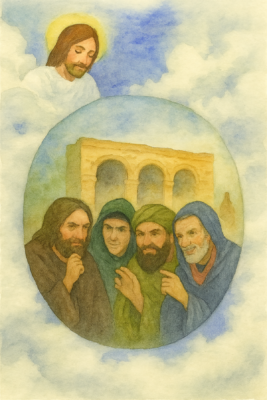
I don’t know if you’ve noticed, but there appears to be two different suggestions, even commands, when it comes to what to do with “wicked men” in the Bible.
Take the four guys in the adjacent image.
They seem to be plotting something.
They’re close together, probably whispering or at most talking quietly. Hatching some sort of plan.
Jesus is figuratively watching them from Heaven.
Let’s assume they’re up to no good.
Planning something evil.
Question: what is “evil”?
Is all evil the same? Is something either good or evil, and there’s nothing in between? Or is evil a whole range of different things, and some things are more evil than others?
We need to know that, don’t we? It comes down to a question of, “what is Jesus talking about?” when He says, “I know that you cannot tolerate wicked men”.
And then after pretty much defining evil, we also need to know “what action(s) constitute not tolerating evil men?”
Translations matter
👿 Who is considered a wicked person in the context of the Ephesus Church letter?
One word can tilt our understanding of what Jesus commended or condemned. In Ephesus, the same Greek term is rendered both ‘wicked’ and ‘evil.’ Which is it? And does the difference matter?
Remember, the letter to Ephesus was written by a Jewish Apostle who converted to following Jesus. But we have Greek words written for a mixed audience that contained many former Jews – written by John with lots of allusions to things that were familiar with life in a Jewish community at that time. Therefore, we must examine what the concept of wicked men entailed in the letter.
As often happens, the combination leads us to a problem. Here’s the English text from the NIV, with Greek below it:

Wicked men or evil?
The adjacent image shows “wicked people” in English.
In the top section, you notice that there’s an arrow underneath “people” pointing to “wicked”. Then, looking below that, you see it ultimately says “evil person”.
This isn’t just a word puzzle
The choice between ‘wicked’ and ‘evil’ shapes how we see the church’s discernment, its justice, and its compassion. It raises questions about what kind of culture a church builds when it confronts wrongdoing.
That means we have to raise some questions.
- Is it wicked people or evil person?
- Given that “people” was added by the translators, do we have a choice between wicked and evil, with the people/person removed?
- Or – is definitely either wicked or evil?
- I’ll add one more thought for examination – is this a difference New and Old Testament concepts, Jewish and Christian concepts, different culture, or something else?
That’s a lot of questions.
👿 Seeking to understand what Jesus meant by “I know that you cannot tolerate wicked men“
In this study, we’ll explore the implications of each translation — not only for Ephesus, but for us today. Is one more accurate? Or do both reveal something about the opportunity and cost of how we respond to evil?
👿🌎 What does wicked mean today?
This time, we’re going to look at current secular use first. You know – the incredible range of things/people that are called wicked these days. It’s like I have a pair of slippers called “wicked good” by the maker – LL Bean. So warm and comfortable. But hardly wicked in the sense we’re talking about here.
I know, slippers aren’t people. But since the word people is implied/added by the translators – and since the form of the Greek word κακός used in the text is an adjective, not a noun, it’s a description of something or someone. That means we need to look at inanimate objects. So, we also must remember that most inanimate objects, in and of themselves, are neither evil nor good. It’s the intent for which they are being used by people that determines the absence or presence of good or evil.
With that in mind, let’s check it out. Are you ready?
👿🌎📖 Here’s what dictionary.com has for wicked as an adjective:
- evil or morally bad in principle or practice; sinful; iniquitous.
- wicked people;
- wicked habits.
- Synonyms:
- villainous , infamous , heinous , dissolute , depraved , corrupt , profligate , immoral , blasphemous , profane , impious , godless , ungodly , unrighteous
- Antonyms:
- virtuous, good
- mischievous or playfully malicious.
- These wicked kittens upset everything.
- distressingly severe, as a storm, wound, or cold.
- a wicked winter.
- passing reasonable bounds; intolerably bad.
- wicked prices;
- a wicked exam.
- having a bad disposition; ill-natured; mean.
- a wicked horse.
- spiteful; malevolent; vicious.
- a wicked tongue.
- extremely troublesome or dangerous.
- wicked roads.
- unpleasant; foul.
- a wicked odor.
- Slang. wonderful; great; masterful; deeply satisfying.
- He blows a wicked trumpet.
👿🌎📖 Conclusion: wicked as an adjective means nothing without context
The only conclusion that can be reached after reading all that is this: today, wicked means nothing unless there’s context attached to it.
As we move through our analysis, you’ll see that this wasn’t always the case. I often feel like there’s intention behind making words meaning the opposite of what they used to. It means things that used to be frowned on, or were downright wrong, are now described with the same words to describe things as good. The opposite happens as well. Words that used to portray good things or good people are now being used to describe bad or evil things and people.
In modern English, ‘wicked’ carries no fixed meaning; only context determines whether it signals evil, mischief, severity, or even praise.
It’s like a way to deaden us to two concepts that used to be important to people: right and wrong; good and evil; acceptable and unacceptable. We’re more and more left in a world where anything goes.
👿✝️ What did wicked mean in Old Testament days?
I have to say right up front, I was surprised when I read this:
The term κακός is of no great significance in the NT. The question of theodicy, which agitates Greek and Hellenistic thinking in face of κακά, loses its point when confronted by the good news proclaimed by Christ and attested by the apostles—the good news of the approaching and victorious dominion of God which is already present in Christ. The problem has found its solution in the history of Christ. Furthermore, κακός as a moral concept is far less important than → ἁμαρτία and → πονηρός. 1Grundmann, W. (1964–). κακός, ἄκακος, κακία, κακόω, κακο͂ργος, κακοήθεια, κακοποιέω, κακοποιός, ἐγκακιέω, ἀνεξίκακος. In G. Kittel, G. W. Bromiley, & G. Friedrich (Eds.), Theological dictionary of the New Testament (electronic ed., Vol. 3, p. 479). Eerdmans.
∅➡️🗑️The term κακός is of no great significance in the NT
Did you catch that: The term κακός … loses its point when confronted by the good news proclaimed by Christ?
If the word has no point, then why are we looking at it? More shocking, if the word has no point, then why is it even in the letter to the Ephesus church? Why is God wasting our time studying a word that has no point?
This is one of those points when we need to ask ourselves – do I want to believe? It’s like this: if we don’t want to believe in all of this, there are so many opportunities to find reasons to not believe. It’s harder sometimes to find a reason to believe.
The logical side of me says this is just wrong. This is a waste of time. I’m learning all this, and then when I dig deeper, I read “The term κακός is of no great significance in the NT. If a word like wicked is of no great significance, why am I talking all this time and energy to learn it? Why are you taking your time and energy to read this?
It comes down to one simple thing. God’s gift of salvation comes one way and only one way – through Jesus’ dying on the cross for us. Since He did that, do I honestly want to just read this one thing and then give up? Or do I want to see – what am I missing here?
Do you see what’s missing in what I just wrote? There’s a reason it’s of no great significance in the NT – and it’s not because wickedness doesn’t matter. It’s because there’s a way to overcome that wickedness. By accepting the gift of salvation. A part of this includes believing Jesus won’t waste His time or ours. To realize that, we need to get beyond our original shock and dismay – and read the next sentence!
… loses its point when confronted by the good news proclaimed by Christ and attested by the apostles—the good news of the approaching and victorious dominion of God which is already present in Christ.
And then keep going:
Furthermore, κακός as a moral concept is far less important than → ἁμαρτία and → πονηρός.
❓📖 What do ἁμαρτία and πονηρός mean?
OK – we’re getting somewhere now. This is where we make the leap from wicked to evil. And to sin. Just in case you haven’t realized it, this is the first time the word sin has been seen on this page. There’s no mention of it at all in the secular definition of wicked. Nothing.
∅➡️🗑️Yes, we’ve dumped sin into the wastebasket of evil terms to be forgotten and removed from our language. And yes, we can do that. But God won’t. It’s still in His language. His definition of Holy means no sin. Not that it’s thrown away and not part of our language. No. He means that it’s not part of our lives. Not even our thinking.
So – what do ἁμαρτία and πονηρός mean?
✝️What does ἁμαρτία mean?
Based on what we just read, this shouldn’t surprise you. But it does enlighten us about some of the confusion we had earlier.
ἁμαρτία is about sin. It’s a very large topic. Much bigger than what we’re looking at today. But here’s what we need to know for “I know that you cannot tolerate wicked men”.
In the Synoptic Gospels it is striking how slight is the role of terms for sin as compared with their application in other parts of the NT. If we investigate the terms and their place in these Gospels, we find certain significant features which may be reduced to the twofold statement, first, that Jesus did not speak of sin and its nature and consequences, but was conscious of its reality (e.g., in the Sermon on the Mount) and acted accordingly, and second, that in His acts and sayings He was conscious of being the Victor over sin. 2Quell, G., Bertram, G., Stählin, G., & Grundmann, W. (1964–). ἁμαρτάνω, ἁμάρτημα, ἁμαρτία. In G. Kittel, G. W. Bromiley, & G. Friedrich (Eds.), Theological dictionary of the New Testament (electronic ed., Vol. 1, pp. 302–303). Eerdmans.
So, we see the emphasis in the Gospels, Jesus’ emphasis, was on Him as the conqueror of sin and death.
✝️❓📖 What does πονηρός mean?

Rather than get into potentially another huge issue, let’s look at a chart that shows the various meanings behind the word πονηρός when we see it in the New Testament.
You can see now, we finally see words like evil, evils, evil one.
However, if we really want to get into what the original word – κακός – meant to the Jewish listeners when the Jewish Messiah gave them to the Jewish Apostle John to include in the letter to the church in Ephesus, we really need to turn to the Old Testament that was their only scripture at the time.
Of course, the teaching of Jesus and the Apostles are part of what they learned. But we cannot ignore the Jewishness in everything they did and said. We cannot – must not – ignore:
The Fulfillment of the Law – Matthew
Mt 5:17 “Do not think that I have come to abolish the Law or the Prophets; I have not come to abolish them but to fulfill them. 18 I tell you the truth, until heaven and earth disappear, not the smallest letter, not the least stroke of a pen, will by any means disappear from the Law until everything is accomplished. 19 Anyone who breaks one of the least of these commandments and teaches others to do the same will be called least in the kingdom of heaven, but whoever practices and teaches these commands will be called great in the kingdom of heaven. 20 For I tell you that unless your righteousness surpasses that of the Pharisees and the teachers of the law, you will certainly not enter the kingdom of heaven.”
After reading that, how can we ignore the Old Testament? Aren’t we leaving a huge gap in our understanding of the One who died to save us if we ignore the Old Testament after He said those words about it?
What can we say if we don’t read and study the OT? Yes, I know Jesus came to fulfill the Law and the Prophets, but I don’t have any idea what that’s even about. It didn’t really seem all that important to me. Can we really do that?
👿 Seeking to understand what Jesus meant by “I know that you cannot tolerate wicked men“
- The heading about is what we started with. Now it’s time to change it a bit. Visually. But change it a lot – for what it meant.
✡️🚫 Seeking to understand what Jesus meant by “I know that you cannot tolerate wicked men“
What did I change?
Wicked) is gone. It’s replaced with prohibited, as in sin. So, now we have no ambiguity as to what we’re talking about – whether it’s good or bad. There’s also no question as to whether or not it’s OK to do something considered sin. It’s prohibited. Not that we won’t do it, but we should recognize the importance God puts on it, and we shouldn’t be making up our own definitions to give us a good feeling about bad things.
I also highlighted one more word: tolerate. Remember, there was kind of an openness as to whether the previous one was about people or things. Although, as we saw, things themselves are rarely good or bad until we do something with them. But now, we’re also adding a question – what does tolerate mean in the Old Testament?
⁉️Are you ready to be shocked about “cannot tolerate wicked men“?
Are you ready to be shocked about “cannot tolerate wicked men“? I was. That is, I was pleasantly surprised to learn that something I wrote about years ago actually turns out to be backed up by examining Greek and Hebrew words in context.
However, many people will be shocked to learn something that’s become all too common today does not hold up to Biblical scrutiny.
There is so much in the news these days about cancelling things we don’t like. Boycott companies who support things we don’t like. Deport people we don’t like. If necessary, make up a reason. And if they’re citizens, take away their citizenship and deport them. If all else fails, just take them to some country in the middle of Africa who’s willing to take them for a large fee.
Even more concerning, much of this is done by Christians in the name of keeping the Christian nationalist point of view front and center and the religion “pure”.
Here’s the problem. The Bible doesn’t say this is appropriate behavior by followers of Jesus.
Ouch!
✡️✝️🚫👿Why and how did Jesus interact with sinners?
If we’re supposed to live as Jesus did, are we supposed to ignore passages like the one below?
The Calling of Matthew – Matthew
9:9-13 pp — Mk 2:14-17; Lk 5:27-32
Mt 9:9 As Jesus went on from there, he saw a man named Matthew sitting at the tax collector’s booth. “Follow me,” he told him, and Matthew got up and followed him.
Mt 9:10 While Jesus was having dinner at Matthew’s house, many tax collectors and “sinners” came and ate with him and his disciples. 11 When the Pharisees saw this, they asked his disciples, “Why does your teacher eat with tax collectors and ‘sinners’?”
Mt 9:12 On hearing this, Jesus said, “It is not the healthy who need a doctor, but the sick. 13 But go and learn what this means: ‘I desire mercy, not sacrifice.’ For I have not come to call the righteous, but sinners.”
Honestly, while this is an interesting passage, the only purpose for viewing it now is to look simply at Jesus interacting with a tax collector. A sinner in the eyes of Jews at the time. To that end, here are two insights from Messianic Jewish commentators.
Sinners. This term came to be used by the P˒rushim to refer to prostitutes, thieves and others of low reputation whose sins were blatant and obvious, not the kind the establishment winked at. Yeshua taught that those who considered themselves not sinners but “righteous” (v. 13) were in fact worse, because they made themselves unteachable (see also Yn 9:38–41). 3Stern, D. H. (1996). Jewish New Testament Commentary: a companion volume to the Jewish New Testament (electronic ed., Mt 9:10). Jewish New Testament Publications.
This throws “normal” thinking into disarray. In this viewpoint, D H Stern isn’t saying Matthew’s not a sinner. But he is saying that Jesus considered righteous, i.e. self-righteous, are even worse than Matthew was.
The next one makes for even more conflict.
A Publican 9:9–17. In a most intriguing account, we have here Matthew’s own personal testimony of how he became a follower of Yeshua. As he was continuing his ministry throughout the Galil, Yeshua spotted a tax collector named Mattityahu collecting his fees. The name means “gift of God,” which was ironic considering this particular individual. As a tax collector, Mattityahu would have been doubly despised by his own people. First, he was a collaborator with, and employee of, the occupying forces of Rome. If this wasn’t bad enough, it was commonly known that such agents would make their living by overcharging and often extorting higher fees. Not exactly the “gift of God” that most first-century Jews would appreciate!
It was not uncommon for Jews to have two names, as is the practice today. Jews in the Diaspora have both a Hebrew name as well as a name common for the country in which they live. We know from the other gospel writers that this man’s secondary name was “Levi.” If this means that he was also from priestly descent, then the enigma of this person is even greater. Because of the problems associated with such “publicans,” the rabbis issued a series of judgments against them, such as their disqualification as legal witnesses and even the unlikelihood of their real repentance (Tractate Sanhedrin 25b). 4Kasdan, B. (2011). Matthew Presents Yeshua, King Messiah: A Messianic Commentary (p. 92). Messianic Jewish Publishers.
In this one, Kasdan points out that if anything, Matthew’s a double sinner – a tax collector – bad enough. But worse, a Jewish tax collector taking advantage of his fellow Jews while working for the Romans. Is that a triple sinner?
Then, on top of even that, we find that Matthew may very well be from the tribe of Levi – the priestly tribe.
And yet, Matthew’s Jewish name means “gift of God”. In order to accomplish the Father’s plan for this particular “gift from God” Jesus must interact with him.
This doesn’t sound like a cancel, ban, exile, deport reaction of today is called for. In fact, it would defeat this portion of God’s own plan.
🌎❌✡️✝️ Tolerate: Is something wrong with our thinking today?
Yes, something’s drastically wrong with our thinking of the word tolerate today. And the error is compounded when it’s negated and turned into cannot tolerate.
Let’s lay out a side‑by‑side comparison of the Greek βαστάζω and the Hebrew נָשָׂא (nśʾ), so you can see how their semantic ranges overlap and diverge.
📖 Semantic Comparison: Greek βαστάζω vs. Hebrew נָשָׂא
| Domain of Meaning | Greek βαστάζω | Hebrew נָשָׂא (nśʾ) | Overlap / Difference |
|---|---|---|---|
| Physical action | Carry, lift, bear weight | Carry, lift, raise, take away | Strong overlap: both mean physically bearing or lifting |
| Endurance / tolerance | Endure, bear with, tolerate | Bear responsibility, endure burden | Overlap: both imply sustaining or enduring something |
| Honor / exaltation | Rare, but “lift up” can imply support | Exalt, raise high, honor | Hebrew adds strong nuance of exalting / elevating |
| Forgiveness / guilt | Bear guilt, endure consequences (rare) | Bear sin, forgive, take away guilt | Hebrew has broader theological use (forgiveness, atonement) |
| Negation (“not…”) | Not endure, not bear, not tolerate | Not lift up, not exalt, not carry | Difference: Greek negation = refusal to endure; Hebrew negation = refusal to honor or carry |
✨ Key Takeaways
- Greek βαστάζω in Rev 2:2: “You do not bear with / endure wicked men.”
- Hebrew נָשָׂא: “You do not lift up / exalt / carry wicked men.”
- Negation nuance:
- Greek → refusal to endure their presence.
- Hebrew → refusal to honor, elevate, or carry their burden.
This means the Ephesus church wasn’t praised for excluding people outright, but for not legitimizing wickedness — not giving it honor, not carrying its weight, not raising it up in leadership. That’s very different from modern “zero tolerance” policies that often mean exile or exclusion.
🌍 Implication for today
You’re right: many groups Jesus met with — tax collectors, sinners, Samaritans — would be excluded under a modern “not tolerate” mindset. But the linguistic roots suggest the opposite: Jesus and the early church could allow presence while refusing to elevate or endorse. That’s a more relational, discerning posture.
🌎❌✡️✝️ Tolerate: something is wrong – but what?
This is all interesting stuff. And this is the short version! But what do we do with it?
Well, one of the cross references I had was to a book many people don’t really spend much time in. Micah. But I like it, so I looked it up. And couldn’t find what was supposed to be there. Sort of. I realized, it wasn’t a word I should’ve been looking for. Instead, it was a concept. The concept of toleration. Or not.
✨ The Contrast
- Micah’s audience: carried wickedness → bore reproach.
- Ephesus church: refused to carry wickedness → received praise.
So yes, “reproach” strengthens the sense of “tolerate.” To tolerate wickedness is to carry its weight and eventually bear its shame. To refuse tolerance is to refuse to carry that burden — which is why Jesus commends Ephesus.
🌍 Implication for today
This nuance challenges our modern “ban/exile” reading.
- Not tolerating doesn’t necessarily mean exclusion.
- It means refusing to lift up, endorse, or carry wickedness.
- Presence may still exist, but the community refuses to let wickedness define or burden them.
That’s a much more relational and discerning posture — one that explains why Jesus could sit with tax collectors and sinners without “tolerating” their sin. He didn’t carry or endorse it, but He also didn’t exclude them from His presence.
An implication of: I know that you cannot tolerate wicked men
That last sentence is where I was hoping to end up about halfway through this. When it became evident that our cancel/deport culture today is not what Jesus had in mind, it had to go here.
For a long time, I hoped this wasn’t what Jesus had in mind for His followers. It would have been a style of Christianity that I’d have a hard time with. In some way, it was one I did have a hard time with when I was a kid and learned from my parents. As I learned more and more about true Christianity, I came more and more to realize there are so many contradictions between the way we live, supposedly from what “Christianity” says. That way of life had to be wrong.
This feels right:
That’s a much more relational and discerning posture — one that explains why Jesus could sit with tax collectors and sinners without “tolerating” their sin. He didn’t carry or endorse it, but He also didn’t exclude them from His presence.
Having it backed up by investigation is great.
But there’s more …
There are more, and deeper implications for the Ephesus church. And for us.
After going through each of the Divine Knowledge statements, we’ll put them all together and get a much better picture of the situation there. And that can only help us with our own lives and journey of faith with our Savior.
Footnotes:
- 1Grundmann, W. (1964–). κακός, ἄκακος, κακία, κακόω, κακο͂ργος, κακοήθεια, κακοποιέω, κακοποιός, ἐγκακιέω, ἀνεξίκακος. In G. Kittel, G. W. Bromiley, & G. Friedrich (Eds.), Theological dictionary of the New Testament (electronic ed., Vol. 3, p. 479). Eerdmans. ↩︎
- 2Quell, G., Bertram, G., Stählin, G., & Grundmann, W. (1964–). ἁμαρτάνω, ἁμάρτημα, ἁμαρτία. In G. Kittel, G. W. Bromiley, & G. Friedrich (Eds.), Theological dictionary of the New Testament (electronic ed., Vol. 1, pp. 302–303). Eerdmans. ↩︎
- 3Stern, D. H. (1996). Jewish New Testament Commentary: a companion volume to the Jewish New Testament (electronic ed., Mt 9:10). Jewish New Testament Publications. ↩︎
- 4Kasdan, B. (2011). Matthew Presents Yeshua, King Messiah: A Messianic Commentary (p. 92). Messianic Jewish Publishers. ↩︎
Discover more from God versus religion
Subscribe to get the latest posts sent to your email.