
With all your mind
-
📖 With all your mind Mark 12:30; Matthew 22:37; Luke 10:27
Meaning: Jesus adds “mind” to the ancient command to love God (originally “heart, soul, strength” in Deut 6:5) to make the Hebrew idea of the whole person intelligible to a Hellenistic (Greek) audience, who understood mind as a distinct faculty of reason, thought, and discernment.
In Hebrew thought, the heart already includes thinking, choosing, willing, and feeling. In Greek thought, the mind (nous) is its own category — the seat of reason and understanding.
By adding “mind,” Jesus is not changing the command. He is translating it into the categories His listeners used, making clear that loving God includes:
- our discernment
- our thinking
- our reasoning
- our learning
- our intellectual growth
For a more detailed explanation, here’s a conversation with MS Copilot AI that led to the short definition above.
❓ What’s the significance of Jesus adding “the mind” when answering the question about The Greatest Command? What did it mean for His audience then – and what does it mean for us today?
🤖◎ The significance of Jesus adding “mind” to the ancient command is actually one of the most important “bridges” between Scripture’s world and ours — and it fits beautifully with the post you’re editing right now.
Here’s the clear, reader‑safe explanation you can use in your piece.
🧠 1. Why Jesus adds “mind” for a Hellenistic audience
In Deuteronomy 6:5, the Shema says:
Love the LORD your God with all your heart, soul, and strength.
But when Jesus quotes it in Mark 12:30, He adds a fourth dimension:
Heart, soul, mind, and strength.
Why?
Because Jesus is speaking to an audience shaped by Hellenistic (Greek) categories of personhood.
In Hebrew thought:
- Heart already includes thinking, willing, feeling, deciding.
- Mind is not a separate category.
In Greek thought:
- Mind (nous) is a distinct faculty — reason, intellect, understanding, discernment.
So Jesus is not changing the command. He is contextualizing it — translating the fullness of the Hebrew idea into categories His listeners would understand.
He is saying:
“Love God with your whole self — including your reasoning, your thinking, your intellectual life.”
This is Jesus making the ancient command intelligible to a culture with different mental categories.
🌱 2. Why this matters for us today
Because we live in a world shaped far more by Greek categories than Hebrew ones.
Most modern people instinctively separate:
- thinking
- feeling
- doing
- believing
We talk about “head knowledge” vs “heart knowledge.” We talk about “faith” vs “reason.” We talk about “spiritual life” vs “secular skills.”
Jesus’s addition of mind quietly dismantles those divisions.
It tells us:
Your intellectual life is part of your spiritual life.
Your reasoning is part of loving God.
Your skills, learning, and growth are part of worship.
Visual representations of differences between with & without God
To hopefully make it easier, especially for those who grasp concepts visually, I had Gemini / Nana Banana make three images for me. Each is a bit different, to show incomplete variations of what this means.
Of course, not every possible way to learn is included below. I chose these three to cover the most current, the now fading, and the ancient ways to learn. Furthermore, since we’re talking about loving God, I’m also showing the difference between including and excluding God from our lives – and maybe especially – from our learning processes.
Hi-tech image, using AI

This is a bit advanced, even for today. Although, it likely exists in many labs. It’s a person using a computer with AI, and holograms for imagery and manipulation of the materials.
It’s not so easy to read, but the things in the hologram are about learning, reasoning, thinking, growth, and discernment.
The thing is, in this image, while the word discernment is there, it has nothing to do with God. It’s clearer in the images below – but “discernment” here is about being able to identify varying rocks and gems.
And so, whatever is put into the learning here – be it heart, soul, strength, and/or mind – there’s nothing of God.
The point is though, the image shows these people learning/working into the night. Whatever they’re doing, there’s no question about their commitment. It’s dark outside – the black windows show this. She doesn’t even take the time to have food or coffee. No one in the lab is talking to anyone else. They’re singularly interested in one thing – the computer in front of them.
I used to be one of those people – albeit with multiple computer screens/PCs – not AI or anything like today. But then, I did have food and the always present cup of coffee. Learning all about computers, then keeping them up and running was my life for many years. Working 6 or 7 days a week – at least 10 to 12 hours a day. I gave it everything.
Or so I thought.
Old school image, using books
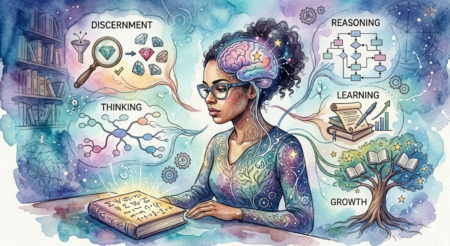
In this next image, very young people may look at it in wonder, never having seen anything like it.
Personally, I could never really get into this.
And yet, this is how lots of people learned.
The thing is, there’s still nothing about God.
It’s all about what can we do with our minds. What can we get into them.
Think – getting a job. Making money.
Getting promoted. Making more money.
And so – we still haven’t touched what Jesus meant by – with all your mind – even if we thought we put all of ourselves into what we were learning/doing.
Very old school image, using an ancient scroll
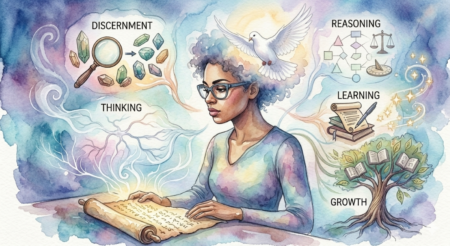
Now we’re getting close.
No – it’s not because the woman’s now using a scroll.
It’s not because computers and even books are somehow evil.
It’s because of the white dove hovering by the woman’s head. The traditional symbol for the Holy Spirit.
You may think, but it’s the same woman, it’s still her heart, her soul, her strength, and her heart.
But when we work with God – He can allow us to do things we could never do without Him.
But there’s more. Remember – I said that I thought I gave everything I had while I was working with computers. And I did – at least as much as I could give then.
But now, working with God, doing the things He has for me to do / doing His work – there’s another factor. Jesus spoke of it in The Vine and The Branches.
The Vine and the Branches – John
Jn 15:1 “I am the true vine, and my Father is the gardener. 2 He cuts off every branch in me that bears no fruit, while every branch that does bear fruit he prunes so that it will be even more fruitful. 3 You are already clean because of the word I have spoken to you. 4 Remain in me, and I will remain in you. No branch can bear fruit by itself; it must remain in the vine. Neither can you bear fruit unless you remain in me.
Jn 15:5 “I am the vine; you are the branches. If a man remains in me and I in him, he will bear much fruit; apart from me you can do nothing. 6 If anyone does not remain in me, he is like a branch that is thrown away and withers; such branches are picked up, thrown into the fire and burned. 7 If you remain in me and my words remain in you, ask whatever you wish, and it will be given you. 8 This is to my Father’s glory, that you bear much fruit, showing yourselves to be my disciples.
Jn 15:9 “As the Father has loved me, so have I loved you. Now remain in my love. 10 If you obey my commands, you will remain in my love, just as I have obeyed my Father’s commands and remain in his love. 11 I have told you this so that my joy may be in you and that your joy may be complete. 12 My command is this: Love each other as I have loved you. 13 Greater love has no one than this, that he lay down his life for his friends. 14 You are my friends if you do what I command. 15 I no longer call you servants, because a servant does not know his master’s business. Instead, I have called you friends, for everything that I learned from my Father I have made known to you. 16 You did not choose me, but I chose you and appointed you to go and bear fruit—fruit that will last. Then the Father will give you whatever you ask in my name. 17 This is my command: Love each other.”
Put all that together – God’s love, our love for Him, doing His work for His glory, having His Holy Spirit to aid us and give us strength – and the joy that comes from all of that – you’ll find we can do far more this way.
Regardless of how great we think AI may be – or may become – it will never approach God. AI cannot love. AI does not have true intelligence. AI doesn’t have the breath of life from God. And AI doesn’t have the Holy Spirit.
AI has none of those things that allow us to love God with all our heart, soul, strength, or mind. Those abilities are gifts from God – and God alone.
And when Jesus added “mind” – He didn’t really add anything new. He only made it clear for people alive during the time He walked this earth, as opposed to a different understanding from the earlier Old Testament times when the heart was believed to encompass it’s own functions, as well as those the Greeks attributed to the mind.
So, for today, while we may think AI will help us have a better/more complete/more successful life – that it will allow us to apply more of ourselves to any task – sorry, but it’s no replacement for God. AI is a tool – and can be a good one, if we use it properly. But the things that truly matter – they’re still from God.
Discover more from God versus religion
Subscribe to get the latest posts sent to your email.