
Shema
-
📖 Shema Yisrael (שְׁמַע יִשְׂרָאֵל) (“Hear, O Israel”) are the first two words of a section of the Torah that is the centerpiece of the morning and evening prayer services, encapsulating the monotheistic essence of Judaism:
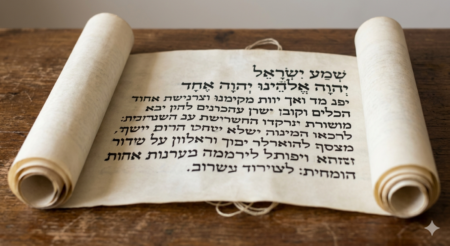
Hebrew scroll “Hear, O Israel: the L-rd is our G‑d, the L-rd is one.”
In its entirety, the Shema consists of three paragraphs: Deuteronomy 6:4–9, Deuteronomy 11:13–21 and Numbers 15:37–41.
Its recitation twice daily (morning and evening) is a biblical commandment. In addition, we recite it just before retiring for the night, as well as in the Kedushah service on Shabbat.
Indeed, this succinct statement has become so central to the Jewish people that it is the climax of the final Ne’ilah prayer of Yom Kippur, and is traditionally a Jew’s last words on earth. 1Shema – The Daily Declaration of Faith
- Orthodox Judaism: Recites the full Shema twice daily (morning Shacharit and evening Ma’ariv), as commanded in Deut. 6:7 (“when you lie down and when you rise up”).
- Conservative Judaism: Also recites the Shema daily in structured prayer services.
- Reform Judaism: Often includes the Shema in daily or weekly worship, though practice varies more widely.
- Cultural or secular Jews: Many still know and use the opening line as a personal affirmation, even if not part of formal prayer.
- At bedtime (a shorter “Bedtime Shema”)
- In moments of danger or death
- At Yom Kippur services
- When teaching children (it’s often the first prayer learned)
- A declaration of God’s unity
- A reminder of covenant identity
- A daily act of love and loyalty
- A link across generations — parents teach it to children, just as Deut. 6 instructs
- The opening line — “Hear, O Israel: the LORD our God, the LORD is one.” — is the core declaration of Jewish faith.
- Traditionally, the Shema includes three biblical passages:
- Deuteronomy 6:4–9 — love God with heart, soul, strength
- Deuteronomy 11:13–21 — covenant faithfulness and consequences
- Numbers 15:37–41 — the command to wear tzitzit as a reminder of God’s commandments
- 1
The definition above is from chabad.org.
However, since actual practice, for any religion, doesn’t always match prescribed practices, I also include a summary from various sources indicating other approaches that take place.
🤖◎ Other practices of Shema
📅 Daily practice today
Across Jewish communities:
It is also recited:
🌟 Why it endures
The Shema functions as:
It’s one of the few prayers that has been recited continuously for over 2,000 years, unchanged in its central role.
Passages in the Shema
The Shema (Deut. 6:4–9, with additional passages) remains one of the central, twice‑daily prayers in Jewish life and practice, recited morning and evening by observant Jews around the world.
What the Shema is
The three passages in the Shema
Love the LORD Your God – Deuteronomy
…
Dt 6:4 Hear, O Israel: The LORD our God, the LORD is one. 5 Love the LORD your God with all your heart and with all your soul and with all your strength. 6 These commandments that I give you today are to be upon your hearts. 7 Impress them on your children. Talk about them when you sit at home and when you walk along the road, when you lie down and when you get up. 8 Tie them as symbols on your hands and bind them on your foreheads. 9 Write them on the doorframes of your houses and on your gates.
…
Love and Obey the LORD – Deuteronomy
Dt 11:13 So if you faithfully obey the commands I am giving you today—to love the LORD your God and to serve him with all your heart and with all your soul— 14 then I will send rain on your land in its season, both autumn and spring rains, so that you may gather in your grain, new wine and oil. 15 I will provide grass in the fields for your cattle, and you will eat and be satisfied.
Dt 11:16 Be careful, or you will be enticed to turn away and worship other gods and bow down to them. 17 Then the LORD’S anger will burn against you, and he will shut the heavens so that it will not rain and the ground will yield no produce, and you will soon perish from the good land the LORD is giving you. 18 Fix these words of mine in your hearts and minds; tie them as symbols on your hands and bind them on your foreheads. 19 Teach them to your children, talking about them when you sit at home and when you walk along the road, when you lie down and when you get up. 20 Write them on the doorframes of your houses and on your gates, 21 so that your days and the days of your children may be many in the land that the LORD swore to give your forefathers, as many as the days that the heavens are above the earth.
Tassels on Garments – Numbers
Nu 15:37 The LORD said to Moses, 38 “Speak to the Israelites and say to them: ‘Throughout the generations to come you are to make tassels on the corners of your garments, with a blue cord on each tassel. 39 You will have these tassels to look at and so you will remember all the commands of the LORD, that you may obey them and not prostitute yourselves by going after the lusts of your own hearts and eyes. 40 Then you will remember to obey all my commands and will be consecrated to your God. 41 I am the LORD your God, who brought you out of Egypt to be your God. I am the LORD your God.’ ”
Footnotes:
Discover more from God versus religion
Subscribe to get the latest posts sent to your email.