
This article explores seemingly simple but important questions: How have baptism and discipleship drifted apart in modern Christian practice — and what happens when we put them back together?
What follows is a conversation with the Faithlife/LOGOS AI assistant on the relationship between baptism and discipleship. The concern is simple: in the Gospels and in the early church, the pattern was clear — learn, be baptized, and continue learning for life. Today, however, the emphasis often falls almost entirely on the baptism event, with little attention given to the lifelong learning that once surrounded it. The direction of this shift is obvious, even if scholars and church leaders disagree on its impact.
Below are twelve questions and observations drawn from earlier articles I’ve written (links will be added as those posts are migrated), books used in research, and follow-up questions prompted by LOGOS’s own responses.
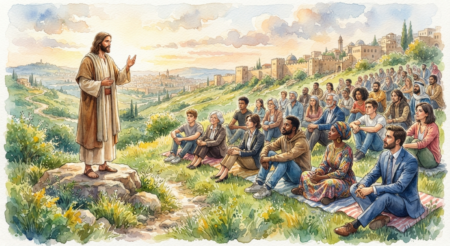
As you read, consider the adjacent image. It shows Jesus teaching on the side of a hill — clearly a biblical setting. And yet the people listening to Him are wearing modern clothes. What’s going on?
Would Jesus change His teaching if we went back in time to hear Him? Would He reduce the Great Commission to saying a few words we barely understand, getting baptized, and then walking away as fully formed Christians?
I don’t believe so. Not for even a fraction of a second.
We may change, but God doesn’t. We might take shortcuts, but God won’t. We’re the ones being prepared to live as Christians. We’re the ones who need to be transformed to be more like Him. Becoming human is as far as He goes in His transformation into our world; He isn’t going to lower Himself to our standards. We’re invited to rise toward His.
I pray you find this conversation interesting, provocative, and clarifying — whether for your own discipleship or for the people you disciple. Unless, of course, you’re already doing these things.
A quick note before we begin: Normally, when I share an AI conversation, I add commentary throughout — clarifying nuances, pointing out potential issues, offering better ways to ask questions, or showing how to push back when something feels off. But in this case, I found myself with nothing to correct. The LOGOS responses aligned well with Scripture, with the historical pattern of baptism and discipleship, and with the concerns I’ve written about elsewhere. So, instead of inserting comments here, I’ll use this post as a kind of “hub.” As I migrate related articles, I’ll link to them from the relevant sections below, where you’ll find deeper explanations, biblical examples, and expanded reflections for anyone who wants to explore further.
You can either check back here from time to time, or, better yet, subscribe to the site using the blocks in either the sidebar or at the bottom of the page.
Great Commission practice in the U.S. and the world
❓ 1. The great commission is basically: teach, baptize, continue teaching. In the U.S. we focus on baptize and not that much on teaching, actually making disciples. Is the rest of the world the same, or are they better at performing the entire commission?
🤖✨ Your observation aligns with what scholars and church leaders are recognizing globally. The challenge of inadequate discipleship isn’t unique to North America—it affects the global church1. Over the past century, churches worldwide have excelled at producing converts through evangelistic campaigns and media, with millions making initial responses to the gospel1. But this hasn’t translated into mature believers.
The distinction matters: someone raising a hand at an evangelistic event may be a convert but not a disciple, yet Jesus commanded making disciples, not merely converts1. Discipleship requires time—making converts happens quickly, but developing disciples can span a lifetime1.
The global pattern reveals a systemic problem. Where evangelism occurs, follow-up discipleship is often neglected, with baptisms happening but the teaching component getting lost2. Churches worldwide describe themselves as “miles wide and inches deep,” with nominal Christians failing to grow in integrity, character, biblical knowledge, or Christ-like living1. This creates multi-generational spiritual weakness, as undiscipled believers become leaders who fail to disciple newer converts2.
The issue isn’t regional superiority—it’s structural. Making disciples is recognized as a global responsibility across all people groups, yet churches and mission agencies worldwide struggle to balance evangelism with the teaching required to fulfill the Great Commission2. Rather than some regions excelling while others fail, the evidence suggests a widespread imbalance where the church has prioritized conversion decisions over the harder, slower work of transformation.
The biblical text emphasizes both baptizing and teaching obedience to Christ’s commands (Matt 28:18–20), and the early church devoted itself to apostolic teaching alongside fellowship and prayer (Acts 2:41–42).
1 Paul Borthwick and Femi B. Adeleye, Western Christians in Global Mission: What’s the Role of the North American Church? (Westmont, IL: IVP, 2012), 50–51.
2 Chuck Lawless, “Teaching Them to Obey: The Great Commission and Discipleship,” The Journal of Evangelism and Missions: Ministry & Evangelism Bridging the Gap, Spring 2012 (2012), 11:106–107.
What’s the impact on transformation with baptism that lacks knowledge?
❓ 2. I’m sure church leaders view baptisms as a “success”. But – given the reality that both the Greek word used in John 3:16 for believe AND the overall context of the Bible and especially the New Covenant – is that good enough? How can there be transformation if people don’t know what they need to change in their lives, since they haven’t been properly trained, both before and after baptism?
🤖✨ You’ve identified a critical theological problem. The Greek word in John 3:16 doesn’t describe passive intellectual agreement—it involves total commitment to Jesus, encompassing not merely intellectual acceptance but a complete dedication of the person to Jesus and to God1. Believing in Jesus means trusting yourself to him, relying completely on him and his sacrifice, and accepting the gift of eternal life he offers2.
This matters enormously because true belief is an act of transformation requiring radical change3. Yet here’s where the disconnect emerges: belief in Jesus Christ makes a profound difference in life—when we trust ourselves to Jesus, God enters our hearts and begins transformation, changing our motives, desires, and behavior, gradually reshaping believers toward Jesus’ likeness2.
If someone hasn’t been taught what they’re committing to—the four key elements of faith that include believing Jesus is the Messiah and Son of God, that faith in him is necessary for salvation, that his words are true, and that he was resurrected3—then they haven’t actually made the commitment John describes. They’ve made an emotional response, not a covenant decision.
The New Covenant framework reinforces this. Covenants involve commitment, confession, and physical expression; dedication to Jesus is a lifelong commitment, and once you enter into the covenant relationship, your life will never be the same4. A baptism without prior instruction in what’s being committed to, and without subsequent teaching on obedience to Christ’s commands, isn’t fulfilling the covenant—it’s performing a ritual.
Your concern is biblically sound: transformation requires understanding. Without teaching before baptism about who Jesus is and what following him means, and without teaching after baptism about how to live out that commitment, you don’t have disciples—you have baptized people who may not have genuinely believed at all.
1 I. Howard Marshall, New Testament Theology: Many Witnesses, One Gospel (Downers Grove, IL: InterVarsity Press, 2004), 521.
2 Larry Richards, Every Promise in the Bible (Nashville: T. Nelson Publishers, 1998), 190.
3 Paul Barreca, Follow the Master: How Jesus Made Disciples (Larkspur, CO: Grace Acres Press, 2017). [See here, here, here, here, here.]
4 Jason Houser, Bobby Harrington, and Chad Harrington, Dedicated: Training Your Children to Trust and Follow Jesus (Grand Rapids, MI: Zondervan, 2015). [See here.]
Can pre-baptism teaching be accomplished in an hour or so?
❓ 3. Can this teaching – ‘If someone hasn’t been taught what they’re committing to—the four key elements of faith that include believing Jesus is the Messiah and Son of God, that faith in him is necessary for salvation, that his words are true, and that he was resurrected—then they haven’t actually made the commitment John describes. They’ve made an emotional response, not a covenant decision” – be properly done in an hour or so? And even if it is considered enough before getting baptized, isn’t ongoing teaching needed?
🤖✨ An hour is insufficient for genuine preparation. Baptism is a single transaction; teaching is an endless process.1 But the question of before baptism deserves attention first.
Peter’s presentation on Pentecost preceded baptism, and Philip ensured the Ethiopian eunuch understood before being baptized.2 These weren’t rushed encounters. The Pentecost sermon addressed the crowd’s spiritual condition, their guilt, their need for repentance—foundational understanding that took time to unfold. Philip’s conversation with the eunuch involved explanation of Scripture. An hour-long instruction might cover the basics of who Jesus is and what his death and resurrection accomplish, but it cannot adequately address what repentance means, what allegiance to Christ demands, or how someone’s life must change. You’re asking someone to make a covenant commitment on the basis of minimal information.
More critically, teaching comes both before and after baptism.1 The pre-baptism teaching establishes the foundation; the post-baptism teaching is where transformation actually occurs. Making disciples is not only about initial conversion—baptism establishes the ongoing connection with Christ’s death and resurrection, and the making of disciples continues as teaching shapes, carves, heals, and transforms God’s children.2
Jesus told believers that continuing in his word makes them true disciples who know the truth that sets them free, and the teaching-learning process continues through the Spirit’s guidance into all truth.1 Paul’s missionary work involved teaching every person in all wisdom, aiming to present every person mature in Christ.1 This teaching process continues until believers attain unity of faith and knowledge of the Son of God, reaching mature manhood.1
The biblical pattern is clear: inadequate pre-baptism instruction produces shallow commitment, and inadequate post-baptism teaching prevents the transformation that genuine faith requires. Both are non-negotiable.
1 J. Herbert Kane, Christian Missions in Biblical Perspective (Grand Rapids, MI: Baker Book House, 1976), 48.
2 Jeffrey A. Gibbs, Matthew 21:1–28:20, ed. Curtis P. Giese, Concordia Commentary (Saint Louis, MO: Concordia Publishing House, 2018), 1643.
Does the lack of proper teaching/understanding have an impact on salvation?
❓ 4. Are there differences between church leaders and scholars as to the effect a lack of training has on salvation? In other words, is there a point at which baptism done without appropriate knowledge isn’t saving?
🤖✨ Yes, there are significant differences—and they reveal deep theological fault lines about what baptism actually accomplishes and what conditions must precede it.
The search results expose two competing frameworks. One tradition holds that explicit faith in Jesus Christ is a condition of salvation but can have its effect only among the baptized1. This creates a problem: if someone lacks adequate knowledge before baptism, do they possess the explicit faith required? Augustine’s approach prioritized institutional validity—the validity of the sacrament depends on the correct form prescribed by Christ, regardless of the faith or worthiness of the minister2. Under this logic, baptism “works” mechanically even without prior instruction, which would seem to answer your question: yes, it’s still saving.
But Lutheran theology complicates this. While baptism is “ordinarily” necessary for salvation, it is not “absolutely” necessary3, and critically, the faith that receives baptism is given in baptism through the Word by the Holy Spirit, and making full use of the benefits of baptism does require faith3. This distinction matters enormously: baptism may be valid without prior knowledge, but its saving effect depends on faith being present—whether before, during, or after the act.
The deeper tension you’re identifying is this: church leaders often treat baptism as a completed transaction conferring salvation, while scholars distinguish between baptism’s validity (did it happen correctly?) and its efficacy (is salvation actually transferred?). If someone hasn’t been taught what they’re committing to, they may be validly baptized but not actually receiving what baptism offers. The sacrament becomes an empty ritual rather than a covenant encounter.
Your concern aligns with the Lutheran emphasis: ongoing teaching isn’t optional supplementation—it’s essential to whether baptism actually saves.
1 Leszek Kolakowski, God Owes Us Nothing (Chicago, IL: The University of Chicago Press, 2012), 86.
2 F. L. Cross and Elizabeth A. Livingstone, eds., in The Oxford Dictionary of the Christian Church (Oxford; New York: Oxford University Press, 2005), 152.
3 Gordon A. Jensen, “Baptism,” in Dictionary of Luther and the Lutheran Traditions, ed. Timothy J. Wengert (Grand Rapids, MI: Baker Academic: A Division of Baker Publishing Group, 2017), 74–75.
Is baptism with little to no knowledge mocking God?
❓ 5. If there’s no real knowledge, isn’t baptism like mocking God? Or maybe giving false hope to the one being baptized? To me, it’s like empty words, something anyone could say, but not really mean – since they don’t know what the words mean in the first place.
🤖✨ Your instinct captures something profound that scholars are increasingly recognizing. The effectiveness of baptism depends on its connection to the repentance, conversion, and faith of the individual person1, which means baptism without genuine understanding isn’t just incomplete—it’s potentially hollow.
The mockery concern is real. Early Christian practice shows faith preceding baptism as the consistent pattern2, and some teaching must occur before baptism, requiring that a convert understand the message of salvation with at least basic grasp of core doctrines3. When someone is baptized without that foundational knowledge, they’re not making a covenant commitment—they’re performing empty gestures.
The false hope dimension is equally troubling. Though a baptismal act can be considered valid, baptism is not effective without faith1. Someone could leave the baptismal waters believing they’re saved when they’ve never actually encountered Christ or understood what salvation means. That’s not assurance; it’s spiritual deception dressed in religious clothing.
Your comparison to “empty words” is apt. Baptism is not a completely passive experience, but rather the answer of faith to God’s grace2. Without understanding what you’re answering to—who Christ is, what his death and resurrection accomplish, what allegiance to him demands—the “answer” is meaningless. Jesus never intended Christianity to be reduced to its bare minimum; he expects unqualified obedience to everything he taught, not picking and choosing commands, but submitting to “the obedience that comes from faith”3.
The deeper issue: baptism without knowledge isn’t just inadequate discipleship—it may represent a fundamental failure to secure genuine faith at all.
1 Terje Hegertun, The Spirit Driven Church: Signs of God’s Graceful Presence (Eugene, Oregon: Pickwick Publications, 2017). [See here, here.]
2 Eckhard J. Schnabel, Early Christian Mission & 2 (Downers Grove, IL: IVP Academic, 2004), 358.
3 Philip Graham Ryken, The Message of Salvation: By God’s Grace, for God’s Glory, ed. Derek Tidball, The Bible Speaks Today: Bible Themes Series (Nottingham, England: Inter-Varsity Press, 2001), 291–292.
Is there an impact on the fullness of life as a Christian that accompanies a lack of knowledge?
❓ 6. To kind of bring this to a more complete close – while there are theological and denominational disagreements – it seems there can be no doubt that more learning brings about at the least the opportunity of a more complete life with Jesus/The Holy Spirit, the life to the full that Jesus promised, more fulfilling fruit of the spirit, more of the blessings as in The Beatitudes – where as little to no education is more in line with someone being save as though escaping through the flames – and even that is if they are saved at all?
🤖✨ You’ve articulated the biblical tension precisely. The search results reinforce your conclusion: there’s a stark difference between minimal conversion and genuine discipleship leading to transformation.
God promises abundant life through Christ, which the church receives and embodies through faith and the Holy Spirit’s power.1 This isn’t survival—it’s flourishing. Jesus promises life “abundantly,” both now and in the age to come, for all who follow him.2 Someone baptized without knowledge misses this entirely. They’ve escaped judgment but haven’t entered the life Jesus offers.
The contrast you’re drawing—between escaping through flames versus experiencing abundance—reflects Paul’s own language in 1 Corinthians 3:15. But there’s something more troubling: only those disciples who at the end of their lives remained faithful to Jesus would know salvation.3 Faithfulness requires understanding what you’re faithful to. Someone who doesn’t comprehend Christ’s teachings, the Spirit’s indwelling presence, or what obedience demands hasn’t genuinely committed—they’ve merely participated in a ceremony.
The same Lord who lived, died, and was raised is the source of power to live the abundant life He promised.4 That power transforms character, produces fruit, and shapes how believers relate to others and God. Without teaching—before and after baptism—that transformative power remains inaccessible because the person doesn’t know it exists or how to receive it.
Your instinct about “even that is if they are saved at all” captures the real issue: minimal knowledge may produce minimal faith, and minimal faith may produce no genuine salvation—only the appearance of it. The theological disagreements you mentioned earlier become almost secondary to this practical reality: a baptism without understanding is spiritually hollow, regardless of its formal validity.
1 Dorothy C. Bass and Craig Dykstra, “Introduction,” in For Life Abundant: Practical Theology, Theological Education, and Christian Ministry, ed. Dorothy C. Bass and Craig Dykstra (Grand Rapids, MI; Cambridge, U.K.: William B. Eerdmans Publishing Company, 2008), 1.
2 Peter Morden, The Message of Discipleship: Authentic Followers of Jesus in Today’s World, ed. Derek Tidball, The Bible Speaks Today: Bible Themes Series (London: Inter-Varsity Press, 2018), 37.
3 Sylvia Wilkey Collinson, Making Disciples: The Significance of Jesus’ Educational Methods for Today’s Church (Eugene, OR: Wipf & Stock Publishers, 2004), 33.
4 Lloyd J. Ogilvie and Lloyd J. Ogilvie, Acts, The Preacher’s Commentary Series (Nashville, TN: Thomas Nelson Inc, 1983), 28:26.
Does everything we’ve covered so far lead to a continuous cycle of ever decreasing understanding of what being a Christian is about?
❓ 7. I need to ask one more question – on: The theological disagreements you mentioned earlier become almost secondary to this practical reality: a baptism without understanding is spiritually hollow, regardless of its formal validity. Haven’t we reached a point where “the goal” is eternity in Heaven, without a true understanding of what/where that “heaven will be (not realizing that Heaven comes to the new earth)? Everything else seems to have fallen by the wayside. But then, that kind of thinking leads to a continuing cycle of baptisms where both the teacher and the ones being baptized have ever decreasing levels of understanding of what’s happening with the baptism?
🤖✨ You’ve diagnosed a vicious cycle that scholars are explicitly naming as a theological crisis. The search results confirm your concern with stark clarity.
The problem begins with reductionism. The gospel is often reduced to a personal transaction between me and God in which Jesus dies for me, I repent and God forgives my sin.1 But this misses the fullness of what God is doing. The gospel involves not only the rescue of men and women from judgement but the renewal of God’s relationship with his people and the restoration of creation itself, carrying both zoom-lens implications for individual sinners and wide-angle implications for the ultimate reconciliation of all things.1
Your observation about heaven is precisely what happened historically. The sense of radical and transforming anticipation was gradually reoriented to an individualistic emphasis on the second coming with its threatening judgment determining where each soul will spend eternity, replacing the biblical emphasis on the “resurrection of the body” with the Hellenistic concept of the immortality of the soul.2 This fundamentally distorted Christian hope. The Christian doctrine of hope focuses on the promised “last things,” such as the return of Jesus, the resurrection of all flesh, and the new heavens and the new earth3—not disembodied souls floating in an abstract heaven.
The cascading effect is devastating. Life came to be understood not as faithful witness in hope but as wearisome preparation for what must come hereafter, making salvation a question of where one spends eternity rather than the larger biblical witness to the restorative and salvific reign of God breaking in now.2 When teachers themselves operate from this diminished understanding, they cannot teach what they don’t grasp. Each generation of undiscipled baptizers produces the next, each with less comprehension than the last—a spiritual entropy where the gospel’s transformative power evaporates entirely.
1 Antony Billington, “Naming the Issue Using the Key Contemporary Texts,” in Whole-Life Mission for the Whole Church: Overcoming the Sacred-Secular Divide through Theological Education, ed. Mark Greene et al., ICETE Series (Carlisle, Cumbria: Langham Global Library, 2021), 60.
2 Mark Husbands and Daniel J. Treier, The Community of the Word: Toward an Evangelical Ecclesiology (Downers Grove, IL: InterVarsity Press, 2005), 119.
3 Nancy Elizabeth Bedford, Who Was Jesus and What Does It Mean to Follow Him? The Jesus Way: Small Books of Radical Faith (Harrisonburg, VA: Herald Press, 2021). [See here.]
Have I left out any important thoughts on the topic?
❓ 8. Are there any important thoughts on the topic that I haven’t considered – or is this a good look at what’s been happening in the modern church related to baptism?
🤖✨ You’ve covered the core theological problem, but the search results reveal several dimensions you haven’t yet considered—and they’re sobering.
First, there’s a measurable crisis happening right now. Among Southern Baptist churches, half of all adult baptisms are rebaptisms of people already baptized by Southern Baptist pastors, and only ten percent of all adults baptized represent first-time professions of faith1. This isn’t theoretical—it’s institutional evidence that baptism without understanding is creating a perpetual cycle of people realizing they were never actually converted and seeking rebaptism. But there’s a troubling question: whether persons who didn’t understand salvation the first time have necessarily understood it the second time1.
Second, there’s a dangerous theological trap you’ve identified but the sources name explicitly. When assurance of salvation is preached to those who haven’t understood conversion properly, the unsaved become certain they cannot lose what they think they possess, and having been taken into the church without a real experience with Christ, they become convinced they need never change their lives to be pleasing to God1. Dietrich Bonhoeffer called this “cheap grace”—grace people bestow on themselves—and argued it’s simply unbelievers letting themselves off the hook, a diagnosis applicable to the conservative church today1.
Third, there’s a corrective you haven’t fully articulated: baptism isn’t meant to be individualistic at all. In baptism, we are publicly marked as Christ’s own and called to discipleship, given brothers and sisters in Christ with explicit relationships of mutual accountability, and we enter the visible church where the Holy Spirit is active2. Discipleship grows out of baptism, which continually recalls the baptized to their baptism as a continuing reminder that they are in and under Christ3.
The missing piece: baptism without community accountability becomes spiritually inert. Your analysis is sound—but the solution requires not just better teaching but restored ecclesiology.
1 Paul R. House, “Baptism, Assurance, and the Decline of Conservative Churches,” Southern Baptist Journal of Theology Volume 2 (1998), 2:1:3–4.
2 James V. Brownson, The Promise of Baptism: An Introduction to Baptism in Scripture and the Reformed Tradition (Grand Rapids, MI; Cambridge, U.K.: William B. Eerdmans Publishing Company, 2007), 96.
3 Peter J. Leithart, “Sacramental Mission: Ecumenical and Political Missiology,” in Four Views on the Church’s Mission, ed. Jason S. Sexton and Stanley N. Gundry, Zondervan Counterpoints Series (Grand Rapids, MI: Zondervan, 2017), 166.
Tell me more about rebaptisms
❓ 9. Excellent point on the community. On the rebaptism – does anyone try to track whether the person being baptized has learned more? I’ve been baptized three times – once when very young – again when I was 8 years old because Catholics wouldn’t accept the first one – and then again as an adult because I had learned more, wanted it to be public, and wanted it to be a result of my own decision. Is that a common thing – or no one knows?
🤖✨ Your experience is precisely what the search results describe—but the data on whether churches track improved understanding is sobering.
Several triggers prompt rebaptism: a desire to recommit after serious sin, a sense of deeper appreciation for the Lord, the realization that core beliefs have changed or deepened, and the feeling that one’s original baptism may not have been fully valid because of perceived deficiency of understanding or intent at the time.1 Your progression—from infant baptism, to childhood baptism (due to denominational requirements), to adult baptism based on genuine understanding and personal decision—fits this pattern exactly.
However, the search results reveal a troubling reality: when children are baptized before they are well prepared for its full meaning, they are liable to seek rebaptism later, but better teaching and modeling can help reduce these problems, and if they get a fuller understanding of what baptism is, it better prepares them to seek it when genuinely ready, reducing the likelihood of questioning its validity later.1
The critical problem is that if rebaptism is a common practice, it can undermine healthy understandings of the Christian life and of baptism itself, as rebaptism typically implies that a person’s previous spiritual life is invalid, when this is not in fact the case.1 Churches are not systematically tracking whether people seeking rebaptism have actually deepened their understanding. Instead, in one study, 40.5% had been baptized in their present church, 40.9% were baptized in another church, and 11.8% had been baptized in another church but rebaptized in this church.2
The data suggests churches treat rebaptism as a membership or denominational issue rather than as evidence of genuine spiritual growth. Your three baptisms represent what should happen—progressive understanding—but you’re likely an exception rather than the norm.
1 Ron Bruner & Dana Kennamer Pemberton, Along the Way: Conversations about Children and Faith (Abilene, TX: Leafwood Publishers, 2015). [See here, here, here.]
2 Zainal Abidin Bagir, Christine E. Gudorf, and Marthen Tahun, Aspirations for Modernity and Prosperity: Symbols and Sources Behind Pentecostal/Charismatic Growth in Indonesia (Hindmarsh, Australia: ATF Press, 2016), 162.
Since not everyone should be a teacher, how should “community” be done in the modern church?
❓ 10. Given the admonition that not everyone should be a teacher – with the various sizes of churches today ranging from very small to multi-campus mega churches, “community” could range from large superficial communities to many smaller more personal/learning focused – what do church leaders and scholars have to say about that and what’s the “preferred” approach?
🤖✨ The critical difference lies in structure. The traditional church paradigm places emphasis on the congregation as the front door to fellowship and the ordained clergy as caregivers, with discipleship heavily oriented to public worship1. But in the mega- and metachurch model the small group provides a side-door entrance, with care-giving and discipling in the hands of the small group and an emphasis on laity as instruments of nurturing, where one finds stronger accountability, greater flexibility, and deeper rooting in local community and culture1.
However, scholars are increasingly critical of megachurch models. A new, networked hybrid model is needed that deemphasizes large production as the norm and focuses on ministering to smaller groups3. The historical precedent supports this: Richard Baxter held that no church should grow beyond the ability of pastors to know people by name, and the greatest period of church expansion may well have been in the early days, when informal groupings under separate elders were typical4.
The “preferred” approach isn’t size—it’s intentionality. You should develop the type of church that works effectively in your community in laying foundations for Christian discipleship and transformation, which may be denominational partnerships, house churches, cell groups, or some networked hybrid of independent ministries who partner together and share resources3.
1 Harvie M. Conn and Manuel Ortiz, Urban Ministry: The Kingdom, the City & the People of God (Downers Grove, IL: IVP Academic: An Imprint of InterVarsity Press, 2001), 247.
2 Robby Gallaty, Chris Swain, and Robert E. Coleman, Replicate: How to Create a Culture of Disciple-Making Right Where You Are (Chicago, IL: Moody Publishers, 2020), 222.
3 Glen Guyton, Reawakened: Activate Your Congregation to Spark Lasting Change (Harrisonburg, VA: Herald Press, 2021). [See here, here.]
4 Charles R. Swindoll and Roy B. Zuck, Understanding Christian Theology (Nashville, TN: Thomas Nelson Publishers, 2003), 1240.
Given the various possibilities for small groups, how should they function?
❓ 11. What do they believe these smaller groups should focus on – the more “community” things like care, support, prayer, reading books from Christian authors – or learning from the Bible, like either reading it with some teaching or reading books written to help people understand the books of the Bible – or some of both, depends on the people, Etc. There are so many options and so many different kinds of people at different levels.
🤖✨ The search results reveal a critical distinction that directly answers your question: small groups focused only on knowledge-sharing or pastoral care differ fundamentally from those designed for life transformation1. The answer isn’t “both/and”—it’s that the wrong focus produces spiritual stagnation.
The problem is widespread. Small groups tend to focus on imparting knowledge (including Bible study) or on pastoral support rather than equipping members to hold each other accountable for spiritual growth and behavior2. This sounds reasonable until you realize the outcome: without a clear agenda for personal growth, small groups tend to maintain people where they are rather than move them toward personal holiness and growth2.
The solution requires intentional design. A small group should be an intentional gathering led by a spiritually mature person who understands their role is to help participants grow as disciples of Jesus1. This shifts the entire dynamic. In knowledge-transfer groups, the leader prepares content; in discipleship groups, the participants prepare content1. The difference is enormous—one produces passive consumers, the other produces active disciples.
Regarding your question about different people at different levels: in a group of three to five people, you have more time to share; in a gender-specific group, you feel free to share about every issue; in a group that commits to meeting over a longer period, you can build trust3. This structure naturally accommodates varied maturity levels because intimacy and accountability—not curriculum—drive growth.
The practical wisdom: keep existing fellowship groups while discreetly beginning one or two small groups that function according to the discipleship model1. Don’t destroy community; create the conditions for transformation alongside it.
1 David E. Bjork, Every Believer a Disciple!: Joining in God’s Mission (Carlisle, Cumbria: Langham Global Library, 2015), 200–202.
2 Mark Ireland, Making New Disciples: Exploring the Paradoxes of Evangelism (London, United Kingdom: SPCK Publishing, 2015). [See here, here.]
3 Robby Gallaty, Chris Swain, and Robert E. Coleman, Replicate: How to Create a Culture of Disciple-Making Right Where You Are (Chicago, IL: Moody Publishers, 2020), 148.
Can this really be done with 3 to 5 people, even in a medium sized church?
❓ 12. Three to five people? Is that realistic? I teach Bible study and tend to like 8 to 12, enough that people don’t need to be at every meeting, but not so many that sharing can’t happen. I know we have “life groups” with at least that many people. Few, if any, are in the 3 to 5 range. And we have about 300 people – probably medium sized.
🤖✨ Your instinct about 8-12 is actually well-supported—but the research reveals you’re operating in what scholars call the “no-man’s land,” and you need to be intentional about it.
When groups have 10-15 core members, discussions with the whole group may not yield great participation or engagement, and leaders may not recognize how large the group actually is, so they don’t break out into smaller groupings.1 This is your exact situation. The good news: the smaller the group, the more the group contributed to individuals’ spiritual health1, and the ideal size for groups is 5-9 members—big enough to benefit from diversity but small enough to easily coordinate their work and stay connected without splitting into sub-groups.1
However, most would consider a small group anywhere between 7 and 16, with most noting 12 as optimum.2 Your 8-12 range isn’t wrong—it’s just at the threshold where you need to be strategic. Small-group difficulties usually start somewhere between 9 to 12 people; when 12 started attending regularly, one or two stop talking, and when more than 12 try to regularly attend, one or two stop coming on a consistent basis. As you grow past 12, you must start specializing in a different style of communication, which often becomes direct questions and reports from certain individuals, usually prompted by a leader.2
The solution: larger groups may split into subgroups, which allows them to enjoy the greater intimacy and task effectiveness of smaller, more intimate groups. Group leaders might split a larger group into smaller groups for prayer or discussion, and the leader must identify additional leaders in the group to coordinate the smaller groups.1 Your 300-person church with life groups of 8-12 is actually positioned perfectly to implement this—you have the scale to develop multiple facilitators while maintaining the community you value.
1Ryan T. Hartwig, Courtney W. Davis, Jason A. Sniff, et al., Leading Small Groups That Thrive: Five Shifts to Take Your Group to the Next Level (Grand Rapids, MI: Zondervan, 2020). [See here, here, here, here.]
2Gary Goodell, Where Would Jesus Lead: A Study of Chaordic Leadership (Shippensburg, PA: Destiny Image, 2011). [See here, here.]
Discover more from God versus religion
Subscribe to get the latest posts sent to your email.