
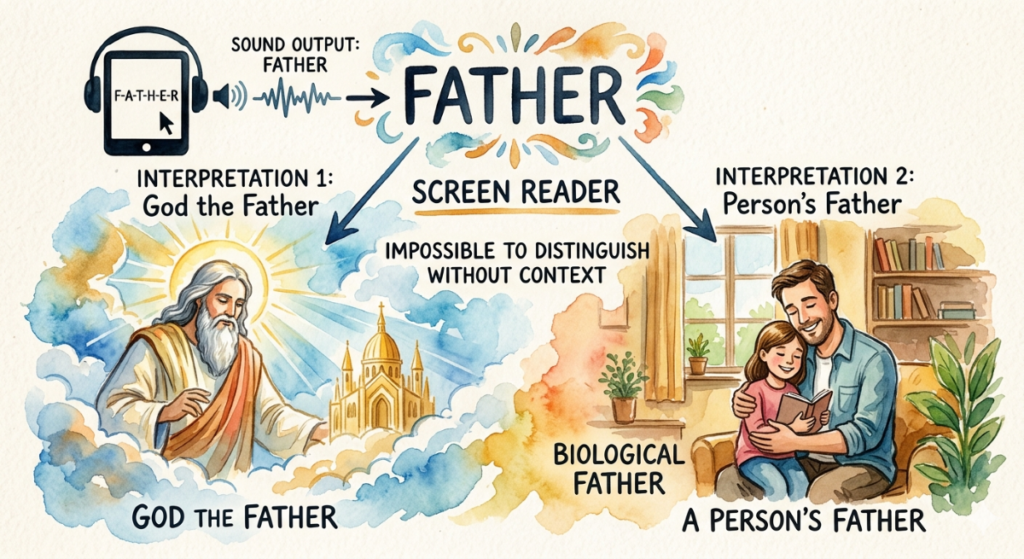
“Father” as in “God the Father”
“Father” as in God the Father. Or Father God. People who hear, but don’t/can’t see what you’re reading cannot necessarily tell the difference between God the Father and a child’s father unless there’s appropriate context – so you may need to tell them. Click for how accessibility tools handle this.
Here’s the fuller picture, in plain English and grounded in how assistive tech actually works:
❓ If text contains capital F “Father”, it’s difficult for someone hearing the letters f a t h e r to distinguish between whether it’s God the Father, or merely someone’s father – because of the capitalization. People don’t generally say capital F Father. Do screen readers or accessibility plugins mention that that there’s an unexpected, capitalized word like this, or just assume it’s a typo?
🤖◎
screen readers do not announce capitalization, and accessibility plugins generally don’t either. So when someone hears the word Father, they hear exactly the same sound as father. Nothing in the audio tells them it was capitalized.
How screen readers handle capitalized words
Screen readers (JAWS, NVDA, VoiceOver, TalkBack):
- Do not announce capital letters by default. They simply read the word as a normal spoken word.
- Do not distinguish “Father” from “father.” Both are spoken identically.
- Assume capitalization is a visual cue, not an auditory one.
There are optional settings like “announce capitals” or “beep on capital letters,” but:
- They are off by default
- Most users never enable them because it makes text sound robotic or overwhelming
- Even when enabled, it usually sounds like:
- a tiny click before the word, or
- “cap Father” (but only if the user explicitly turns that on)
So in real‑world usage, capital-F Father is indistinguishable from father.
How accessibility plugins handle it
Accessibility plugins (like the one affecting your Gutenberg editor):
- Focus on visual adjustments (contrast, font size, spacing, color, etc.)
- Do not reinterpret capitalization semantically
- Do not warn users about “unexpected capitalization”
- Do not provide audio cues for capital letters
They assume capitalization is a stylistic choice, not a meaning‑bearing one.
What this means for theological writing
You’re exactly right: When someone hears Father, they cannot tell whether it means:
- God the Father
- someone’s biological father
- a title (e.g., “Father Gregory”)
The distinction is purely visual, not audible.
This is why:
- Preachers often clarify verbally (“God the Father…”)
- Audio Bibles sometimes add slight emphasis or pacing
- Writers sometimes add context in parentheses or phrasing
The bottom line then:
If you’re reading to someone, please try to ensure clarity for them when the context isn’t obvious.
If you’re using a screen reader, it appears that even if you have an option to notify you of capital letters, it may not make things easier, but possibly harder for you.
If you’re a writer – it’s not easy because, sadly, we’re likely just not used to doing it, but it’s on us to be sure the clarity is there for people who are listening to this and not reading it themselves.
Discover more from God versus religion
Subscribe to get the latest posts sent to your email.