
Pantheon
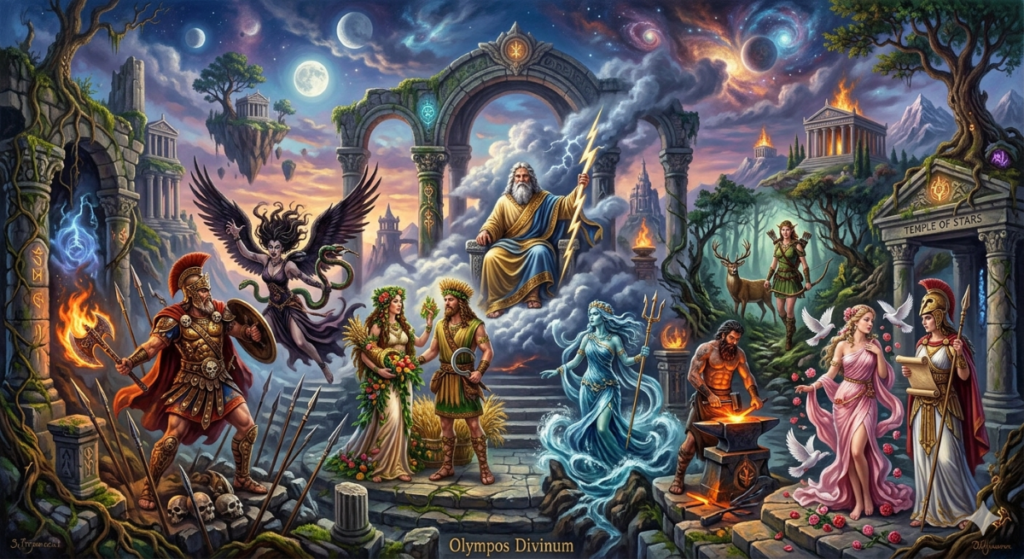
A pantheon is the collection of gods in a religion that has many deities. Each god has limited power and a specific role — like war, love, storms, or harvest — and they interact, compete, or cooperate with one another. A pantheon describes a divine world made up of many beings who are powerful but not ultimate.
This is different from the God of the Bible, who is not one god among others but the single Creator of everything, unlimited in power and not confined to any domain.
1. What “pantheon” means (beyond the one‑sentence dictionary line)
Dictionary.com gives the basic definition: “all the gods collectively of a religion” . That’s accurate, but incomplete for theological work.
A pantheon is best understood as:
A collection of multiple gods, each with limited domains, powers, personalities, and weaknesses, who together make up the divine world of a religion.
A pantheon is not just “many gods.” It is a system:
- gods with specialties (war, fertility, storms, love)
- gods with boundaries (they can’t do everything)
- gods who compete, conflict, or cooperate
- gods who are born, change, suffer, or die
- gods who are part of the universe, not the source of it
This is true whether you’re talking about Greek, Roman, Canaanite, Mesopotamian, Hindu (in some traditions), or Norse systems.
A pantheon is a divine ecosystem, not a single ultimate being.
2. How a pantheon differs from the God of the Bible
**A pantheon is many limited gods.
The God of the Bible is one unlimited God.**
Pantheon gods
- One among many
- Limited in power, knowledge, and presence
- Assigned domains (sea, sky, war, crops, love)
- Bound by nature (they emerge from it, live within it)
- Moral ambiguity — they lie, fight, seduce, deceive
- Dependent — they need worship, sacrifices, temples
- Vulnerable — they can be tricked, wounded, or overthrown
The God of the Bible
- One (not first among many, but only)
- Unlimited — not bound by space, time, or nature
- Creator, not part of creation
- Sovereign over all domains, not assigned to one
- Morally perfect — not capricious or self-serving
- Self‑existent — needs nothing from humans
- Unchanging — cannot be overthrown, diminished, or replaced
This is why biblical writers constantly contrast YHWH with the gods of the nations: not because He is the “top god,” but because He is categorically different.
3. The key distinction in one sentence
A pantheon is a group of many limited gods who share the universe; the God of the Bible is the single, unlimited Creator who stands outside and above the universe.
Discover more from God versus religion
Subscribe to get the latest posts sent to your email.