
Trinity
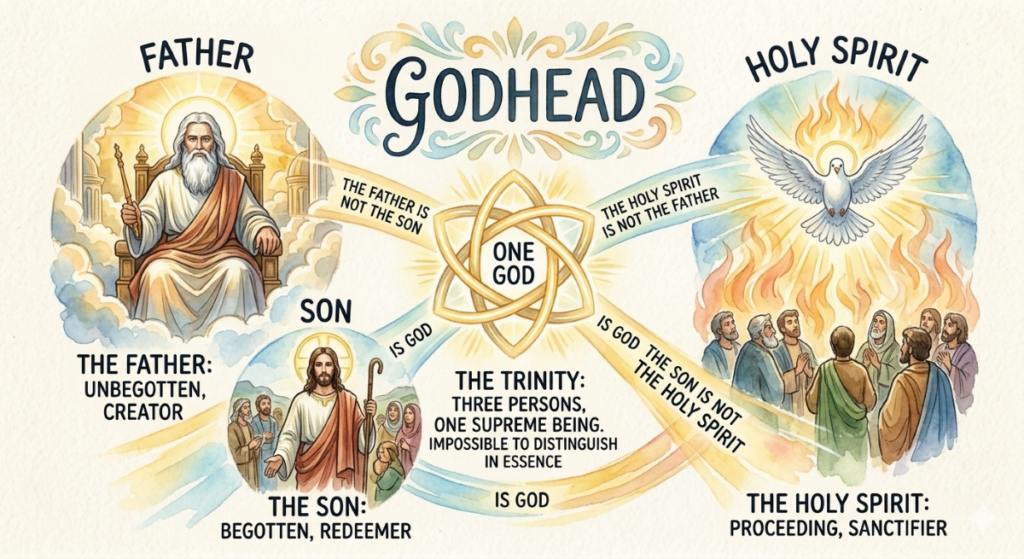
Very simply, the Trinity of God is the union of the three persons of God (Father, Son, and Holy Spirit) in one Godhead, or the threefold personality of the one Supreme Being.
A more detailed explanation follows, although we must remember that all of this is what we can glean from the Bible, since the word Trinity is never used in the Bible and it’s far beyond our ability to understand. However – that doesn’t mean we shouldn’t try.
A general definition of the Trinity of God
🤖✨The Trinity is a theological term describing the biblical teaching that there is one God who exists in three co-equal persons who are one in essence yet distinct in personality.1 More concisely, it refers to the doctrine that the one God is three Persons, distinct from one another, each fully God, of the same “essence.”2
This definition avoids two critical errors. The three are not three separate gods, like three separate human beings—the true Christian faith is not tritheism, a belief in three Gods.3 Conversely, the Trinity must not be explained as three modes of existence, that is, one God manifesting Himself in three ways; the Trinity is essential to the being of God and is more than a form of divine revelation.3
Importantly, the doctrine of the Trinity is not an object or thing; rather, it is a definition of God’s being and communal character—for the Christian, the word Trinity is a synonym for God.4 Within God’s eternal being, there are three centers of consciousness who, while they each exhaust the other’s awareness, still think of themselves as I and Thou.4
1 Tony Evans, The Tony Evans Bible Commentary (Nashville, TN: Holman Bible Publishers, 2019), 39.
2 Jason Meyer, Mark for You, ed. Carl Laferton, God’s Word for You (The Good Book Company, 2022), 259.
3 Steve Lewis, “The Doctrine Of The Trinity—Part I,” Journal of Dispensational Theology Volume 12 (2008), 12:35:37.
4 Francis Geis, “The Trinity and the Eternal Subordination of the Son,” Priscilla Papers (2013), 27:4:23.
A general definition of the Trinity of God – in non-academic English
Christians use the word Trinity to describe the belief that there is one God who exists as Father, Son, and Holy Spirit. These three are fully God, equal in divinity, and share the same essence, yet each relates to the others in a distinct, personal way.
This definition protects against two common misunderstandings.
- The Trinity is not three separate gods.
- And it is not one God simply switching between three roles or appearances.
Instead, the Trinity describes God’s very being — God’s eternal, relational life. For Christians, “Trinity” is simply another way of saying “God.”
Within God’s own life, the Father, Son, and Spirit each have a real sense of “I” and “You,” yet they share such complete unity that each fully knows and indwells the others. Their distinction is relational, not a division of essence or power.
Other dimensions of the Trinity of God
🤖✨The Trinity’s role in salvation stands as perhaps the most crucial scriptural emphasis. The doctrine demonstrates that the Triune God accomplishes salvation through the calling of the Father, the incarnation of the Son, and the indwelling of the Holy Spirit.1 This isn’t merely theological abstraction—it’s the framework Scripture uses to explain how redemption actually works. The early church father Irenaeus referred to this threefold involvement as “the economy of salvation.”2
The Trinity’s progressive revelation is another critical element. The doctrine unfolds progressively throughout Scripture, with the Old Testament providing partial revelation.3 When God says “Let us make man in our image,” the plural words imply more than one person, with at least God and the Spirit of God included in the Godhead.3 This gradual disclosure begins with the Old Testament emphasizing God’s oneness while placing markers testifying to the Father, Son, and Spirit, which the New Testament interprets in light of the incarnation.1
The inseparable operations of the Trinity deserves emphasis too. Scripture’s depiction of the three divine persons acting in common supports the doctrine of inseparable trinitarian operations.3 There is no division between Father, Son, and Spirit; in every action they are all involved, even if they may have different roles.4
Finally, the Trinity reveals God’s fundamental nature as love. At the very heart of who God is, he is Father, Son, and Spirit in perfect relationship—God is love. God didn’t create the world because he was lonely or lacking anything, but rather he is and always has been a blaze of perfect love, joy, and fellowship between Father, Son, and Spirit.4 This transforms the Trinity from abstract doctrine into the foundation of all Christian hope and purpose.
1 Zachary Lycans, “The Trinity and Scripture,” in Lexham Survey of Theology, ed. Mark Ward et al. (Bellingham, WA: Lexham Press, 2018). [See here, here.]
2 Brian L. Harbour, ed., Notable Harbour Doctrine Collection Vol 6 (WORDsearch, 2013). [See here.]
3 Gregg R. Allison, 50 Core Truths of the Christian Faith: A Guide to Understanding and Teaching Theology (Grand Rapids, MI: Baker Books: A Division of Baker Publishing Group, 2018), 91–92.
4 Matt Searles, God’s Story: The Bible Explained (Oxford, England: Lion Books, 2021), 174–175.
Other dimensions of the Trinity of God – in non-academic English
The Trinity isn’t just a belief about who God is — it also shapes how Christians understand what God does. Scripture shows the Father, Son, and Spirit working together in every part of salvation. The Father calls and sends, the Son becomes human and accomplishes redemption, and the Spirit comes to live within believers. Early Christian writers called this shared work “the economy of salvation,” meaning the coordinated way God carries out His saving purpose.
The Trinity also becomes clearer as the Bible unfolds. The Old Testament strongly emphasizes that God is one, yet it also contains hints — like God saying, “Let us make humanity in our image” — that more than one divine person is involved. These early clues are fully illuminated in the New Testament when Jesus arrives and the Spirit is poured out. The doctrine isn’t a later invention; it’s the Bible’s own gradual unveiling of who God has always been.
Another key idea is the inseparable operations of the Trinity. In Scripture, the Father, Son, and Spirit never act independently or in competition. They always work together, sharing one will and one purpose, even when each has a distinct role. Whatever God does, all three are involved.
Finally, the Trinity reveals that God’s very nature is love. Before creation existed, God was already Father, Son, and Spirit in perfect, joyful relationship. God didn’t create the world because He was lonely or incomplete. Creation flows out of the overflowing love that has always existed within God’s own life. This makes the Trinity not an abstract puzzle but the foundation of Christian hope: the God who saves is the God who has always been love.
Discover more from God versus religion
Subscribe to get the latest posts sent to your email.