
The letter to the church in Ephesus, in Revelation, warns the people of the church that Jesus is about to remove their status as one of His Churches. Talk about horrible news. And yet, by the end of the letter, Jesus tells them that if they overcome/conquer/are victorious, then they’ll be granted the right to eat from the Tree of Life.
You may remember the Tree of Life in the Garden of Eden – back in The Beginning. Now, at The End, it’s the Tree of Life – in the paradise of God. Talk about awesome news! But how can this happen?
How can these people who were on the brink of spiritual death now be on the brink of entering the paradise of God, eating from the tree that, after The Fall, God placed on the east side of the Garden of Eden, cherubim and a flaming sword flashing back and forth to guard the way to the tree of life?
What’s happening in this image of the people in the Church in Ephesus?
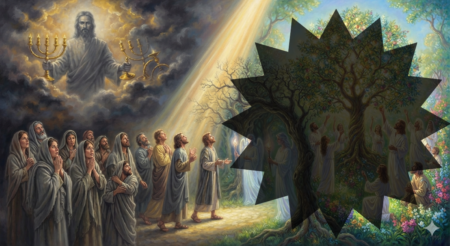
The letter to the church in Ephesus isn’t very long. Only seven verses. But there’s so much packed into it. And so, it’s been a while – time for me to write, time for you to read, lots of articles. I feel like a quick visual recap, with a short explanation, is in order.
So – with that in mind, I gave the opening paragraph above to Google Gemini / Nana Banana, and got this image back.
Remember, Ephesus was warned that Jesus may take away their lampstand, symbolism for telling this church that they’re about to lose their status as a Church of Jesus. That’s what’s depicted on the left side.
But by the end of the letter, the Ephesus church learns there is hope. However, since the image portrays the initial verses of the letter, that’s a hope they likely can’t even imagine, so it’s grayed out.
With that backdrop, here’s why it gave me what you’re looking at.
The Left Side (The Warning): A somber group of ancient Ephesians stands in muted, gray robes, their faces filled with anxiety, prayer, and dawning hope. Above them, a powerful figure representing Jesus emerges from dark, stormy clouds, holding golden lampstands—one of which is tilting, symbolizing the warning to remove their status.
The Center (The Transition): A powerful, golden beam of heavenly light breaks through the darkness, illuminating a path forward. Guarding the entrance to paradise are two glowing, angelic beings with torches, symbolizing the transition from the guarded garden of Genesis to the open gates of Revelation.
The Right Side (The Promise): The scene transitions into a breathtaking, vibrant paradise filled with lush greenery and colorful flowers. At the center stands the magnificent Tree of Life, glowing with supernatural light and bearing radiant fruit. Figures dressed in joyful white robes look up in awe, worshiping and reaching for the fruit, symbolizing the ultimate victory and restoration through the Holy Spirit.
The difference between the image and what the opening of the letter to the church in Ephesus said
Ephesus was a church that was up on their theology. They knew it, and they recognized falsehoods when they began to creep in. The people in that church almost certainly expected the right side of the image – rejoicing in paradise, eating from the Tree of Life. But then, Jesus told them they messed up one thing. They had lost God’s kind of love. You may remember that Paul wrote that without love, he had nothing. Given that Paul wrote that to the church in Corinth while he was in Ephesus – the people there seemingly must’ve heard that theme – probably many times.
But despite that, Jesus’ words cast a darkness over those hopes of entering paradise, being with Jesus, and eating from the Tree of Life. It may have felt like it was all for nothing. It was over. The dream was lost. Hope was lost.
But I wonder – was anyone left who knew better? Was anyone left who might remember that there’s always hope, as long as we’re alive?
Fortunately, Jesus didn’t make them wait very long before He told them that very thing. Their hearts could start beating again. They could breathe again. If ….
A final look at the Letter to the Church in Ephesus
Let’s take one more look at the letter. Find out about the hope. And the “if …”
To the Church in Ephesus – Revelation
Rev 2:1 “To the angel of the church in Ephesus write:
These are the words of him who holds the seven stars in his right hand and walks among the seven golden lampstands: 2 I know your deeds, your hard work and your perseverance. I know that you cannot tolerate wicked men, that you have tested those who claim to be apostles but are not, and have found them false. 3 You have persevered and have endured hardships for my name, and have not grown weary.
Rev 2:4 Yet I hold this against you: You have forsaken your first love. 5 Remember the height from which you have fallen! Repent and do the things you did at first. If you do not repent, I will come to you and remove your lampstand from its place. 6 But you have this in your favor: You hate the practices of the Nicolaitans, which I also hate.
Rev 2:7 He who has an ear, let him hear what the Spirit says to the churches. To him who overcomes, I will give the right to eat from the tree of life, which is in the paradise of God.
And there it is:
Rev 2:7 He who has an ear, let him hear what the Spirit says to the churches. To him who overcomes, I will give the right to eat from the tree of life, which is in the paradise of God.
Well, there it is, depending on which translation of the Bible you read. And depending on whether you understand what that translation means. And, oh yeah, the big one – it depends on whether you have ears to hear, actually take the time to hear, understand what you hear, and act on what you hear. Piece of cake – right?
Well – of course, that depends.
We don’t really know what’ll happen. This is, after all, a vision of things that “must happen”. Many churches across the world are in some ways the image of this Ephesian church. We’ve heard Paul’s writings, not from him personally – but from our own pastors, priests, rabbis, or whatever title is used. And we managed to not quite do it with God’s love – or maybe we did it all without His love. In other words, we’re human, we’re distracted, we’re always needing to turn back – and the only questions are things like:
- Are we close to the path – or are we far away?
- Do we have friends who can help us – or are we alone with no Christian support?
- Did we ever really have/use the Holy Spirit – or did we do it all “our way”?
- Is there anyone else in our church that wants to turn around – or is everyone just angry about what Jesus said?
The list is longer, to be sure. But to the extent we have a community that is available to do this together, we’re better off. To the extent we, or someone close to us, at least was truly living in God’s love, with His Holy Spirit, we’re better off.
But if we’re hung up on being mad at Jesus – how can He say things like that about us; I gave everything – what else does He want? I do love, even though Jesus just said otherwise – then we have a problem. It’s the usual suspects: pride, ego, the “I can take care of myself” attitude.
Really, it’s all the things we need to repent for. But can we? Especially – can we be among the first to say, “Im sorry”, and to turn back to Jesus?
I know – it’s a lot. And yet, that one close verse has everything we need to change our future from the darkness of losing a lampstand to the joy of being in God’s paradise.
He who has an ear, let him hear what the Spirit says to the churches.
Every one of the seven letters to the churches in Revelation has these words:
He who has an ear, let him hear what the Spirit says to the churches.
But what does it mean? To get an idea, since so much of what John wrote about the vision he received is given in Old Testament symbology and references, let’s check there first.
The good news is that the reference has an obvious root in the Old Testament. The bad news is that, today, when people often aren’t familiar with the Old Testament, the obvious reference, which was recognized and gave a message merely by being referenced – it’s lost on far too many people today. Unless we go look it up, take the time to understand it, we don’t really begin to understand the message. A message that new followers of Jesus and Jews alike would’ve immediately brought up a depth of meaning we won’t relate to.
Let’s take a look, beginning with Isaiah.
Hearing and seeing – but not understanding the words or the sights
That heading, Hearing and seeing – but not understanding the words or the sights, may have sounded familiar. This is the actual quote.
Isaiah’s Commission – Isaiah
Isa 6:1 In the year that King Uzziah died, I saw the Lord seated on a throne, high and exalted, and the train of his robe filled the temple. 2 Above him were seraphs, each with six wings: With two wings they covered their faces, with two they covered their feet, and with two they were flying. 3 And they were calling to one another:
“Holy, holy , holy is the LORD Almighty;
the whole earth is full of his glory.”
Isa 6:4 At the sound of their voices the doorposts and thresholds shook and the temple was filled with smoke.
Isa 6:5 “Woe to me!” I cried. “I am ruined! For I am a man of unclean lips, and I live among a people of unclean lips, and my eyes have seen the King, the LORD Almighty.”
Isa 6:6 Then one of the seraphs flew to me with a live coal in his hand, which he had taken with tongs from the altar. 7 With it he touched my mouth and said, “See, this has touched your lips; your guilt is taken away and your sin atoned for.”
Isa 6:8 Then I heard the voice of the Lord saying, “Whom shall I send? And who will go for us?”
And I said, “Here am I. Send me!”
Isa 6:9 He said, “Go and tell this people:
“ ‘Be ever hearing, but never understanding;
be ever seeing, but never perceiving.’
Isa 6:10 Make the heart of this people calloused;
make their ears dull
and close their eyes.
Otherwise they might see with their eyes,
hear with their ears,
understand with their hearts,
and turn and be healed.”
Isa 6:11 Then I said, “For how long, O Lord?”
And he answered:
“Until the cities lie ruined
and without inhabitant,
until the houses are left deserted
and the fields ruined and ravaged,
Isa 6:12 until the LORD has sent everyone far away
and the land is utterly forsaken.
Isa 6:13 And though a tenth remains in the land,
it will again be laid waste.
But as the terebinth and oak
leave stumps when they are cut down,
so the holy seed will be the stump in the land.”
I included the entire passage above to show something. This is one of the many “dual purpose” prophecies in the Old Testament. The entire passage is about events about to unfold in that time. However, the highlighted verses – 9 & 10 – are also about another time. In a way, two other “times”. The first is in the Gospels and the book of Acts. The second is a reminder of the first, many years later, here in the book of Revelation.
By the way, the very next passage in Isaiah is titled “The sign of Immanuel”, where prophecy on the coming of the Savior is clear.
All of this takes us into something known as “parabolic hearing”. Rabbis in Old Testament times often used parables, simple stories that were easily understandable at one level, to tell a deeper story to teach about God. Jesus took that to a new level. The Holy Spirit is needed to truly understand the parables Jesus told. But what we don’t necessarily think of is that chapters 9 through 21 of Revelation are full of these parables, although in a different format. The same parabolic hearing needed to understand Jesus’ parables is needed to understand the vision that John wrote about in Revelation.
And, they are the very things referenced in Isaiah 6:9-10. They’re the things for which Jesus said the words, “He who has an ear, let him hear what the Spirit says to the churches.
Well, other than people who are deaf, everyone can “hear”. The physical functioning ear isn’t what Jesus was speaking about though. It was the listening to the Holy Spirit.
Hearing the Holy Spirit
The problems with hearing the Holy Spirit are that (1) we often don’t take the time to listen – we just pray, say Amen, and go on with life; and (2) even when we do take the time to listen, He’s “quiet”.
If that wasn’t heard enough, with the Holy Spirit being quiet. We also have to deal with Bible translations. Just consider the five below, chosen at random. Look at what they say right after listening to what the Spirit says to the churches.
So – which one is it? Victorious? Overcomes? Conquers? Something else from another translation? Even the 2010 NIV changed from the 1984 translation, which used “overcomes”. But then, after showing those differences, I still ask – are any of them really getting across the right message about what the person who overcomes/conquers/is victorious actually does?
But first, let’s pick one more translation, one I like to use when looking at differences like this. Young’s Literal Translation says:
To him who is overcoming
I feel like, before examining in detail, this might be the one. If it is, I’ll explain why. Of course, if it’s not – well, I still need to explain something.
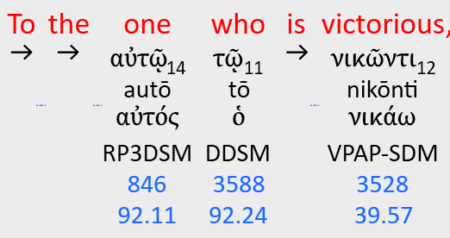
Anyway, let’s look at the Greek words they’re all translated from.
The adjacent image shows three Greek words.
But the question for us – why do some say victorious, some say conquers, and others say overcomes. Or, as Young’s Literal did – “is overcoming”.
Let’s examine νικῶντι (nee-KOHN-tee). It’s the dative singular of νικῶν, “the one who conquers / the one who overcomes,” a participial form from νικάω (“to conquer, to be victorious”).
The Greek words, and their form, get us “To the”. It’s singular, so it’s to the one. As for the translation of νικῶντι:
📖† 3528 νικάω [nikao /nik·ah·o/] v. From 3529; TDNT 4:942; TDNTA 634; GK 3771; 28 occurrences; AV translates as “overcome” 24 times, “conquer” twice, “prevail” once, and “get the victory” once. 1 to conquer. 1A to carry off the victory, come off victorious. 1A1 of Christ, victorious over all His foes. 1A2 of Christians, that hold fast their faith even unto death against the power of their foes, and temptations and persecutions. 1A3 when one is arraigned or goes to law, to win the case, maintain one’s cause. Strong, J. (1995). In Enhanced Strong’s Lexicon. Woodside Bible Fellowship. 1Strong, J. (1995). Enhanced Strong’s Lexicon. Woodside Bible Fellowship.
Enhanced Strong’s Lexicon
So, we see that any of the words: victorious, conquers, overcomes – they’re all “acceptable”.
As far as the form of speech, though, it’s present tense. That makes me think “is overcoming” has an edge.
Would you like hash browns, baked potatoes, French fries, or all of them mashed together?
Huh? Potatoes? I used that heading as a way of showing what we get with modern English Bible translations. Any one of them, as we’ll see, is incomplete – although that’s not necessarily the fault of the translator. Sometimes what we get is various thoughts, all mashed together into something that may taste/sound good, but which doesn’t portray the message people in John’s time would’ve immediately grasped. We’ll get a bit into those thoughts, but hopefully not too deep so as to lose the message.
As a result, I feel like I opened a can of worms with the Young’s Literal Translation. And yet – it’s a can worth examining. Why? Because I think it’s only by looking at the things done in our English Translations – and probably other languages – to make them more palatable to us.
I went through so many searches, chats with multiple AI’s, and several books to see what happened. But I think this one will bring it out.
❓ When translating the phrase about overcoming in the letters to the churches in Revelation, since it’s present tense, is the Young’s Literal translation’s “to the one who is” overcoming, more proper – in that that act of overcoming, being victorious, conquering, is an on-going process for the believers? Also, what about the reality that the ultimate cause of overcoming/being victorious, and especially maybe conquering – is really Jesus, not any one person?
Faithlife/LOGOS AI didn’t quite get my point about Jesus being the reason for any of us being the one who overcomes, but the answer makes it clear that this is the case. Plus, it lays out some of the issues related to grammar/tenses vs. readability – and – being brief at the expense of having a complete picture of who does what in this process of overcoming/being victorious/conquering. To be fair, Christians should be able to figure this out. But to be real, many Christians aren’t at a level where they know enough to be able to do that. And, if someone new to Christianity, or who knows little to nothing about Christianity, cannot get the actual picture involved in the left out details.
Having said all that, these letters were written to churches – not to non-believers. And, one hopes someone in each church could explain what’s actually going on, if needed.
So, with that backdrop, let’s go through the LOGOS response.
🤖✨ Your observation about Young’s Literal Translation captures something important. The present participle construction suggests an ongoing demand for victory on the part of the believer1, and that grammatical choice reflects a theological reality: overcoming isn’t a one-time achievement but a continuous posture of resistance and faithfulness.
1 Stephen S. Smalley, The Revelation to John: A Commentary on the Greek Text of the Apocalypse (London: SPCK, 2005), 64.
So, we see, it is an ongoing process. Even Paul, who certainly had no question as to whether he’d be saved, wrote the paragraph below on that topic. Interestingly enough, and more than a little ironic – this was to the church in Ephesus!
Paul’s Farewell to the Ephesian Elders – Acts
…
Ac 20:22 “And now, compelled by the Spirit, I am going to Jerusalem, not knowing what will happen to me there. 23 I only know that in every city the Holy Spirit warns me that prison and hardships are facing me. 24 However, I consider my life worth nothing to me, if only I may finish the race and complete the task the Lord Jesus has given me—the task of testifying to the gospel of God’s grace.
…
So, we have the on-going component settled. Now, it’s time to bring in something else. Something most Christians are aware of, but a reminder here couldn’t hurt.
We are not the source of our salvation
🤖✨ However, the ultimate source of overcoming belongs entirely to Christ. Jesus’ death on the cross and his resurrection are the reason that no power in the world can finally have the victory2. As children of God, believers are included in this victory, which is not an achievement or reward, but is given them, placing them in a position in which they themselves can overcome evil2. The language shifts from Christ’s definitive victory (already accomplished) to believers’ participatory victory (ongoing).
2 W. Günther, “Νικάω,” in New International Dictionary of New Testament Theology, ed. Lothar Coenen, Erich Beyreuther, and Hans Bietenhard (Grand Rapids, MI: Zondervan Publishing House, 1986), 1:651.
So, yes, we have something to do. Something related to that overcoming/victory/conquering. But our salvation is from Jesus’ death on the cross alone.
That reality can be lost or forgotten with the translations we have. Here’s why. Jesus’ birth, death on the cross, resurrection on the third day, and ascension to return to Heaven were all in the past. “To him who overcomes” sounds like a future accomplishment. “To him who is overcoming” sounds like an ongoing event – began in the past and continues into the future.
And yet, it still points to “him who” – not to Jesus.
Is that really a big deal? Well, let me put it this way. Ephesus is the church who forgot their first love. They forgot, not what Jesus said, but what He meant. The Ephesus church pretty much did all the right things – but not for the right reason. So, yes – I feel it really is that important to bring this up – and to keep it, front and center.
Who is “the conquerer” in the Bible?
Speaking of what Jesus said, let’s consider this:
🤖✨ Jesus says in John 16:33, “I have conquered the world,” and the true victory was won on the cross, with the final battle being only the last act of defiance by an already defeated foe3. Witness to God and obedient death constitute victory and lead to acclamations of his worthiness, opening up a path for his followers to pursue as well—just as Jesus conquered through complete obedience to God, even unto death, so believers conquer wherever they hold fast to their witness to Jesus and God’s Word4.
3 Daniel L. Akin, Exalting Jesus in Revelation, ed. Daniel L. Akin, David Platt, and Tony Merida, Christ-Centered Exposition Commentary (Nashville, TN: Holman Reference, 2016), 39–40.
4 David A. deSilva, An Introduction to the New Testament: Contexts, Methods & Ministry Formation (Downers Grove, IL: IVP Academic: An Imprint of InterVarsity Press, 2018), 822.
Since I don’t generally like to pick a portion of a verse, we should look at the passage it comes from. And since it’s about grief turning to joy, it’s even more important to read all of it.
The Disciples’ Grief Will Turn to Joy – John
Jn 16:17 Some of his disciples said to one another, “What does he mean by saying, ‘In a little while you will see me no more, and then after a little while you will see me,’ and ‘Because I am going to the Father’?” 18 They kept asking, “What does he mean by ‘a little while’? We don’t understand what he is saying.”
Jn 16:19 Jesus saw that they wanted to ask him about this, so he said to them, “Are you asking one another what I meant when I said, ‘In a little while you will see me no more, and then after a little while you will see me’? 20 I tell you the truth, you will weep and mourn while the world rejoices. You will grieve, but your grief will turn to joy. 21 A woman giving birth to a child has pain because her time has come; but when her baby is born she forgets the anguish because of her joy that a child is born into the world. 22 So with you: Now is your time of grief, but I will see you again and you will rejoice, and no one will take away your joy. 23 In that day you will no longer ask me anything. I tell you the truth, my Father will give you whatever you ask in my name. 24 Until now you have not asked for anything in my name. Ask and you will receive, and your joy will be complete.
Jn 16:25 “Though I have been speaking figuratively, a time is coming when I will no longer use this kind of language but will tell you plainly about my Father. 26 In that day you will ask in my name. I am not saying that I will ask the Father on your behalf. 27 No, the Father himself loves you because you have loved me and have believed that I came from God. 28 I came from the Father and entered the world; now I am leaving the world and going back to the Father.”
Jn 16:29 Then Jesus’ disciples said, “Now you are speaking clearly and without figures of speech. 30 Now we can see that you know all things and that you do not even need to have anyone ask you questions. This makes us believe that you came from God.”
Jn 16:31 “You believe at last!”Jesus answered. 32 “But a time is coming, and has come, when you will be scattered, each to his own home. You will leave me all alone. Yet I am not alone, for my Father is with me.
Jn 16:33 “I have told you these things, so that in me you may have peace. In this world you will have trouble. But take heart! I have overcome the world.”
We need to ask, did the people in Ephesus have knowledge of what’s in verse 33? Maybe – maybe not. Certainly, there wasn’t any Bible for them to read.
However, I included this passage for us today. We do have it. So, it’s something we need to remember. Even when Jesus was still alive, before He died on the cross – he said, “I have overcome the world”.
And Jesus reminded His disciples of that, something they wouldn’t understand until later, to turn their grief into joy. Not the “let’s have a party” joy – but God’s kind of joy. The fruit of the Spirit kind of joy.
But how do we deal with the apparent contradictions of past, present, future – and already completed?
Believers participate in Jesus’ victory
This is another one of the things we, in theory, should know. But do we? Let’s go through it, briefly, and you can decide for yourself whether or not you knew it before.
🤖✨ The present tense in the letters emphasizes that believers participate in Christ’s victory through sustained faithfulness—not by generating victory themselves, but by aligning with the victory already secured. Young’s translation highlights this participatory, ongoing character beautifully.
This is why I like the Young’s Literal Translation. No, it doesn’t explicitly say how we are the “one who is overcoming”.
Honestly, just look at the little bit we went through to get here. Imagine if I put in a more complete explanation – and there is one. The Bible would be so long, few would read it.
But – this is what’s happening. It’s a process. We are not the only ones involved. In fact, our only involvement is in believing – as Jesus meant it in John 3:16. And then following through with that action Jesus said is needed, becoming transformed to become more like Jesus, and doing the things He commanded us to do. Not to win this victory. If it was up to us alone, we’re doomed.
Now, we can finally examine the last portion of the letter to the church in Ephesus.
Eating from the Tree of Life
I will give the right to eat from the tree of life, which is in the paradise of God.
Uh oh. I thought the Tree of Life was in the Garden of Eden.
And aren’t we going to Heaven?
So how are we going to eat from the Tree of Life, if we’re in Paradise and it’s in Eden?
Is there a heavenly “door-dash”?
Uh – No.
The journey of the Tree of Life
As much as I’d love to get into a full blown look at what happens, I’m going to sidestep it a bit. I’ll give a very short view of it, list a few verses, and just say – as long as the rapture doesn’t happen before we get there, this will come up later.
I also need to point out, we’re only looking at the journey of the Tree – not ours. Our journey gets way more complex, including the fact that we don’t all take the same journey.
I will say though, we need to have faith that, for the “overcomers”, the Tree of Life will be where we need it when we need it. And isn’t that all we really know, since God always keeps His promises?
❓ What are the verses in the Bible that show us how the Tree of Life began in Eden, is going to be in Paradise, and will end up on the New Earth?
🤖✨ The biblical narrative traces the tree of life across three cosmic moments, creating a narrative arc from creation through redemption to restoration.
In Eden: The tree of life stood in the middle of the Garden of Eden alongside the tree of the knowledge of good and evil. (Gen 2:9) After humanity’s fall, God prevented access to the tree, stationing cherubim and a flaming sword to guard the way to it. (Gen 3:22–24)
In Paradise (the intermediate heaven): Christ promises the overcoming churches that they will eat from the tree of life, which exists in the paradise of God. (Rev 2:7)
On the New Earth: In the New Jerusalem, the tree of life stands on each side of a river, bearing twelve crops of fruit monthly, with leaves that heal the nations. (Rev 22:2) Those who wash their robes receive the right to the tree of life and entry into the city. (Rev 22:14)
The tree’s journey reflects humanity’s restoration. Adam and Eve were designed to live forever through eating from the tree, but after sinning were banished from the Garden and subject to physical death.1 On the New Earth, access to the tree will be forever restored, as it will be relocated from the present Heaven to the New Earth, just as it was apparently relocated from Eden to Heaven.1 The tree’s expansion to grow on both banks of a river suggests it will become a forest of life, reflecting humanity’s expanded population and dominion.1
1 Randy Alcorn and Jason Beers, Everything You Always Wanted to Know about Heaven (Carol Stream, IL: Tyndale Momentum, 2014). [See here, here, here, here.]
It looks so easy. And for God, it is.
As to us, and what happens when we physically die – well, that depends on when, choices we made in our lives – or didn’t, and whether or not we truly asked forgiveness from God. Maybe that all sounds easy – maybe not. But, as with the Tree – we do know Jesus has prepared a place for us, and that it will be perfect.
The believer’s “overcoming” task
We also are learning, as we go through the seven letters, things to examine in our lives, and ways to ensure we are and that we stay on the right path. If we love even a bit in the way God loves us, then we’ll also be helping others to do the same – as in the Great Commission.
This is a big part of what we need to do, as believers, and as indicated in the letter to the church in Ephesus. It’s important to know the theology, like they did. But it’s just as important to live it out – to examine our lives to ensure we’re truly living as a disciple of Jesus.
The thing about “we” is this: we could be each one of us individually, Or, “we” could be all of us, as a community. Or, in the Christian sense in this letter, it’s both. Remember, as we went through the letter, there were so many “warnings”, heard as normal sermons, as part of discussion with Paul while he was present in Ephesus, in conversations with other people in the church, in prayer with the Holy Spirit. And yet – if those things did happen in Ephesus, they weren’t enough to prevent the loss of their love for Jesus.
So, no – we can’t defeat Satan. But we can, and need to, learn from Jesus, from the leaders of our church, from others in our church – and to the extent we can, we should take responsibility for our church community and for each other, as well as ourselves.
Those are all things that are part of being the one who is overcoming.
So – take to heart the message of the letter to the church in Ephesus. Remember it. Review it from time to time – certainly in your BIble, maybe from here as well.
And – keep going. Don’t stop with Ephesus. Even if your number one problem was identical to theirs, after you solve it, your new number one problem is likely in one of the other churches.
There’s more coming. Next up is the letter to the church in Smyrna.
If you’d like to be notified as new articles are available for it, just sign up with the prescription block below.
Footnotes:
- 1Strong, J. (1995). Enhanced Strong’s Lexicon. Woodside Bible Fellowship. ↩︎
Discover more from God versus religion
Subscribe to get the latest posts sent to your email.