
In Part 1, we looked at a puzzle as old as Scripture itself: when modern translations tell us that God built eternity into our hearts so that people would “fear” Him, what kind of picture does that paint in our minds? Are we looking at a God of terror hiding in dark clouds, or a God of magnificent holiness who invites us into His light with a mixture of reverence and awe?

We saw that while the original Hebrew word (yare’) carries the weight of both dread and deep honor, Jesus’ arrival and the broader witness of Scripture radically shift our posture. We aren’t called to cower as frightened slaves; we’re invited to cry “Abba, Father”.
But if the terror is stripped away, what remains? How do we balance a healthy, staggering realization of God’s unmatched sovereignty with the intimate, fearless love that Christ secured for us?
Let’s pick up right where we left off and explore how the true “fear of the Lord” transforms from a confusing theological hurdle into the very bedrock of wisdom, freedom, and everyday faith.
Why the difference between be afraid and be in awe?
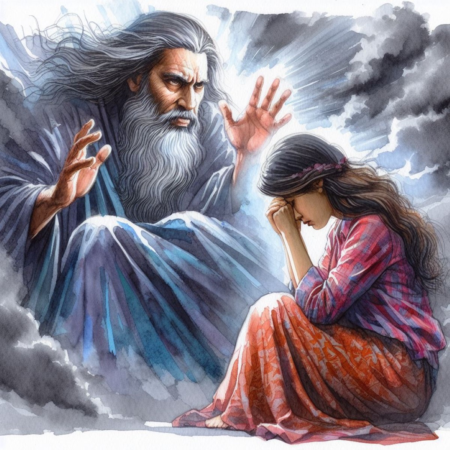
There are so many verses I can put here to show why there’s a disconnect between the two women we looked at in the Part 1 images. But here are just two. One for each case.
John 3:16 – be afraid – and be in awe
Lots of people know about John 3:16. But, it’s one verse in a larger passage. We must know and understand the larger passage to get the message Jesus was trying to give Nicodemus. And us.
Let’s do a verse at a time to see what Jesus was telling us.
John 3:16 – John
Jn 3:16 “For God so loved the world that he gave his one and only Son, that whoever believes in him shall not perish but have eternal life.
This gift of eternal life is available to everyone. Yes, everyone. However, as the Bible shows us many times, a whole lot of people won’t accept the gift. Don’t even want to accept the gift.
7 For God did not send his Son into the world to condemn the world, but to save the world through him.
So God isn’t waiting for us to mess up so He can scare us, threaten us with Hell, and then pat Himself on the back when we’re afraid of Him. His desire is that all of us will accept His offer of salvation.
Note – there is a difference between God’s will and God’s desire. His desire is that we all love Him and accept His gift of salvation. However, While God’s will is always done, His desires are not.
Loving Him is a choice He gives us. We can love Him – or not. But either way, justice must be done. A price must be paid for all the things we did wrong. If we love God, then Jesus pays the price. If we do not love God, then we must pay the price. That’s why the next verse says what it does.
18 Whoever believes in him is not condemned, but whoever does not believe stands condemned already because he has not believed in the name of God’s one and only Son.
Yes, when we choose to not love God, we condemn ourselves. We turn down the gift of salvation and eternal life with God. We make ourselves afraid of God.
If we take the time, with an open mind and an open heart, we can learn that about God. And the more we learn, like the second woman (in the image at the top of the series pages and described in Part 1), the more we’ll love Him and be in awe of Him.
As we learn more, we begin to understand more and more of this passage, as well as the rest of the Bible.
For instance, we learn that believe means we have a belief so strong that we want to change. We want to become more like Jesus.
19 This is the verdict: Light has come into the world, but men loved darkness instead of light because their deeds were evil.
This is where Jesus makes it abundantly clear that many people do not and will not choose to love Him. Too many of us love life the way it is, with all its problems, troubles, strife, and all. As much as we might rail against this life, we don’t/won’t even look for something better.
20 Everyone who does evil hates the light, and will not come into the light for fear that his deeds will be exposed. 21 But whoever lives by the truth comes into the light, so that it may be seen plainly that what he has done has been done through God.”
One thing we fail to learn and/or accept is that God already knows everything about us. He knows us better than we know ourselves. Everything is already exposed to Him. But He will forgive us anyway.
God doesn’t love us or not love us based on what we did. If anything, God loves us in spite of the things we’ve done. And He certainly does love us because He created us.
But will we choose to love Him back?
The Holy Spirit
We aren’t going to go through this next passage in a whole lot of detail. It’s included mostly to show the importance of one difference in the images I haven’t pointed out yet. Something that happens with those who love God. But not with those who choose to not love God. Something that enables the awe of God rather than the fear of God in the phrase “Fear of the Lord”.
Jesus Promises The Holy Spirit – John
Jn 14:15 “If you love me, you will obey what I command. 16 And I will ask the Father, and he will give you another Counselor to be with you forever— 17 the Spirit of truth. The world cannot accept him, because it neither sees him nor knows him. But you know him, for he lives with you and will be in you. 18 I will not leave you as orphans; I will come to you. 19 Before long, the world will not see me anymore, but you will see me. Because I live, you also will live. 20 On that day you will realize that I am in my Father, and you are in me, and I am in you. 21 Whoever has my commands and obeys them, he is the one who loves me. He who loves me will be loved by my Father, and I too will love him and show myself to him.”
Jn 14:22 Then Judas (not Judas Iscariot) said, “But, Lord, why do you intend to show yourself to us and not to the world?”
Jn 14:23 Jesus replied, “If anyone loves me, he will obey my teaching. My Father will love him, and we will come to him and make our home with him. 24 He who does not love me will not obey my teaching. These words you hear are not my own; they belong to the Father who sent me.
Jn 14:25 “All this I have spoken while still with you. 26 But the Counselor, the Holy Spirit, whom the Father will send in my name, will teach you all things and will remind you of everything I have said to you. 27 Peace I leave with you; my peace I give you. I do not give to you as the world gives. Do not let your hearts be troubled and do not be afraid.
Jn 14:28 “You heard me say, ‘I am going away and I am coming back to you.’ If you loved me, you would be glad that I am going to the Father, for the Father is greater than I. 29 I have told you now before it happens, so that when it does happen you will believe. 30 I will not speak with you much longer, for the prince of this world is coming. He has no hold on me, 31 but the world must learn that I love the Father and that I do exactly what my Father has commanded me.
“Come now; let us leave.”
You see here just some of the importance of the Holy Spirit. We receive the Holy Spirit when we’re baptized. However, the Holy Spirit won’t force Himself into our lives.
The other difference in the images
How is that shown in the images?
The be afraid meaning of “Fear the Lord” has just the “old man” who seems to be trying to scare the young woman and seems to make her afraid. The “old man” is her view of God – the Father.
But the other one, the be in awe meaning of “Fear the Lord” has more. There’s the friendly, smiling “old man”. That’s God – the Father. In the upper right corner is Jesus. Within her is the Holy Spirit, who she uses to guide her study of the Bible. The Holy Spirit, in a way we cannot understand”, is the mind of the Father and the mind of Jesus. And that’s why she’s in awe and feels at peace with God.
Conclusion – What does Fear of the Lord really mean?
Being in fear of God, the modern “afraid of” kind of fear, is a natural response when we start to get even an idea of just how awesome, powerful, and great God is. Having said that, when that knowledge is accompanied with reverence, faith, belief – we also see that God’s response to our being afraid is to tell us – “don’t be afraid”. It’s kind of like fear without fear.
Not having that reverence, faith, belief, salvation through Jesus – then it’s fear with fear. Ultimately, it will be nothing but fear. A fear that we probably can’t even imagine.
The thing is, we do get to choose which “fear” of the Lord we will experience. Faith, belief in Jesus, and it’s the reverence kind of “fear”. Rejection of Jesus, and it’s Fear with a capital “F” – the scary one.
And that is why it’s so important to figure out what words like these in the Bible actually mean. Fear of the Lord doesn’t have to be something to be afraid of. In fact, “fear of the Lord” the way Jesus had it isn’t fear, but should be the absence of fear. Too many people read/hear “fear of the Lord” and automatically think that we’re supposed to be afraid of God all the time. And, they think, for good reason. It’s like God wants us to be afraid of Him. But, as we just saw, that’s not the case at all.
Chances are, most non-Christians don’t know this. Or don’t believe it. They think “fear the Lord” means be afraid of the Lord.
I wouldn’t be at all surprised that a significant number of “Christians” also have the “scared” type of “fear of the Lord”.
In addition, I wonder just how many Christians who know “fear of the Lord” doesn’t mean to be afraid of Him actually know why. If someone was to ask you, before you read this, would you have been able to explain something like “fear of the Lord” – or why some translations say “fear” and others say “revere”?
The thing is, this is a relatively simple example of confusing words. That’s why I chose it to write about. The point was to show what the people knew about the Scriptures in the Old Testament and early New Testament times, compared to what we know now, and the importance of us learning more.
There’s another article I’m writing now about Jesus’ death on the cross being a fragrant aroma to God. Think about that one for a while. It’s not an analogy. It’s not a mistake. There’s a reason why the Bible says that. And I’ll go into that as well. My point is that there are plenty of times we need to ask ourselves – do we really know/understand what God’s trying to tell us through the Bible, His Word? I think that quite often, we feel like the answer is yes, we do know. But do we really know?
The thing is, when we learn more about the original language/culture/original intent of these incredible words, the deeper our own faith can be. It takes time. It takes effort. But hey – it’s for God, our creator, our hope and our salvation. If He’s not worth our time and effort then who/what is?
As a reminder, Jesus said –
The Greatest Commandment – Matthew
22:34-40 pp — Mk 12:28-31
Mt 22:34 Hearing that Jesus had silenced the Sadducees, the Pharisees got together. 35 One of them, an expert in the law, tested him with this question: 36 “Teacher, which is the greatest commandment in the Law?”
Mt 22:37 Jesus replied: “ ‘Love the Lord your God with all your heart and with all your soul and with all your mind.’ 38 This is the first and greatest commandment. 39 And the second is like it: ‘Love your neighbor as yourself.’ 40 All the Law and the Prophets hang on these two commandments.”
Obviously, I’m talking about Love the Lord your God with all your heart and with all your soul and with all your mind.
But just as much – Love your neighbor as yourself. Implicit in that statement is something it’s taken a long time for me to realize (and it’s ongoing) is that Jesus loves us – and our neighbors. Obviously we’re supposed to love our neighbors. The hidden message (at least hidden from me) is that we are supposed to love ourselves as well. Not in some kind of narcissistic way – but in the same way that Jesus wants us to love our neighbors. If we don’t feel that “Jesus kind of love” for ourselves, if we think we have no value, how can we possibly feel the right kind of love for someone else?
And part of all that love for ourselves – for our neighbors – and for God – is taking the time to really learn about the Bible.
I’ll leave you with one closing thought.
There was a time in the Old Testament when The Book of The Law was lost. Yes – lost. As in lost but not found.
To give an idea of the importance of The Book of The Law, here’s God telling Joshua about it –
The LORD Commands Joshua – Joshua
…
Jos 1:6 “Be strong and courageous, because you will lead these people to inherit the land I swore to their forefathers to give them. 7 Be strong and very courageous. Be careful to obey all the law my servant Moses gave you; do not turn from it to the right or to the left, that you may be successful wherever you go. 8 Do not let this Book of the Law depart from your mouth; meditate on it day and night, so that you may be careful to do everything written in it. Then you will be prosperous and successful. 9 Have I not commanded you? Be strong and courageous. Do not be terrified; do not be discouraged, for the LORD your God will be with you wherever you go.”
…
For us today – where all Christians are called to make disciples of all the nations (another interesting Bible term) – even if it’s only by being an example to non-Christians – it’s just as important that all of us know our Book – the Bible. Otherwise – we end up in a scenario like this one, when The Book of The Law was finally found:
The Book of the Law Found – 2 Kings
…
2Ki 22:8 Hilkiah the high priest said to Shaphan the secretary, “I have found the Book of the Law in the temple of the LORD.” He gave it to Shaphan, who read it. 9 Then Shaphan the secretary went to the king and reported to him: “Your officials have paid out the money that was in the temple of the LORD and have entrusted it to the workers and supervisors at the temple.” 10 Then Shaphan the secretary informed the king, “Hilkiah the priest has given me a book.” And Shaphan read from it in the presence of the king.
2Ki 22:11 When the king heard the words of the Book of the Law, he tore his robes. 12 He gave these orders to Hilkiah the priest, Ahikam son of Shaphan, Acbor son of Micaiah, Shaphan the secretary and Asaiah the king’s attendant: 13 “Go and inquire of the LORD for me and for the people and for all Judah about what is written in this book that has been found. Great is the LORD’S anger that burns against us because our fathers have not obeyed the words of this book; they have not acted in accordance with all that is written there concerning us.”
…
Whether we don’t know what’s in our Book because we (a) lost it or (b) have it but don’t read it (c) read it but don’t understand it – it makes no difference. Bottom line – in all those scenarios – we don’t know it.
To put it bluntly, for a Christian to not even make the effort to understand the Bible – it’s just wrong. It says something about our commitment to God – and it’s not good. How can we be a good light to the world when we don’t know how to do that – when we don’t know what a good light is?
If you’re not already trying to learn what the Bible really tells us – I encourage you – make your light shine brighter – learn more about it!
Final thoughts on fear the Lord – versus fear of the Lord
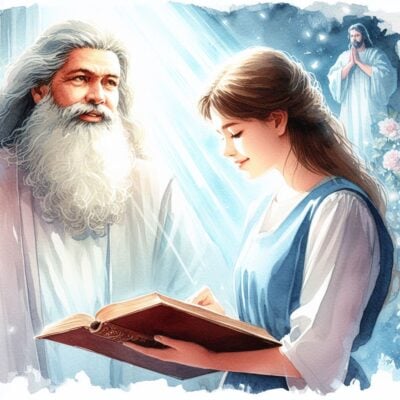
Let’s say we decide to go for this image – the one that inspires awe, with Jesus watching over our shoulder to protect and guide us.
Does that mean we instantly, in one amazing moment, have a 180 degree turn on our view of God? Is all the fear gone, forever, never to return?

Uh – no.
The adjacent progress bar shows what we can expect. Like pretty much everything in our walk of faith and trust with God – there are times when we make progress and times when we backslide.
It’s perfectly normal. It’s part of life in the fallen world.
One thing to watch out for
There is one scenario I do want to warn about though. We need to be honest with ourselves about how we’re doing.
I write about people who claim to be Christians, maybe even believe they are, but who are likely to hear what I think are four of the most dreaded words in the Bible: “I never knew you”. They’re from the passage below.
A Tree and Its Fruit – Matthew
Mt 7:15 “Watch out for false prophets. They come to you in sheep’s clothing, but inwardly they are ferocious wolves. 16 By their fruit you will recognize them. Do people pick grapes from thornbushes, or figs from thistles? 17 Likewise every good tree bears good fruit, but a bad tree bears bad fruit. 18 A good tree cannot bear bad fruit, and a bad tree cannot bear good fruit. 19 Every tree that does not bear good fruit is cut down and thrown into the fire. 20 Thus, by their fruit you will recognize them.
Mt 7:21 “Not everyone who says to me, ‘Lord, Lord,’ will enter the kingdom of heaven, but only he who does the will of my Father who is in heaven. 22 Many will say to me on that day, ‘Lord, Lord, did we not prophesy in your name, and in your name drive out demons and perform many miracles?’ 23 Then I will tell them plainly, ‘I never knew you. Away from me, you evildoers!’”
This is about people who think, are even sure, they’re doing all the right things. The truth is, maybe they are. But doing the right things for the wrong reasons isn’t, well, right. Ultimately, it’s no different than doing the wrong things.
For examples of this, I invite you to check out my other site – whichgodcansave.org.
God doesn’t leave us to tr to figure this out on our own. One example comes from Psalm 139.
psalm 139 – Psalms
For the director of music. Of David. A psalm.
Ps 139:1 O LORD, you have searched me
and you know me.
Ps 139:2 You know when I sit and when I rise;
you perceive my thoughts from afar.
Ps 139:3 You discern my going out and my lying down;
you are familiar with all my ways.
Ps 139:4 Before a word is on my tongue
you know it completely, O LORD.
Ps 139:5 You hem me in—behind and before;
you have laid your hand upon me.
Ps 139:6 Such knowledge is too wonderful for me,
too lofty for me to attain.
Ps 139:7 Where can I go from your Spirit?
Where can I flee from your presence?
Ps 139:8 If I go up to the heavens, you are there;
if I make my bed in the depths, you are there.
Ps 139:9 If I rise on the wings of the dawn,
if I settle on the far side of the sea,
Ps 139:10 even there your hand will guide me,
your right hand will hold me fast.
Ps 139:11 If I say, “Surely the darkness will hide me
and the light become night around me,”
Ps 139:12 even the darkness will not be dark to you;
the night will shine like the day,
for darkness is as light to you.
Ps 139:13 For you created my inmost being;
you knit me together in my mother’s womb.
Ps 139:14 I praise you because I am fearfully and wonderfully made;
your works are wonderful,
I know that full well.
Ps 139:15 My frame was not hidden from you
when I was made in the secret place.
When I was woven together in the depths of the earth,
Ps 139:16 your eyes saw my unformed body.
All the days ordained for me
were written in your book
before one of them came to be.
Ps 139:17 How precious to me are your thoughts, O God!
How vast is the sum of them!
Ps 139:18 Were I to count them,
they would outnumber the grains of sand.
When I awake,
I am still with you.
Ps 139:19 If only you would slay the wicked, O God!
Away from me, you bloodthirsty men!
Ps 139:20 They speak of you with evil intent;
your adversaries misuse your name.
Ps 139:21 Do I not hate those who hate you, O LORD,
and abhor those who rise up against you?
Ps 139:22 I have nothing but hatred for them;
I count them my enemies.
Ps 139:23 Search me, O God, and know my heart;
test me and know my anxious thoughts.
Ps 139:24 See if there is any offensive way in me,
and lead me in the way everlasting.
This is a real example of the difference between being afraid of God and feeling awe and love towards God.
If we’re afraid of God, then the times when we most need to go to Him are the very times we most want to avoid Him.
On the other hand, if we love God, and are in awe of Him, then the times we most need Him are the very times we run to Him.
So – if you truly want to know and follow Jesus – don’t be afraid.
Related Articles

Search me, know my heart, test me. Who would ever say these things? Do you say them? Maybe you should. Ps 139:23 Search me, O God, and know my heart; test me and know my anxious thoughts. That’s from Psalms. So if you’re a Christian, you should be asking this …
Discover more from God versus religion
Subscribe to get the latest posts sent to your email.