
I just watched the landing of NASA’s Perseverance on BBC. An amazing accomplishment. Katty and Christian were all excited about it. Everyone they interviewed was celebrating and grinning from ear to ear. As I was watching the people in NASA’s control room, I couldn’t help but notice some words on the wall: Dare Mighty Things. But when all was said and done, I couldn’t help but wonder – why not Dare Mightier Things?
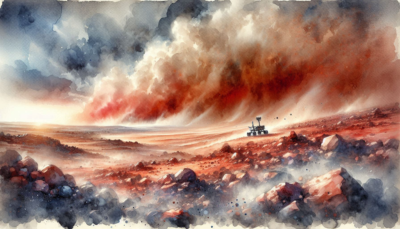
Consider the adjacent image. As is the norm for me, it’s AI generated. It’s not real.
It’s also done in watercolor style. That’s not a whole lot of detail.
It looks good. But it’s not a true representation of the surface of Mars.
The Perseverance Rover is even in the image. Wouldn’t it be better to have an image downloaded from the Rover? After all, if we’re going to dare mightier things, don’t we want to know as much as possible about what we’re getting into? I mean, who likes to fail, especially for lack of preparation? I know – weird questions. But hang in there.
Summary
This reflection begins with NASA’s Perseverance Rover and its motto “Dare Mighty Things,” then asks why we don’t dare mightier things – especially in our relationship with God. It contrasts watercolor‑style AI images with photorealistic accuracy to illustrate how often we settle for partial or comfortable views of God rather than the fuller truth He offers.
Dare Mightier Things: reflects on NASA’s Perseverance Rover mission and suggests aiming for even greater achievements, both scientifically and spiritually.
Image Accuracy: Discusses the importance of accurate representations of Mars, comparing AI-generated images to actual photos from the rover. It then compares that to what we want to know, or not know, about the God who created Mars, us, and everything else.
Biblical Perspective: Connects the concept of daring mightier things to biblical teachings, emphasizing the search for God and eternal life.
Call to Action: Encourages readers to seek deeper truths and not settle for incomplete answers in both scientific and spiritual quests.
The conclusion invites readers to recognize that while human missions are impressive, the mightiest thing we can dare is to seek God Himself — embracing His light, His discipline, His calling, and the eternal life He offers. Only then can we truly “dare mightier things” than anything humanity can accomplish on its own.
Knowing about how to dare mightier things
Let’s stick with the image. How do we know whether it’s a true representation or not?

Well, we already know from experience, a watercolor picture isn’t as accurate as a photograph. So, let’s get a photograph of Mars instead.
Now, that’s still AI generated, so let’s get that out right away. For this discussion though, let’s say it’s an actual photo. (BTW – I don’t want to run into Copyright issues, so I made sure to avoid that with an AI image.)
In any case, if this was an actual photo of Mars, we know there’s much more detail than what was in the watercolor. But still, how do we know if it’s accurate? For someone like me, who used to work as a photographer in the days of film – before there was a thought of digital cameras – we knew that when digital images first came out, they weren’t very accurate at all, especially when enlarged.
Later, after I got into computers, I was offered a job at JPL to work on receiving “images” from space in the Voyager program. I turned them down. But I did learn a bit about what they did to receive the “images”. The quality, procedures, communication, and pretty much every aspect of that job are completely different today.
To that end, I asked Copilot, my AI engine of choice for these images, about the accuracy of the images from the Perseverance Rover.
🤖◎ Scientists use a combination of sophisticated technology and rigorous analysis to determine the authenticity of objects in images from Mars Rovers. Here’s how they do it:
- Calibration: The cameras on the rovers are equipped with calibration targets to ensure that the colors and details in the images are true to Mars’ environment1. This helps differentiate between actual Martian features and any potential distortions.
- Image Analysis Algorithms: Advanced algorithms, like the AEGIS system on the Curiosity rover, analyze images for specific features. AEGIS can select a target rock and pinpoint it with the rover’s laser system, ChemCam, before scientists on Earth have time to look at the images2. This helps confirm the presence of certain elements or compounds, indicating that the object is indeed part of the Martian landscape.
- Multispectral Imaging: The Mastcam-Z camera functions as a low-resolution spectrometer, dividing the light it captures into 11 colors. This allows scientists to make links between features seen from orbit and what they see on the ground1. By analyzing these spectral signatures, scientists can distinguish between real Martian features and noise or distortions.
- Peer Review and Verification: Findings from Mars images are often peer-reviewed. For example, claims of insect-like forms on Mars based on rover images have been met with skepticism and require further verification to rule out pareidolia (seeing patterns, like faces or animals, in random data)3.
- Comparison with Surroundings: Objects that stand out dramatically from their surroundings and have clear form, symmetry, and segmentation are studied closely to confirm their authenticity3.
By using these methods, scientists ensure that what we see in the images from Mars Rovers is a true representation of the Martian environment, free from distortions or noise. It’s a meticulous process that combines technology and human expertise to explore and understand the red planet.
Learn more: 1 nasa.gov 2 astronomy.com 3 scitechdaily.com 4 usatoday.com
Why is the Mars Rover on a Christian Site?
Dare Mighty Things
To be sure, sending the Perseverance Rover to Mars and successfully landing it was a mighty thing. So why am I saying Dare Mightier Things?
And, in case you didn’t read the Summary at the top, this is going to get around to talking about God, Jesus, and Christianity. Soon.
Dare Mightier Things – why now?
But first, why am I bringing this up so many years after Perseverance Rover landed?
When I first wrote this, very little of what you just read was included. In fact, only the opening paragraph was in the first version. Everything else is new.
Everything else includes events in my life over the past several years. About eight years ago, I had a staph infection that nearly killed me. By the time they found a drug combo to kill it, my kidneys “took a big hit”, as the doctors put it. I had pneumonia. My liver was beginning to fail. I was swelling up like a sausage. Even the thought of eating was enough to make me want to vomit.
I was told afterwards that I “beat the reaper”. During that time in the hospital, I had a “conversation with God where I asked Him, “Is it time for me to go home?” Then, the next day, they found the right drug cocktail. I was sent home two days later, since I’d gone almost three weeks with very little food. There was another 5 weeks of antibiotics delivered via a battery-operated device. Three days after I was sent home, even with so much of the infection still in me, the pneumonia was gone, my kidneys and liver were both back to normal, and I could at least eat a little bit.
A couple years after that, I was diagnosed with prostate cancer. Now, as a cancer survivor, a couple years “cancer free”, my feeling about daring mightier things has gotten, for lack of a better word, mightier.
One of the things I “told” God in the hospital is that while I’d love to “go home”, I think there’s more I can do for His Kingdom – and that I’d be OK either way – go home or stay, whichever He wanted.
Why do all this – the research, the writing, the teaching Bible Study? It’s because my life has changed so much, for the better. My relationship with God is so much closer. And I want more. And every year it grows stronger.
Just as we should want to share what we have as Christians – God’s love, peace, comfort, salvation, and so much more – as we grow in our faith, as we get closer with God, our desire to share what we have should be that much stronger.
And so, what used to be mighty to me – it doesn’t seem that mighty anymore. It’s not like I’m required by God to do all this. But I want to. Not for me. For you. It’s a shocking feeling for me, to want to do that. To take so much time doing it.
But hey, it is what it is. I only pray it helps someone come to a more realistic view of God. In this case, more of a photorealistic view, based on what God told us Himself – rather than a watercolor that gives us maybe a pretty view, but not an accurate one. It’s the difference between daring nothing, daring a little, daring mighty things, and daring mightier things.
So now, let’s get back to the BBC show on the Mars mission.
Let’s get to the point
Back to Mighty things with the Perseverance mission
Let me start with what this seems to be about, based on the people speaking on BBC.
Beyond “just” landing the rover, it’s a search for life. Most of us probably think about life as being people. Or little Martian aliens. Something that at least has intelligence. But that’s not the case here. They’re looking for evidence of life that existed more than 3 billion years ago. More correctly, that might have existed more than 3 billion years ago. Maybe. The feeling is that the building blocks for life existed. But as yet, there’s no evidence that there was actually life.
And by life, they mean microbial life. Something likely too small for us to see with the naked eye. Oops. No intelligence either. No space aliens. Not life as most of us think of it. Life in the scientific sense, but not what we normally consider life to be.
Is the Perseverance mission mighty enough?
It would be a big deal to find microbial life. And yet, is the goal mighty enough? What do I mean by mighty enough? I don’t mean going to Saturn, which is farther away and therefore more challenging. Not even to another solar system. Nor to another galaxy.
In large part, these missions take place within the lifetime of everyone working on them. None of them have ever found real physical evidence of life. And yet, they keep looking.
Furthermore, for any one person’s life, they participate in some number of missions, and then they (hopefully) retire or (sadly) some die during the mission. These are just facts of life. But they do indicate dreams. Things people dare to do. And, as I said, they do dare mighty things. But can you begin to see where I’m going with dare mightier things?
Dare Mightier Things
How do we do that? How about by removing that finite length of our life? That’s daring a mightier thing! And we do know how to do that.
The mightiest
The Beginning – Genesis
Ge 1:1 In the beginning God created the heavens and the earth.
This tells us that God created our universe and everything in it. And, by the way, it also tells us God created time.
If we keep reading, it tells us more.
Ge 1:1 In the beginning God created the heavens and the earth. 2 Now the earth was formless and empty, darkness was over the surface of the deep, and the Spirit of God was hovering over the waters.
Ge 1:3 And God said, “Let there be light,” and there was light. 4 God saw that the light was good, and he separated the light from the darkness. 5 God called the light “day,” and the darkness he called “night.” And there was evening, and there was morning—the first day.
Ge 1:6 And God said, “Let there be an expanse between the waters to separate water from water.” 7 So God made the expanse and separated the water under the expanse from the water above it. And it was so. 8 God called the expanse “sky.” And there was evening, and there was morning—the second day.
Ge 1:9 And God said, “Let the water under the sky be gathered to one place, and let dry ground appear.” And it was so. 10 God called the dry ground “land,” and the gathered waters he called “seas.” And God saw that it was good.
Ge 1:11 Then God said, “Let the land produce vegetation: seed-bearing plants and trees on the land that bear fruit with seed in it, according to their various kinds.” And it was so. 12 The land produced vegetation: plants bearing seed according to their kinds and trees bearing fruit with seed in it according to their kinds. And God saw that it was good. 13 And there was evening, and there was morning—the third day.
Ge 1:14 And God said, “Let there be lights in the expanse of the sky to separate the day from the night, and let them serve as signs to mark seasons and days and years, 15 and let them be lights in the expanse of the sky to give light on the earth.” And it was so. 16 God made two great lights—the greater light to govern the day and the lesser light to govern the night. He also made the stars. 17 God set them in the expanse of the sky to give light on the earth, 18 to govern the day and the night, and to separate light from darkness. And God saw that it was good. 19 And there was evening, and there was morning—the fourth day.
Ge 1:20 And God said, “Let the water teem with living creatures, and let birds fly above the earth across the expanse of the sky.” 21 So God created the great creatures of the sea and every living and moving thing with which the water teems, according to their kinds, and every winged bird according to its kind. And God saw that it was good. 22 God blessed them and said, “Be fruitful and increase in number and fill the water in the seas, and let the birds increase on the earth.” 23 And there was evening, and there was morning—the fifth day.
Ge 1:24 And God said, “Let the land produce living creatures according to their kinds: livestock, creatures that move along the ground, and wild animals, each according to its kind.” And it was so. 25 God made the wild animals according to their kinds, the livestock according to their kinds, and all the creatures that move along the ground according to their kinds. And God saw that it was good.
Ge 1:26 Then God said, “Let us make man in our image, in our likeness, and let them rule over the fish of the sea and the birds of the air, over the livestock, over all the earth, and over all the creatures that move along the ground.”
Ge 1:27 So God created man in his own image,
in the image of God he created him;
male and female he created them.
Ge 1:28 God blessed them and said to them, “Be fruitful and increase in number; fill the earth and subdue it. Rule over the fish of the sea and the birds of the air and over every living creature that moves on the ground.”
Ge 1:29 Then God said, “I give you every seed-bearing plant on the face of the whole earth and every tree that has fruit with seed in it. They will be yours for food. 30 And to all the beasts of the earth and all the birds of the air and all the creatures that move on the ground—everything that has the breath of life in it—I give every green plant for food.” And it was so.
Ge 1:31 God saw all that he had made, and it was very good. And there was evening, and there was morning—the sixth day.
Ge 2:1 Thus the heavens and the earth were completed in all their vast array.
Ge 2:2 By the seventh day God had finished the work he had been doing; so on the seventh day he rested from all his work. 3 And God blessed the seventh day and made it holy, because on it he rested from all the work of creating that he had done.
Aren’t those verses the answers to the questions we try to answer with so many of the things we study in science? To put it simply, how did we come to exist? If that’s the question, and if what you just read is even possibly the answer, why don’t we want to hear it?
Why don’t we want to learn, know, and do mightier things by putting even more effort into knowing the One who did all that stuff above?
Why do we have so much trouble reaching out to the Mightiest One in order for us to do mightier things than we could ever do without Him?
I don’t know if I’ll ever understand why not. At least, not in this life.
But there’s more.
Check out what John wrote about Jesus at the beginning of his Gospel:
The Word Became Flesh – 3 John
Jn 1:1 In the beginning was the Word, and the Word was with God, and the Word was God. 2 He was with God in the beginning.
Jn 1:3 Through him all things were made; without him nothing was made that has been made. 4 In him was life, and that life was the light of men. 5 The light shines in the darkness, but the darkness has not understood it.
Here, also in the beginning, “The Word” is Jesus. This view is kind of like God the Father being the CEO – and Jesus the Son being the one who actually carries out the wishes of the CEO. It’s a theme that runs throughout, not just here. So, we see Jesus as the part of the Trinity of God as the One who actually created everything. Literally everything in our universe.
Why so many turn down the chance to do mightier things
Verse 5 is where I get the idea of Dare Mightier Things.
It’s also where we learn something about why everyone has an opportunity to do mightier things – but turns it down.
It’s why we so often settle for mediocrity rather than true greatness.
5 The light shines in the darkness, but the darkness has not understood it.
We also don’t understand what’s meant by light and darkness. But hold that thought for a moment. We’ll return to it.
The world is backwards
If the world is backwards, then we must, at least should, ask, backwards from what? And backwards in what way(s)?
We can see one huge example from what Jesus said when His disciples were arguing about who was the greatest.
Who Is the Greatest – Mark
9:33-37 pp — Mt 18:1-5; Lk 9:46-48
Mk 9:33 They came to Capernaum. When he was in the house, he asked them, “What were you arguing about on the road?” 34 But they kept quiet because on the way they had argued about who was the greatest.
Mk 9:35 Sitting down, Jesus called the Twelve and said, “If anyone wants to be first, he must be the very last, and the servant of all.”
Mk 9:36 He took a little child and had him stand among them. Taking him in his arms, he said to them, 37 “Whoever welcomes one of these little children in my name welcomes me; and whoever welcomes me does not welcome me but the one who sent me.”
Let’s take a look at a short description of what’s going on there:
✒️ Loving one another (vv. 33–37).
Jesus spoke about suffering and death, but the Twelve argued over who was the greatest! They misunderstood Jesus’ teaching. They lived in a society in which position and power were important, and they thought that the Christian fellowship functioned the same way. Even in the Upper Room, before Jesus went to the cross, the Twelve were still debating over which of them was number one (Luke 22:24–30). God wants us to be childlike but not childish. In the Aramaic that Jesus spoke, “child” and “servant” are the same word. True greatness is found, not in rank or possessions, but in character and service (Phil. 2:1–13). 1Wiersbe, W. W. (1992). Wiersbe’s expository outlines on the New Testament (p. 125). Victor Books.____Warren Wiersbe
Just before the passage on who was the greatest, Jesus was talking to the disciples about the importance of prayer and about how He was going to be betrayed and put to death. But look where the disciples’ minds were during these important words. Not on what Jesus was trying to tell them, but rather on which of them was the greatest. Maybe who’d take over after Jesus died?
Regardless of why Jesus’ disciples were off in the wrong place in their minds, it illustrates the backwardness we’re examining.
But it begs the question, exactly what is backwards and what’s the thing that’s not backwards?
In other words, is Jesus’ way of viewing things backwards?
Or is it our way of viewing things that’s backwards?
How we answer that question says a lot about us. Where our minds are. And our view of God’s importance in our lives.
From a Christian point of view, I believe, it’s Jesus’ way that’s the right way, and it’s the normal human way of doing things that’s backwards. So, when Jesus says something like, “If anyone wants to be first, he must be the very last, and the servant of all”, this is how we should view it:
- Wanting to be first is the backwards thing to be worried about.
- Being last isn’t something we should be worried about either,
- Being a servant to all should be the thing we aim to do (the forward way of living).
- Then, God will see us as following Him and everyone else will see us as last.
Ultimately then, first or last shouldn’t be our goal. We shouldn’t be looking to anyone else to see where we’re at with God. We should look at ourselves in light of what God sees in us. That’s it.
Then how do we manage to be last?
If we don’t look around at others, how do we know whether we’re last? I know – I just wrote that we’re not supposed to do that. But we will, so I’m asking the question for us all.
You may remember something from Hebrews about running a race – highlighted below. It’s part of some words on discipline. That context is important, so here’s the entire passage.
God Disciplines His Sons
Heb 12:1 Therefore, since we are surrounded by such a great cloud of witnesses, let us throw off everything that hinders and the sin that so easily entangles, and let us run with perseverance the race marked out for us. 2 Let us fix our eyes on Jesus, the author and perfecter of our faith, who for the joy set before him endured the cross, scorning its shame, and sat down at the right hand of the throne of God. 3 Consider him who endured such opposition from sinful men, so that you will not grow weary and lose heart.
Heb 12:4 In your struggle against sin, you have not yet resisted to the point of shedding your blood. 5 And you have forgotten that word of encouragement that addresses you as sons:
“My son, do not make light of the Lord’s discipline,
and do not lose heart when he rebukes you,
Heb 12:6 because the Lord disciplines those he loves,
and he punishes everyone he accepts as a son.”
Heb 12:7 Endure hardship as discipline; God is treating you as sons. For what son is not disciplined by his father? 8 If you are not disciplined (and everyone undergoes discipline), then you are illegitimate children and not true sons. 9 Moreover, we have all had human fathers who disciplined us and we respected them for it. How much more should we submit to the Father of our spirits and live! 10 Our fathers disciplined us for a little while as they thought best; but God disciplines us for our good, that we may share in his holiness. 11 No discipline seems pleasant at the time, but painful. Later on, however, it produces a harvest of righteousness and peace for those who have been trained by it.
Heb 12:12 Therefore, strengthen your feeble arms and weak knees. 13 “Make level paths for your feet,” so that the lame may not be disabled, but rather healed.
Here’s a question. In the highlighted portion – let us run with perseverance the race marked out for us – (1) are we all running the same race or (2) are we each running different races, or (3) maybe groups of people run the same race, but each group runs a different race?
Grammatically, there’s no way to know. The only way to determine which of those possibilities is to look at the context. The context tells us the correct way to interpret the statement is that each of us runs our own race.
How do we know that? One thing to consider is that each of us has our own free will. Another thing is that we all have unique gifts, souls, abilities, interests, and on and on. Plus, considering the context of this one passage, as well as the Bible overall, is discipline.
When we’re disciplined by God, our course changes. First, it changes because it’s the reality that we’re off the course that can bring the discipline. Or we may be in a Job-like situation. We might just be in the wrong place at the wrong time in a fallen world. No matter what the reason, stuff happens. It takes us off course. And our reaction to that discipline is different from other people.
The only sense in which we run the same race is the most general case, where our goal is to become a true follower of Jesus and be saved by Him, accomplished via our belief and faith in Him and our love for Him.
Other than that, each of us runs a different course. There’s just no way to look at others to see where we are.
To put it another way, if we look at our relationship with God, are we just doing the bare minimum to try to get to Heaven, or are we asking Him to help us do mightier things, because we love Him and want to bring others into His Kingdom as well?
An AI analysis of my comments above on let us run with perseverance the race marked out for us
When I first wrote this, AI didn’t exist. But now that it does, I have the ability to ask the Faithlife/LOGOS AI to examine it’s entire library of Christian, Jewish, Messianic, and other related books. So, I asked it to do that, with the following brief Q&A chat.
You may ask, why focus so much on this “race” in the Bible?
Well, just as the rover follows a mission path marked out for it, Scripture tells us that each of us has a race marked out for us. Everyone in a space mission has a task, and they all have to work together.
But things are different with God. Yes, we will work with other people when we do the things God has for us. But “race”, as it’s described in the Bible, each of us has our own mission, just for us to accomplish. And since our work is for God and with God, we need to understand that our personal relationship with Jesus is our part of that Biblical race, even as the goal is likely a team effort with other Christians.
So, since this idea of a personal, God‑given race is so crucial, I wanted to check how consistently Scripture presents it.
❓ In Hebrews 12:1, are these thoughts valid and supported by scholars: let us run with perseverance the race marked out for us – (1) are we all running the same race or (2) are we each running different races, or (3) maybe groups of people run the same race, but each group runs a different race? Grammatically, there’s no way to know. The only way to determine which of those possibilities is to look at the context. The context tells us the correct way to interpret the statement is that each of us runs our own race. How do we know that? …
The question addressed the interpretation I outlined above.
It returned the following response, along with the sources used to determine the validity of my comments.
🤖✨ Your interpretation aligns with scholarly consensus. The phrase “the race marked out for us” points toward individual, personalized paths rather than a single universal race or group-based races.
The key is recognizing that while the metaphor might suggest one enormous contest, God has designed a unique race for each person.1 These individual races vary dramatically—some resemble a sprint while others are marathons, and still others involve navigating successive obstacles.1 This interpretation rests on the understanding that God accounts for individual strengths, weaknesses, abilities, and limitations when establishing each person’s course.1
Scholarly commentaries support this reading. The race represents “the lifelong test of faith that we experience during our time in this world,”2 and God has marked out a specific course for each believer, with particular places to go, things to do, and challenges to confront.3 Rather than competing against one another, believers are not in competition with one another,1 which further supports the individual-race interpretation.
The broader biblical context reinforces this. The race is “not only for Caleb or Bishop Polycarp or Blandina but also for each one of us,”4 suggesting that while the calling is universal, its expression is personal. The Christian’s true calling involves persevering in the various settings where God places you, holding fast your convictions in different seasons of life, and growing in grace to glorify God through faith to the end.3
Your point about discipline also resonates with scholarly interpretation. Discipline in running this race involves putting aside sins that have repeatedly hindered growth, stopping foolish choices that lead to failure, and setting aside things that aren’t sinful but create spiritual dead weight.2
1 Darlene Sala, Encouraging Words for Women (Uhrichsville, OH: Barbour Books, 2017). [See here, here, here, here.]
2 J. Wesley Adams and Donald C. Stamps, Fire Bible (Springfield, MO: Life Publishers International, 2011). [See here, here.]
3 Richard D. Phillips, Hebrews, ed. Richard D. Phillips, Philip Graham Ryken, and Daniel M. Doriani, Reformed Expository Commentary (Phillipsburg, NJ: P&R Publishing, 2006), 530–531.
4 Helen Roseveare, “One Thing,” in Stand: A Call for the Endurance of the Saints, ed. John Piper and Justin Taylor (Wheaton, IL: Crossway Books, 2008), 96.
It’s nice to see that my little bit of previous research several years ago aligns with broader Scripture. Not that I know everything. Not even close. I hope it comes from listening to the Spirit to put together the things I can read, the limited understanding I have, and also my view of the character of a God that continues to be amazed at the extent of His love and grace for us as I continue learning. Daring to think greater things about His love, His peace, His grace – as long as we don’t add things the Bible doesn’t say – or leave out things it does say – I think brings us closer to understanding just how awesome God is. And as believers, His Spirit is in us. How awesome is that?
And yet, …
Why don’t we want to Dare Mightier Things?
Earlier, I wrote that we’d get to how we often don’t understand what’s meant by light and darkness.
Think about this. So many people spend so much of their lives working on things like the Perseverance Rover mission. And lots of other people spend a lot of time keeping track of what it’s doing. And even more people are just plain fascinated by it all.
But we seem to be OK with all those wishes, desires, dreams and the like coming to an end. Worse yet, come to an end with no conclusion! Why doesn’t everyone with such an interest in something like searching for life also want to actually know the answer? I mean, know to the point where we’ll Dare Mightier Things in order to find out.
Dare mightier things like absolutely want God to exist. Dare enough to want to search for God even more than we want to search for life? The Bible promises us that we can live forever with the creator of literally everything! Why don’t we want that certainty more than we want the likelihood of failing to get an answer at the end of our mission – or the end of our life?
Why do we settle for failure when we can be assured of success?
As John puts it, why do we settle for darkness when we can have light?
Why do we “only” dare mighty things when we can dare mightier things?
Why do we put so much effort into things like trying to learn from space missions, but so little effort into trying to learn about God? And the question becomes infinitely more important when we realize this life and its little bit of knowledge will end, but an eternity with the maker of everything will go on forever?
Why don’t we put in the effort that will enable us to do mightier things?
Conclusion – Dare mightier things – even more than Mars Perseverance Rover
We don’t do it because we love the darkness.
The thing is, darkness isn’t meant to portray a lack of physical light. Back in “The Beginning”, the Bible talked about God created light, and separated light from darkness. We tend to think of that as day and night. Somehow, we also come to think of light as good and darkness as evil.
But there’s a Jewish concept of God created all things good. Light. And then He separated the light from the darkness. Good from evil.
So, when we read something like, “The light shines in the darkness, but the darkness has not understood it”, there’s a meaning far beyond light and a lack of light.
It means Jesus came to earth to show us how to do good, with His power, in this evil world. But the evil in us prevents us from understanding what He’s trying to tell us.
It’s only with the Holy Spirit that He will give us, if we truly want to follow Him, that we can have the light in us. If we reject God’s offer of salvation, the darkness will reign in us. We won’t understand. But if we can bring ourselves to accept it, then we’ll understand.
From what we’ve just read then, it’s only when we begin to realize that our way is backwards and God’s way is the right way that we can “lower” ourselves to accept God’s help. Then He will raise us to be one of His children. Then, and only then, can we succeed when we dare to do mightier things.
Footnotes:
- 1Wiersbe, W. W. (1992). Wiersbe’s expository outlines on the New Testament (p. 125). Victor Books. ↩︎
Discover more from God versus religion
Subscribe to get the latest posts sent to your email.